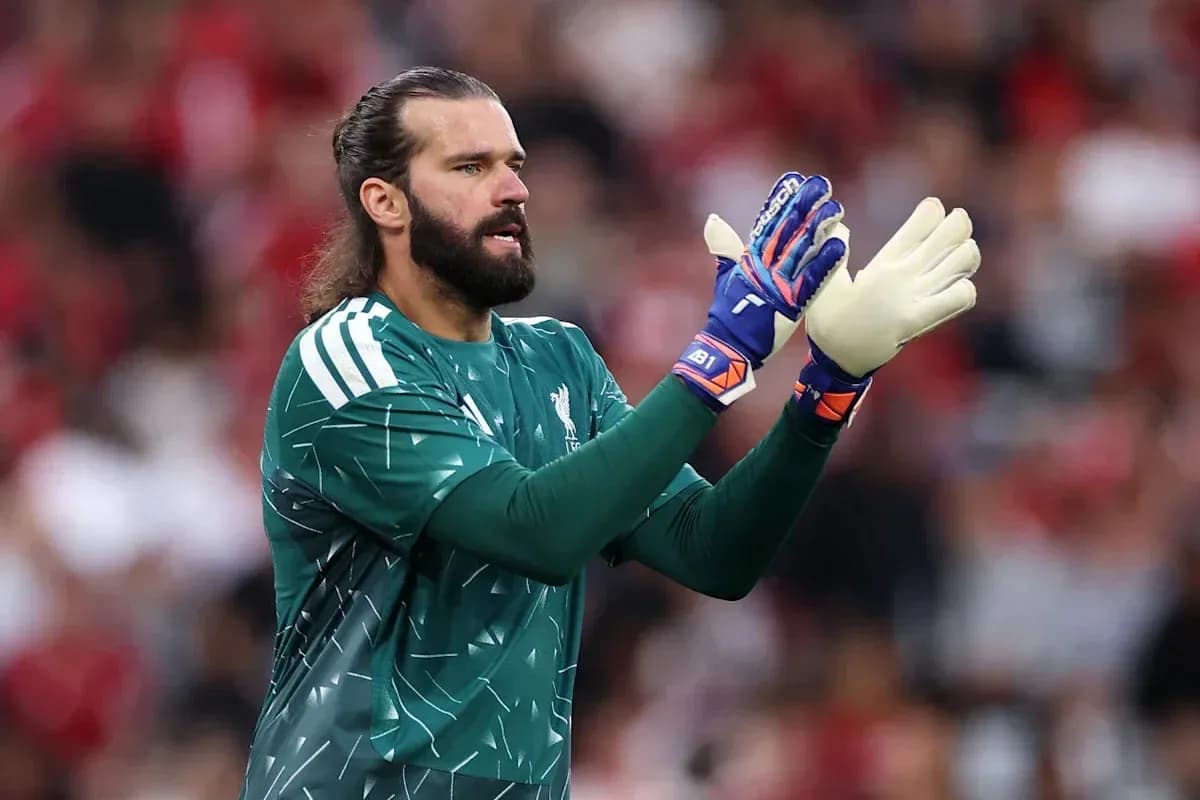
Alisson Appointed Liverpool Vice-Captain but Rules Prevent Armband
Alisson Becker has been promoted into Liverpool’s official leadership group as vice-captain – yet he still won’t be the man wearing the armband when Virgil van Dijk is not on the pitch.
New head coach Andoni Iraola has confirmed that, under his structure, the Brazilian will be vice-captain in status, but an outfield player will take the armband on matchdays if Van Dijk is absent.
The reason is simple: the rules have changed.
Why Alisson won’t wear the armband
Premier League regulations now state that only the captain can approach the referee to discuss contentious decisions. For Iraola, that makes it impractical for a goalkeeper to be the official on-field captain.
He spelt it out with a straightforward example: if a flashpoint occurs in the opposition penalty area, it makes little sense for Alisson to sprint the length of the pitch just to hear an explanation.
“I explained to Alisson that it's not going to be possible that he wears the armband because with the new rule I think there is a big limitation if a goalkeeper wears the armband,” Iraola said.
“Because basically, if something happens in the opposition box the referee has to explain to the captains what's happening, all the decisions.”
Iraola has lived this before. At Bournemouth he had Neto as captain and quickly ran into the same problem.
“I had one season with Neto in Bournemouth and then you have to start every game to say a different player that can act as a captain, and this is not viable,” he explained.
So at Liverpool, he has moved early. The hierarchy is clear: Van Dijk remains club captain, Alisson is vice-captain in the dressing room, but Dominik Szoboszlai is expected to wear the armband on the pitch when Van Dijk is missing.
Szoboszlai, last season’s player of the year, and Joe Gomez, now the club’s longest-serving player, have both been added to Iraola’s leadership group as the new core around which he wants to build.
Respect for Alisson – and a rule he cannot bend
Alisson, at the club since 2018 and now into the final year of his contract, was given a full explanation by Iraola, who stressed the decision was about logistics, not status.
“But I wanted him to feel like we value him,” Iraola said. “I've had enough time and we will have more time to know each other, but I had to explain also the decision about the armband to Ali.
“Because he is a goalkeeper and unfortunately they are putting the rules in a way that there is a lot of disadvantages to having a goalkeeper as a captain.”
In other words, Alisson’s influence remains undiminished behind the scenes. The law has simply pushed him out of the visible role on the pitch.
Life after Robertson and Salah
The reshuffle comes after a seismic summer in which Andy Robertson and Mohamed Salah – two of the most influential figures of the Jürgen Klopp era – left the club.
Their departures naturally raised questions about leadership inside the dressing room. Iraola, though, is calm.
“We lost a lot in terms of experience, high-level players who have performed so well for so many years here,” he admitted. “But I think it is also a natural thing in clubs.”
The response, in his view, lies with the next generation.
“I think we have a lot of young players willing to take those minutes and ready to take those leadership roles. Overall, I am very happy with the attitude of the players in the pre-season.”
So Liverpool step into a new season with Van Dijk still at the helm, Alisson officially his deputy, and Szoboszlai and Gomez pushed to the front of the leadership queue.
The faces wearing the armband may change. The expectation that it still represents a standard, not a souvenir, clearly will not.