Andrew Robertson on Trent Alexander-Arnold's Defensive Struggles
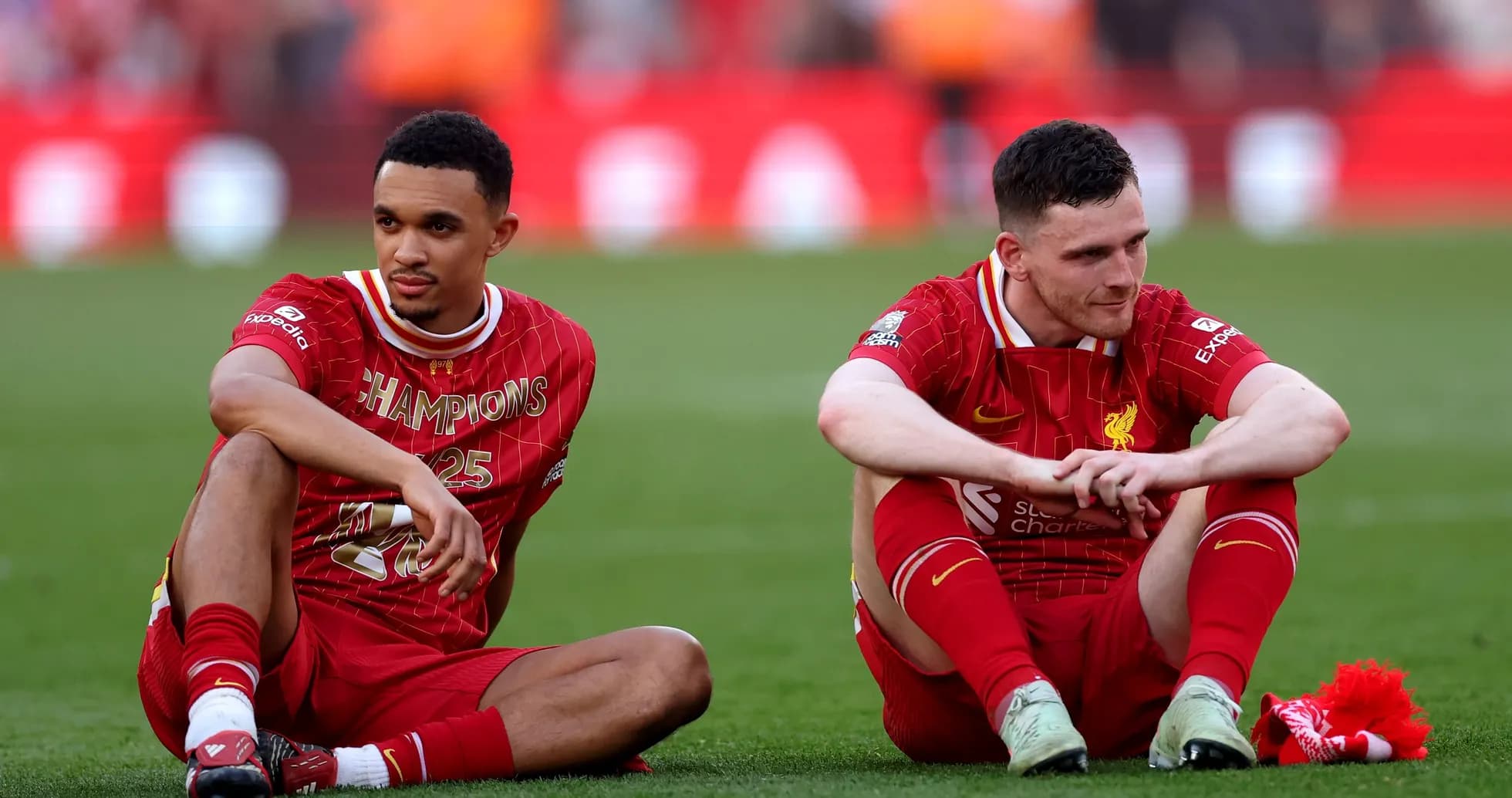
Andrew Robertson has lifted the lid on what it was really like defending alongside Trent Alexander-Arnold at Liverpool – and why he always felt his teammate took the heaviest hits when things went wrong.
Under Jurgen Klopp, the pair became one of Europe’s most devastating full-back duos, driving Liverpool to the Champions League in 2019 and the Premier League title a year later. Their crossing, creativity and relentless energy turned the flanks into a permanent attacking threat, with both men regularly near the top of the assist charts.
But behind the highlight reels, Robertson insists the defensive burden was far from equal.
‘I started to feel sorry for him’
Speaking on The Overlap, the current Tottenham defender explained how Liverpool’s structure left Alexander-Arnold exposed on the right in a way he never was on the left.
“The way I defended at Liverpool compared to Trent was very different,” Robertson said. On his side, he had Sadio Mane tearing back to help. Mane’s work rate and aggression gave Robertson a safety net: “If I missed [a tackle], he’d usually be there.”
On the opposite flank, the picture changed. Mohamed Salah’s role demanded he stay high, ready to spring forward rather than track all the way back towards his own box. Liverpool didn’t want their main goal threat defending deep. That meant Alexander-Arnold often had to hold the fort until a midfielder – regularly Jordan Henderson – could shuffle across.
“A lot of times, Trent was waiting on someone like [Jordan Henderson] to come over, so, sometimes, I started to feel sorry for him,” Robertson admitted.
The result was a recurring image: Alexander-Arnold isolated in wide areas, judged in slow-motion replays while the tactical context disappeared.
English spotlight, different standards
Robertson also pointed to the scrutiny that comes with being an English star at a giant club. The Scot believes Alexander-Arnold has lived under a harsher spotlight than most.
“It’s very different when you are English, compared to another nationality,” he said. “I always said to Trent, ‘I will never get as much high praise as you, but I’ll never get as much criticism as you.’”
That contrast has shaped the narrative around the right-back since his breakthrough. While Robertson’s own mistakes tended to pass with less noise, Alexander-Arnold’s were replayed and debated, feeding a long-running claim that he “can’t defend”.
Robertson strongly rejects that idea.
Locking down Mbappe and shining on the biggest stage
For all the talk of defensive frailty, Alexander-Arnold produced some of his best work when the stakes were highest during Liverpool’s peak years.
He posted standout defensive numbers in the run to the 2018 Champions League final, facing elite European attacks and holding his own. Robertson highlighted one night in particular as a reference point: “I’ve seen him lock out [Kylian] Mbappe at PSG. In the Champions League finals, he was unbelievable.”
For Robertson, that evidence outweighs the criticism.
“Trent is a very, very good defender… [in his] best games, he was an unbelievable one-v-one defender,” he insisted, pushing back against the idea that his former teammate is purely an offensive weapon.
Yes, there have been errors. Robertson did not pretend otherwise. “Now, at times, he maybe makes mistakes. But we all do,” he said. The issue, in his eyes, is that Alexander-Arnold has carried a label he never deserved.
“It’s as if he can’t shift it,” Robertson added. “He’s had that from a very early age.”
A career at a crossroads
Alexander-Arnold’s story has moved on from Anfield, but the debate has followed him.
He left Liverpool for Real Madrid in 2025, a blockbuster move that was supposed to open a new chapter at the very top of the European game. Instead, his time in La Liga has stuttered. Form has dipped, rhythm has been hard to find, and his long-term future in Madrid is now uncertain.
At 27, he stands at a critical point in his career. The talent that lit up the Premier League and Europe is unquestioned, yet he is again fighting to prove he belongs as a first-choice right-back at one of the world’s most demanding clubs.
On the international stage, the challenge is just as sharp. Alexander-Arnold has earned a place in Thomas Tuchel’s latest England squad, but a regular starting spot has consistently eluded him under previous managers. This camp offers another chance – perhaps his best under a fresh regime – to convince a new head coach that he can be trusted in the biggest games.
The stigma Robertson talks about still lingers. The question now is whether Alexander-Arnold can finally play his way out from under it, or whether that early-career tag will keep chasing him, no matter how many times he proves it wrong.