Andy Robertson on Liverpool's Emotional Collapse After Jota's Death
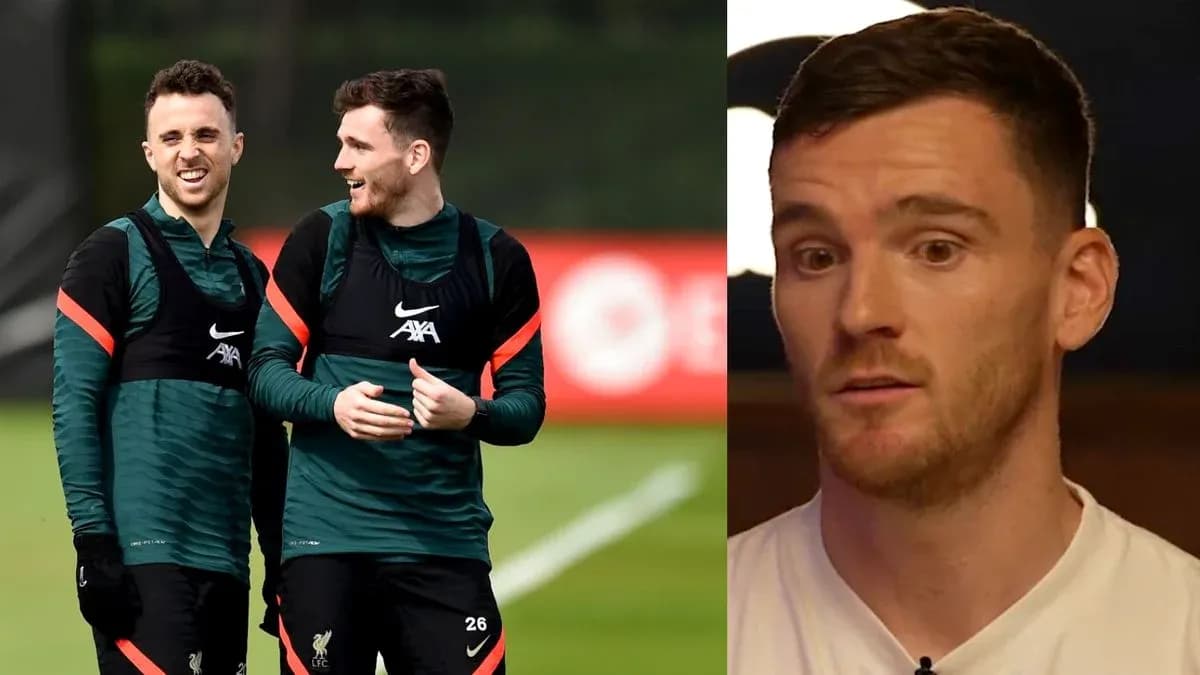
Andy Robertson has laid bare the emotional toll behind Liverpool’s title defence collapse, admitting the squad “lost their edge” as they tried to process the death of Diogo Jota.
The Portuguese forward was killed in a car crash in July 2025, along with his brother Andre Silva, while travelling across Spain back to England for the start of pre-season. Liverpool were reigning Premier League champions, riding the high of a historic title and a record-breaking parade. Within days, everything changed.
“We didn't care about football”
Speaking on the Stick to Football Podcast on Disney+, Robertson described a dressing room shattered by grief and unable to function at the standards that had defined Liverpool’s rise.
“It's difficult to describe or talk about, really, because what we went through, it was horrendous,” he said. “Say if I'm talking about the new signings, they're coming into a club that is heartbroken.
“They're trying, and that's where I felt so sorry for these guys because they'd signed and they were signing for big money and all that, if I'm talking about football. It took them months to settle in because we didn't care, we didn't care about football.
“That was the truth of it. We didn't care about football because you've just lost one of your best mates in the changing room.”
Liverpool, a machine for so long, suddenly felt human and raw. The levels dropped. The ruthlessness went with them.
“That's why I probably have so much sympathy in football terms towards the new signings, because I think they came into a team that was, like... we were elite in everything that we did for years,” Robertson said.
“And maybe we couldn't be that because of what had happened. And then they then started getting quite a lot of criticism. And that's why I think these lads will be absolutely fine at Liverpool. I would treat this season as their first season. That's the way I would do it.”
“What's the point?”
Robertson didn’t hide from the footballing reality. The edge that had driven Liverpool to trophies, comebacks and relentless standards simply vanished.
“I think all footballers, we all have that edge, don't we? And I think when you lose that edge sometimes then you can't perform to the best. And I think last season we lost the edge.
“I think when I look back on it now, I think we lost that determination a little bit and things like that because I know at times we were maybe going, ‘You know what, what's the point?’
“Like look at what Jota's family are going through. Look at his kids. But yeah, we were grieving. It was our mate at the end of the day. He’s not a footballer to us, he was a teammate, he was a friend.”
For Robertson, the pain was brutally personal.
“The week before he died, I was at his wedding,” he said. “So that's one of the most difficult things you'll ever go through. Seeing him on the happiest day of his life, and then the next week you're seeing his family torn apart.”
Slot’s impossible season
Liverpool’s season unravelled. Arne Slot, appointed to build on a title-winning campaign, instead found himself guiding a grieving squad through the most traumatic period of their careers. The Reds eventually finished fifth in the Premier League, and Slot lost his job at the end of the campaign.
Robertson, though, was adamant the Dutchman handled the aftermath with empathy and care that the outside world never fully saw.
“We spoke a lot (in pre-season). The manager was really good, to be fair,” he recalled. “Like our pre-season was barely anything because, to be fair to Arne, he was like, ‘If you don't want to train, you don't train.’
“Say one day you come in and you're struggling or whatever, that was his attitude of the pre-season.”
Liverpool leant heavily on the club’s psychologist, who organised informal support groups.
“We had a psychologist that worked in the club anyway and he kind of set up little groups and it would just be like, if you want to grab a coffee and come round and talk and things like that.
“So we did that quite a few times, and I think that helped. But it was incredibly difficult times.”
The defender kept circling back to Jota’s family.
“You always just feel sorry for his family, for his wife. At the end of the day, their life got flipped completely upside down.
“Ours, we were heartbroken and everything like that, but for them daily, it must be so difficult even now.
“We managed to get through it together, I think, and we always just said, ‘Look, we'll always remember him,’ and everything like that.
“But we had to play football at the end of the day. We didn't have a choice in that. We tried to do it as best we could and that's why last season was so tough.”
From open-top bus to funeral
Robertson did not argue with the basic truth of football. Results decide futures. Slot paid the price.
“It's a difficult one. At the end of the day, football's based on results, and we didn't get enough results. And that was the fact,” he said.
But he pointed to the sheer emotional whiplash of that summer and questioned how much context was truly taken into account.
“If you go back to the summer before, we have the biggest parade in Liverpool's history, right? We're on the open-top bus, we're going through the city centre, and I think over a million people had come out and seen us.
“The next day, we all shake each other's hands, we all go off for the summer. The next time we see everyone is at the airport heading over to Porto for his funeral. That's the next time I see all my teammates.
“So, from going from the highest of highs in terms of being on a parade with the Premier League trophy, and you're parading it round thousands and thousands of fans, to then seeing staff and players the way we were, like that, it's not normal.
“It's not normal what we went through. So, I think could it have been factored in? Yeah, maybe it could have.”
The cracks beneath five wins
Liverpool actually started the league campaign strongly. The numbers looked good. The mood did not.
“When the season goes on and things like that, we know that we then have to do better and we need to win games and things like that,” Robertson accepted. “And I get why then there was a lot of frustration around the way we were playing, the results that we were getting. I can understand it.”
What he wanted to underline was Slot’s sensitivity in those early weeks.
“At the time at the start, the manager was really good and he helped us a lot. He understood the situation in terms of pre-season, in terms of not pushing us too hard, not trying to cause too much competitiveness or whatever, in case somebody was struggling that day or whatever.”
Liverpool flew out of the blocks: five league games, five wins. From the outside, it looked like business as usual.
Inside, it felt very different.
“We then were starting slow, but we then go and win the first five games, and everyone thinks Liverpool are going to win the league again,” Robertson said.
“We won the first five games but we were probably covering over the cracks at that point. And then after the international break, the cracks came.”
Those cracks cost them a title defence, cost Slot his job and left a squad searching for that lost edge. The question now is whether, with time and distance from tragedy, Liverpool can ever recapture it in the way they once did.