Arsenal Back in Champions League Final After Epic Semi-Final Win
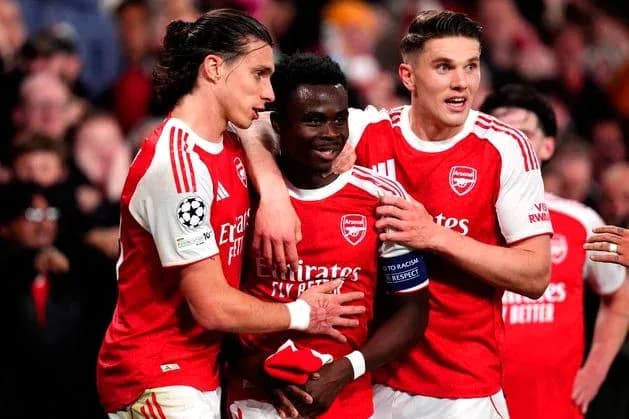
The final whistle sounded and Arsenal’s players did not so much celebrate as erupt. Fists in the air, bodies collapsing to the turf, roars swallowed by the night. A season that has felt like a grind, a test of nerve and faith, now stands on the brink of something extraordinary.
The Premier League title is still in play. So is the European Cup. And, after this suffocating semi-final win over Atletico Madrid, Arsenal are back in a Champions League final for the first time since 2006. For a club that looked broken when Mikel Arteta walked into the mess of December 2019, that alone is a seismic achievement.
He has dragged Arsenal back to seriousness. Back to relevance. Back to the elite.
This is what they imagined when they stuck with him through the early turbulence. Nights like this. Stakes like this. A Champions League final in Budapest, and a shot at history for the Basque coach who could yet be the first to bring that trophy to north London.
On this night, though, the title race felt like background noise. All that mattered was surviving Atletico. And survival is exactly what this was.
A semi-final played in bruises, not space
The game mirrored Arsenal’s season: tense, narrow, unforgiving. Nothing came easy. The lead was fragile, the margins brutal. Every duel felt like a decision. Every decision felt like a potential crisis.
Atletico dragged the tie into the trenches. Diego Simeone’s team did what they always do: contested everything, argued everything, turned every touch into a scrap. This was not a semi-final of sweeping moves and open grass. It was one played in the margins, and often right on the edge of the laws.
It was heavy football. It needed muscle as much as it needed talent.
Viktor Gyokeres gave Arsenal that muscle. The striker has been criticised, sometimes fairly, for failing to hold the ball and for looking out of sync with the rhythm of this team. Here, he made himself a problem Atletico could not ignore. He chased, he wrestled, he fought for every loose ball. He turned lost causes into chances.
From that stubbornness came the breakthrough.
Gyokeres harried his way free down the right, chasing what looked like a dead ball into a pocket of space near the byline. There was no obvious angle, no clear passing lane. Just a sliver of possibility. He found it. He clipped a cross to Leandro Trossard, whose sharp, angled effort forced Jan Oblak into a smart save.
But Bukayo Saka had already read the script.
Saka’s return, Saka’s moment
Saka, whose long injury lay-off had drained some of the electricity from Arsenal’s attack and raised questions about whether he could truly dominate at this level, arrived exactly where he needed to be. Drifting in from the right, unnoticed between two defenders, he tapped in the rebound.
A simple finish. A huge goal.
Since returning, Saka has restored that extra layer to Arsenal’s play – that cut inside from the right that defenders know is coming but still struggle to stop. Atletico didn’t react quickly enough. They paid for it.
It was fitting that Saka, Gyokeres and Myles Lewis-Skelly were at the heart of this. All three have lived through their own strain of doubt this season. Saka’s fitness. Gyokeres’ suitability. Lewis-Skelly’s future.
The teenager, at times seemingly discarded to the point that talk grew of a sale, injected the kind of energy Arsenal have missed in long stretches. He pressed, he snapped into tackles, he carried the ball in tight areas when legs around him looked heavy. Against a side that thrives on grinding opponents down, that spark mattered.
They needed every ounce of it.
Atletico’s fury and Griezmann’s last shot at it
On the other side, the story turned cruel. This defeat closes the book on Antoine Griezmann’s Champions League career. One of the great modern forwards will now never lift this trophy. In flashes, you saw the quality that has defined him – the clever touches, the bursts of invention. But he could not sustain it. Nor could Atletico.
Once Griezmann went off, their threat withered. There was one big opening, a snatched chance for Alexander Sorloth, but it drifted away like so many of their attacks: half-formed, never quite convincing.
The tension, though, never left. If anything, it tightened.
This was a match where players celebrated goal-kicks like goals. At one point, Griezmann and Robin Le Normand punched the air when a tight decision went their way, the ball ruled out for a corner. That was the tone of the night: every inch contested, every contact debated.
And those contacts will echo for a while yet.
Arsenal could easily add to their catalogue of grievances from the first leg. Trossard appeared to be bundled over by Griezmann in the box, only for play to continue. It was not as clear as some of Atletico’s own claims, but it added another layer of needle to an already spiky tie.
Atletico’s biggest shout came when Giuliano Simeone seemed poised to punish a rare Declan Rice mistake, only to collide with Gabriel. Replays struggled to show the defender making any contact with the ball as the two jostled, both losing their balance in the area. The referee gave a corner. It looked, on another night, like it might have been a penalty.
Minutes later, during Atletico’s fiercest spell of pressure, Griezmann went down under a challenge from Riccardo Calafiori. The whistle blew, but not for him. The referee pointed the other way, spotting a foul by Marc Pubill in the build-up. Simeone on the touchline exploded, arms wide, rage pouring out.
The decisions went Arsenal’s way. They will know they had luck. Arteta would probably argue they were due some.
Gyokeres’ miss, Arsenal’s resolve
The drama refused to settle. Gyokeres, having done so much of the dirty work, had the chance to kill it.
On 65 minutes, substitute Piero Hincapie swept in a glorious cross on the counter. Gyokeres, alone, with only Oblak to beat, misjudged the bounce and sent the ball over the bar. It was the kind of miss that feels written into his season: something always slightly off, some caveat attached to every performance.
A second goal would have calmed everything. Instead, the game stayed on a knife-edge. Arsenal had to live with that. They had to embrace it.
They did. They matched Atletico’s aggression, then outlasted it. They dug in when the pressure came, when the crowd sensed blood, when every clearance seemed to come straight back at them. They fought for every header, every second ball, every scrap of territory.
In the end, they won the fight. They won the game.
And now, with Budapest ahead and the league still alive, they stand on the brink of something that once felt impossible. The question is no longer whether Arteta has restored Arsenal to the elite.
It is whether this team is about to win everything that matters.