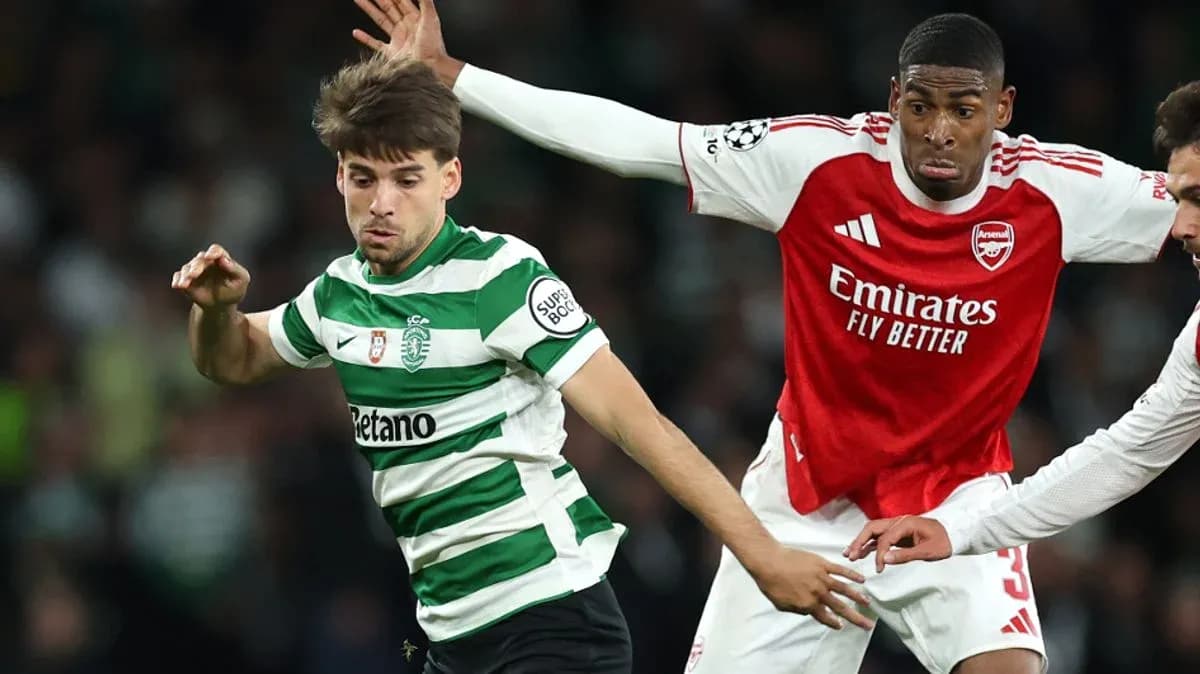
Arsenal vs Sporting CP: Tactical Stalemate in UEFA Champions League
Arsenal and Sporting CP played out a tactical stalemate at Emirates Stadium, a 0–0 draw in the UEFA Champions League quarter-final that was more about structure and control than penalty-box chaos. Both sides finished with identical 50% possession and just one shot on target each, and the contest evolved into a careful chess match between two 4‑2‑3‑1 systems. Arsenal used their shape to apply territorial pressure and create a higher volume of attempts (15 shots to 8), while Sporting focused on compactness, duels and selective counters. The result keeps the tie finely balanced, but the underlying patterns reveal contrasting strategic priorities.
Arsenal's Formation
Arsenal’s 4‑2‑3‑1 was built on a high technical base and wide pressure. David Raya in goal acted as the first distributor, with a back four of Piero Hincapié at left-back, Gabriel Magalhães and William Saliba centrally, and Cristhian Mosquera on the right. They pushed into a medium-high line, trusting the Saliba–Gabriel axis to control depth against Luis Javier Suárez. In front, Declan Rice and Martín Zubimendi formed a double pivot: Rice often stepping left to cover Hincapié’s overlaps, Zubimendi more central as the main circulator.
Ahead of them, Arsenal’s three attacking midfielders shaped the attacking identity. Gabriel Martinelli held the left touchline, Noni Madueke mirrored on the right, and Eberechi Eze operated as the nominal 10 but frequently drifted into the left half-space. This created an asymmetry: Arsenal overloaded the left through Hincapié–Rice–Eze–Martinelli combinations, while Madueke was used more as an isolation threat on the right, looking to attack Maximiliano Araújo 1v1. Viktor Gyökeres led the line, pinning Ousmane Diomande and Gonçalo Inácio and offering depth runs to open lanes for Eze between the lines.
The statistical profile underlines Arsenal’s territorial dominance without cutting edge. They produced 15 shots, with 8 from inside the box, but only 1 on target and a total xG of 0.64. Six blocked shots show Sporting’s penalty-area density: the Portuguese side consistently defended with at least six players in and around their box, with Morten Hjulmand and Hidemasa Morita screening. Arsenal’s 8 corners to Sporting’s 3 also reflect sustained pressure, but the low xG indicates that Sporting forced most attempts into suboptimal or heavily contested zones.
Sporting's Formation
Sporting’s 4‑2‑3‑1 was more conservative and counter-oriented. Rui Silva was protected by a back four of Araújo, Inácio, Diomande and Eduardo Quaresma. The full-backs were cautious, stepping out only selectively; Araújo in particular was tasked with containing Madueke and later Gabriel Jesus and Leandro Trossard when they appeared. Hjulmand and Morita anchored midfield, sitting narrow and deep to deny Eze and Gyökeres space between lines. Ahead, Pedro Gonçalves, Francisco Trincão and Geny Catamo supported Luis Javier Suárez, but their primary duty was to spring from a compact block rather than maintain long spells of possession.
The passing data shows how evenly balanced the base structure was: Arsenal completed 385 of 443 passes (87%), Sporting 388 of 445 (also 87%). The difference lay not in volume or accuracy, but in field position. Arsenal’s circulation, especially through Zubimendi and Rice, was used to move Sporting side to side and create crossing or cutback angles. Sporting’s passes were more often in their own half and in transition channels, aiming to reach Suárez quickly when Arsenal’s full-backs were advanced.
Goalkeeping Performances
In goal, both keepers had quiet but clean evenings. Raya and Rui Silva each registered 1 save, reflecting the low shot quality at both ends. With xG at 0.64 for Arsenal and 0.29 for Sporting, neither goalkeeper was asked to deliver high-difficulty interventions; both essentially met expectation, with no goals prevented beyond the model.
Substitution Patterns
The substitution pattern from minute 56 onward reveals the managers’ attempts to tilt a finely balanced tie. At 56', Kai Havertz (IN) came on for Viktor Gyökeres (OUT), shifting Arsenal’s attacking reference. Havertz offered more dropping movements into midfield, creating a 3‑2‑4‑1 in some phases as he linked play with Eze and the wingers. This was a clear attempt to add combinational quality in tight central zones rather than rely on Gyökeres’ depth running.
On 63', Max Dowman (IN) replaced Noni Madueke (OUT). This move suggested a desire for more control and perhaps more secure possession on the right flank, with Dowman likely instructed to support the midfield link rather than repeatedly drive at Araújo. Arsenal’s right side became less about pure 1v1s and more about creating triangles with Mosquera and Rice.
Sporting’s triple change around the 70–77' mark was geared toward fresh legs and maintaining defensive intensity. At 71', Daniel Bragança (IN) came on for Pedro Gonçalves (OUT), and Geovany Quenda (IN) replaced Geny Catamo (OUT). Bragança provided a more possession-oriented profile in the left half-space, while Quenda added energy and pressing on the right side. At 77', João Simões (IN) replaced Morita (OUT), keeping the double pivot fresh to continue closing central lanes as Arsenal increased pressure.
Disciplinary Overview
The only booking of the night underlined Sporting’s defensive edge. In the 79th minute, Maximiliano Araújo received a yellow card for a foul, a direct consequence of repeated high-intensity duels on his flank as Arsenal rotated their wide attackers. Almost simultaneously, Arsenal refreshed their own front line: Gabriel Jesus (IN) came on for Eberechi Eze (OUT) at 79', and Leandro Trossard (IN) replaced Gabriel Martinelli (OUT) at 79'. These changes reconfigured Arsenal into a more fluid front three, with Havertz often between the lines, Jesus attacking central channels, and Trossard drifting inside from the left. The aim was to destabilize a Sporting back line that had grown comfortable defending Arsenal’s earlier, more predictable patterns.
Sporting’s final double change at 85' was about consolidating. Rafael Nel (IN) replaced Trincão (OUT), and Giorgos Vagiannidis (IN) came on for Eduardo Quaresma (OUT). Nel offered fresh pace for late counters, while Vagiannidis reinforced the right side defensively against Trossard and overlapping runs. Sporting’s priority was clearly to preserve the clean sheet and leave London with the tie intact.
From a disciplinary and physical standpoint, Sporting’s 11 fouls to Arsenal’s 7 and their single yellow card highlight a slightly more aggressive defensive posture. Arsenal, with no bookings, maintained control largely through positioning and counter-pressing rather than tactical fouling.
The statistical verdict confirms what the eye test suggests: Arsenal had the initiative but not the incision. Their higher shot volume, superior corner count and marginally higher xG did not translate into clear, repeated high-quality chances, thanks to Sporting’s compact 4‑2‑3‑1 block and disciplined central protection. Sporting, for their part, produced fewer shots (8 total, 7 in the box) and a lower xG of 0.29, but they succeeded in dragging the game into a low-event, low-variance state that suits an underdog away leg in a knockout tie.
Overall form-wise, Arsenal’s metrics point to a side capable of controlling Champions League knockout tempo but still searching for an extra layer of creativity against deep, organized opponents. Sporting’s defensive index on the night is strong: limiting Arsenal to 1 shot on target despite conceding territory and set pieces speaks to their structural cohesion and the effectiveness of their midfield screen and centre-back pairing. With neither goalkeeper truly tested and cards minimal, the tie now pivots to the return leg, where one side will need to break from this cautious equilibrium.