Atletico Madrid vs Barcelona: Champions League Quarter-Final Analysis
Under the Madrid lights at Metropolitano Stadium, this UEFA Champions League quarter‑final second leg unfolded exactly as the numbers hinted it might: a clash between Atletico Madrid’s ferocious home punch and Barcelona’s more polished, expansive firepower. Following this result – a 2‑1 Barcelona win (2‑1 at half-time, unchanged by the final whistle) – the tie crystallised into a story of efficiency versus volume, and of how each side’s seasonal DNA shaped the tactical landscape.
Across the campaign, Atletico had built a fortress at home. Heading into this game they had played 7 Champions League fixtures at Metropolitano, winning 5 and losing only 2, with a striking 21 home goals – an average of 3.0 – against 10 conceded at 1.4 per match. Overall, their Champions League goal difference stood at +8 (34 scored, 26 conceded) across 14 games, a profile of a side that embraces chaos more than Diego Simeone’s earlier vintages. Barcelona arrived with a different kind of authority: 12 matches in total, 7 wins and 2 draws, with 32 goals for and 20 against, giving them an overall goal difference of +12. On their travels they were more measured but still dangerous: 12 away goals at an average of 2.0, conceding 11 at 1.8.
I. The Big Picture – Structure and Stakes
Simeone doubled down on his evolving, more front‑foot Atletico with a 4‑4‑2 that looked almost like a 4‑2‑2‑2 in possession. J. Musso anchored the side behind a back four of N. Molina, R. Le Normand, C. Lenglet and M. Ruggeri. Ahead of them, G. Simeone and M. Llorente flanked Koke and A. Lookman in a hard‑running midfield, with A. Griezmann drifting around J. Álvarez up front.
Hansi Flick stayed loyal to Barcelona’s season‑long 4‑2‑3‑1, a shape they had used in all 12 Champions League games. J. Garcia started in goal, protected by a back line of J. Cancelo, G. Martin, E. Garcia and J. Kounde. The double pivot of Gavi and Pedri fed a fluid three of Lamine Yamal, D. Olmo and Fermín behind F. Torres as the nominal striker. It was a structure designed to stretch Atletico’s compact block both horizontally and between the lines.
In the broader competition context, Barcelona’s stronger standing – 5th in the overall table with 16 points and a +8 goal difference (22 goals for, 14 against in that ranking snapshot) – contrasted with Atletico’s 14th place, 13 points and a slimmer +2 (17 for, 15 against). The quarter‑final stage demanded that Simeone’s side lean heavily on their home scoring power; Flick’s men, by contrast, needed to trust their superior attacking balance over two legs.
II. Tactical Voids – Absences and Discipline
The absentees subtly re‑wrote both game plans. Atletico were without P. Barrios (muscle injury), J. M. Gimenez and D. Hancko (both injured), plus M. Pubill suspended for yellow cards. The result was a back four missing its most established organiser in Gimenez and an extra rotation option at full‑back. It forced Lenglet and Le Normand into a partnership that had to learn on the job against a high‑class Barcelona front line, and it nudged Simeone towards a slightly deeper starting line to protect them.
Barcelona’s defensive depth was also compromised. A. Christensen (knee injury) and Pau Cubarsí (suspended after a red card) were missing, as was Raphinha with a thigh injury and M. Bernal with an ankle issue. Without Christensen and Cubarsí, Flick had to lean on E. Garcia as the central anchor. Garcia’s Champions League profile – 11 appearances, 780 minutes, and 15 tackles with 11 interceptions – underlined his reliability in stepping out, but his red card earlier in the campaign also highlighted the risk of aggressive front‑foot defending if Atletico could isolate him.
Disciplinary trends framed the emotional tempo. Atletico’s yellow‑card distribution showed a clear spike between 46‑60 minutes, where 29.17% of their bookings came, and another 20.83% between 61‑75. Barcelona’s bookings were more clustered around half‑time: 26.09% between 31‑45 minutes and 21.74% from 76‑90, while their red cards had been brutally concentrated – 66.67% between 31‑45 and 33.33% between 76‑90. This history hinted at a volatile Barcelona back line under stress in transition phases and around key momentum swings.
III. Key Matchups – Hunter vs Shield, Engine Room
The headline duel was unmistakable: J. Álvarez, one of the Champions League’s most prolific forwards this season, against a patched‑up Barcelona defence. Álvarez’s campaign numbers were elite: 13 appearances, all as a starter, 9 goals and 4 assists, with 32 shots (20 on target) and 33 key passes from 401 total passes at 81% accuracy. He had also converted 2 penalties from 2, with no misses. In a home side averaging 3.0 goals at Metropolitano, Álvarez was the spearhead.
Up against him, E. Garcia and J. Kounde carried Barcelona’s “shield” responsibilities. Garcia’s 702 passes at 92% accuracy and 15 tackles underscored his calm build‑up and solid defensive reading, but he had already conceded a penalty this season. Any time Álvarez drifted into the right half‑space, looking to combine with Griezmann, Atletico were targeting that seam between Garcia’s stepping out and Gavi’s cover.
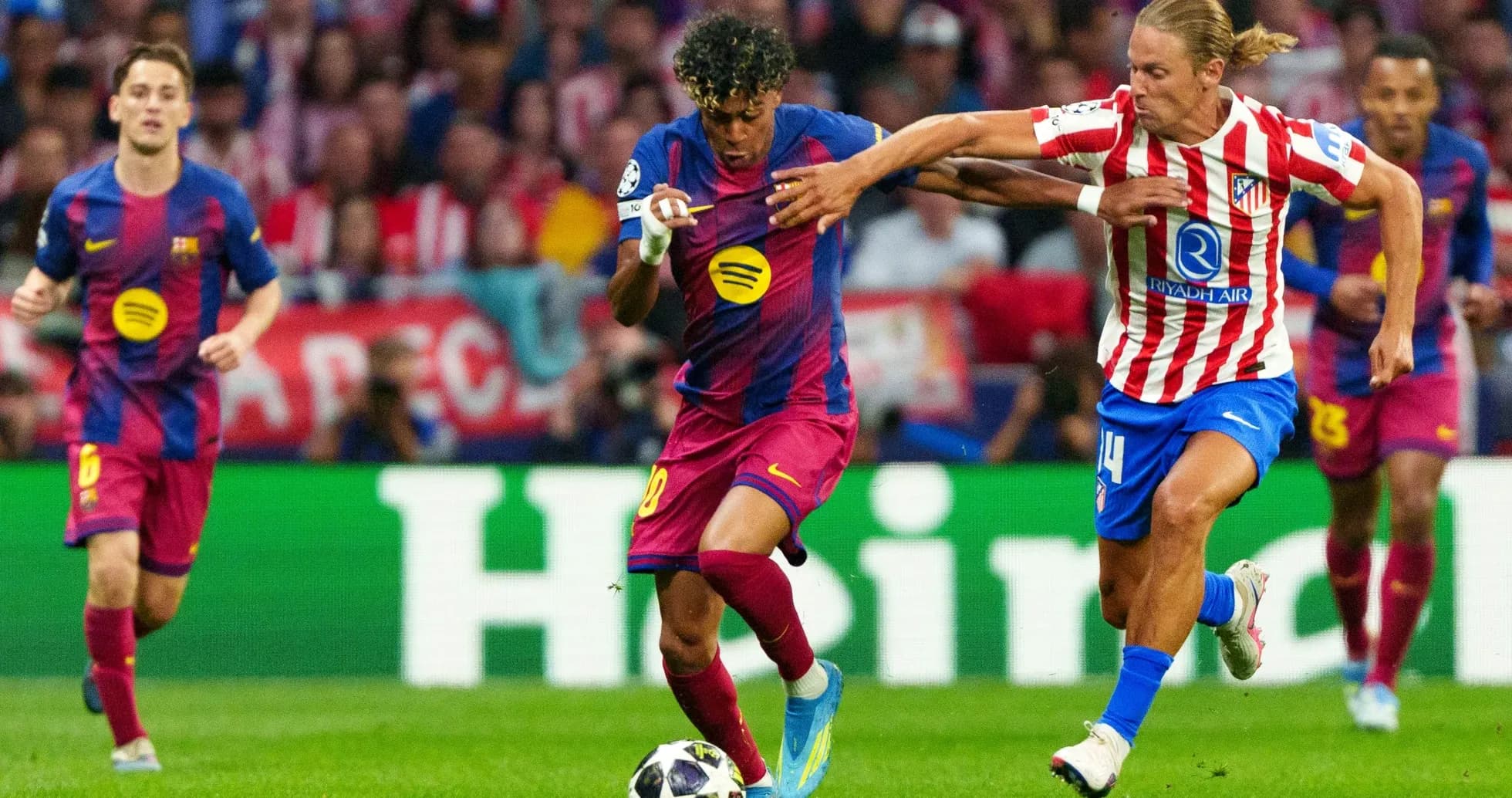
On the flanks, the contrast was stark. Lamine Yamal arrived as perhaps the competition’s most electric wide player: 6 goals and 4 assists in 10 appearances, 24 shots (15 on target) and a remarkable 82 dribble attempts with 45 successes. He also led Barcelona’s pressing and duelling on that side, with 149 duels and 89 won. Against M. Ruggeri and A. Lookman, Lamine was both creator and outlet. His disciplinary line – 4 yellow cards but no reds – showed a player walking the edge of intensity without tipping over.
In the engine room, Koke’s metronomic presence for Atletico had to contend with Pedri and Gavi’s double pivot. Barcelona’s midfielders were tasked with breaking Atletico’s 4‑4‑2 shell by receiving between the lines and immediately feeding Lamine or Fermín. Fermín himself, with 6 goals and 4 assists in 11 matches and 10 key passes, was a late‑arriving threat from midfield that Atletico’s second line struggled to track consistently.
IV. Statistical Prognosis – xG Logic and Defensive Reality
Even without explicit xG values, the underlying shot and scoring data sketches a clear probabilistic picture. Barcelona, with 2.7 goals per game overall and no clean sheets all campaign, are built for open exchanges rather than control through defensive solidity. Atletico, at 2.4 goals per game overall but conceding 1.9, are similarly open, especially on their travels, but at home they usually compress the box and trust their forwards to out‑gun opponents.
Heading into this tie, the numbers suggested a match where Barcelona would likely generate more possession‑based chances, especially through Lamine and Fermín, while Atletico’s best route lay in high‑value, central shots for Álvarez and Griezmann. The fact that Barcelona edged this leg 2‑1 in regular time, matching their away average of 2.0 goals and holding Atletico to just 1 despite the hosts’ 3.0 home scoring trend, speaks to a defensive performance from Flick’s side that slightly outstripped their season‑long profile.
Atletico’s inability to find a second goal – despite Álvarez’s form and their usual home avalanche – becomes the decisive tactical hinge. Barcelona’s back line, with E. Garcia and G. Martin stepping up and J. Kounde locking down the right channel, managed to compress the central zones just enough to deny Álvarez the volume of shots he normally enjoys.
Following this result, the statistical prognosis is vindicated in broad strokes: the more balanced, higher‑ceiling attack progressed, but only by surviving the one venue in Europe where chaos and emotion usually tilt the pitch. For Simeone, the story is of a side that has evolved into a more expansive, risk‑embracing unit – yet on the night when margins were finest, it was Barcelona’s slightly sturdier defensive reality, and the individual brilliance of Lamine and Fermín, that wrote the final chapter.