Barcelona vs Atletico Madrid: Tactical Analysis of Champions League Defeat
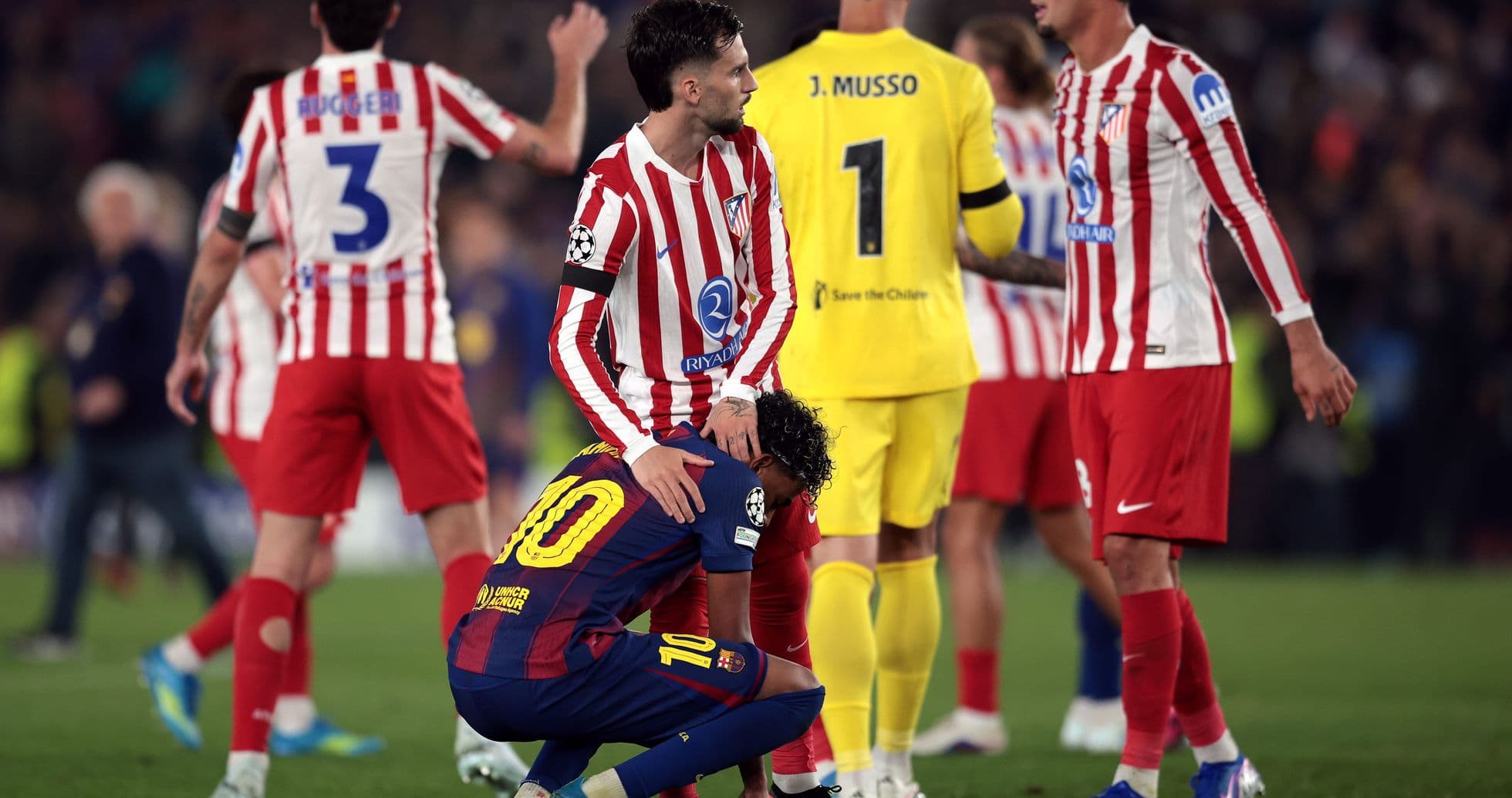
Barcelona’s 2–0 home defeat to Atletico Madrid at Spotify Camp Nou in this UEFA Champions League quarter-final first leg hinged on control versus clarity. Hansi Flick’s side dominated possession (58%), territory, and shot volume (18 attempts, 7 on target), but Diego Simeone’s Atletico condensed the pitch, protected the box, and punished transitions with ruthless efficiency. A pivotal red card for Pau Cubarsí at 44' reshaped the contest, forcing Barcelona into a high-risk, high-possession game against a low block that thrived on compactness. Atletico’s 4-4-2, anchored by Juan Musso’s seven saves and a disciplined back line, translated just 0.45 xG into two decisive away goals.
Barcelona began in a 4-2-3-1 with Joan García behind a back four of Joao Cancelo, Gerard Martín, Pau Cubarsí, and Jules Koundé, Eric García and Pedri as a double pivot, and an attacking band of Lamine Yamal, Dani Olmo, Marcus Rashford behind Robert Lewandowski. The structure was clearly designed for territorial dominance: both full-backs high, Pedri and Eric García orchestrating circulation, and Yamal plus Rashford stretching Atletico’s 4-4-2 laterally.
In possession, Barcelona built in a 2-3-5 shape. Eric García dropped close to the centre-backs to help progression, Cancelo inverted at times to form a midfield three, and Pedri operated between Atletico’s first and second lines. The 596 total passes at 90% accuracy underline that the first phase was under control. However, Atletico’s mid-block was calibrated to concede wide spaces while aggressively protecting the central lane. Koke and Marcos Llorente screened Lewandowski’s feet, forcing Barcelona to rely on cut-backs and crosses rather than clean central combinations.
The shot profile reflects this tension. Thirteen of Barcelona’s 18 shots came inside the box, yet their xG of 1.16 suggests many were from crowded or suboptimal angles. Musso’s seven saves were important but not spectacular heroics; Atletico’s defenders consistently contested shooting lanes, turning promising positions into rushed finishes. Lamine Yamal and Rashford found pockets between full-back and centre-back, but Atletico’s back four rarely allowed them to turn freely, funnelling them into traffic.
Atletico, in contrast, were minimalist but incisive. Their 4-4-2 out of possession became a 4-4-1-1 when Antoine Griezmann dropped to shadow Barcelona’s pivot, disrupting central progression. On the ball, they were content with just five shots and 0.45 xG, but every attacking phase was built around verticality: early passes into Julián Alvarez’s runs, diagonal switches to Ademola Lookman, and late surges from Llorente. With only one corner and limited sustained possession (42%), Atletico focused on exploiting transitional moments rather than building slowly.
Tactical Shift
The match’s tactical hinge came between 42' and 45'. The VAR “Card upgrade” incident at 42' on Pau Cubarsí foreshadowed the decisive moment: at 44', Cubarsí was shown a straight red card for a professional foul as the last man. That expulsion did two things tactically: it stripped Barcelona of a ball-playing centre-back crucial for breaking Atletico’s first line, and it forced Flick to rebalance his structure while chasing the game. Atletico immediately capitalised on the disarray. At 45', Julián Alvarez scored a normal goal, turning a controlled but tight contest into a scenario where Barcelona had to break down an elite low block a man down.
Halftime adjustments were aggressive from Flick. At 46', Pablo Gavi (IN) came on for Pedri (OUT), and Fermín López (IN) replaced Robert Lewandowski (OUT). Removing Lewandowski signalled a shift from classic reference nine play to more fluid, mobile occupation of the last line, with runners attacking half-spaces rather than crosses targeted to a fixed striker. Gavi’s introduction aimed to raise pressing intensity and verticality from midfield, trying to destabilise Atletico’s build-up and create chaos in which Barcelona’s technical superiority might still tell.
Simeone’s response at 60' was textbook game-state management. Alexander Sørloth (IN) came on for Ademola Lookman (OUT), and Alejandro Baena (IN) replaced Koke (OUT). Sørloth provided an aerial and hold-up outlet to relieve pressure and pin Barcelona’s depleted back line, while Baena added fresh legs and ball-carrying threat in transition. Atletico’s yellow cards for Koke at 31', Marc Pubill at 45+1', and Baena at 63'—all for fouls—illustrate their willingness to break rhythm and accept disciplinary cost to maintain structural integrity.
Barcelona’s own discipline frayed under the scoreboard and numerical pressure. Pablo Gavi’s yellow card at 65' for a foul symbolised the growing frustration of a side forced to chase the ball after turnovers with one fewer defender. Flick doubled down on attacking substitutions at 73', with Ferran Torres (IN) for Marcus Rashford (OUT) and Ronald Araújo (IN) for Jules Koundé (OUT), effectively trading some build-up stability for aerial and physical presence at the back and more direct threat in the final third. At 86', Alejandro Balde (IN) replaced Joao Cancelo (OUT), adding pure width and overlapping speed on the left in a late attempt to stretch Atletico’s block horizontally.
Atletico's Second Goal
Atletico’s second goal at 70' underlined their tactical clarity. Sørloth, already on the pitch, finished a normal goal assisted by Matteo Ruggeri. The pattern fits the broader match logic: Ruggeri advancing from full-back into space vacated by Barcelona’s aggressive shape, then finding Sørloth attacking a disorganised back line. With Barcelona committing numbers forward and lacking Cubarsí’s recovery speed and positioning, Atletico’s direct, low-volume attack produced a goal that effectively killed the tie’s first leg.
From a defensive standpoint, the contrast between the sides is stark. Atletico conceded 18 shots but allowed only 1.16 xG, reflecting a high Defensive Index: they protected central zones, forced poor shot quality, and relied on Musso’s seven saves as the final layer. Barcelona, by contrast, faced just five shots but conceded two goals from 0.45 xG, a poor Defensive Index night heavily influenced by the red card and subsequent structural compromises. Joan García’s single recorded save highlights how few clear actions he had; Atletico rarely wasted attacks, and when they reached the final third, they were efficient.
Statistically, Barcelona’s Overall Form in this match—measured through possession, pass accuracy, and territorial control—was strong: 58% possession, 596 passes at 90% accuracy, seven corners to Atletico’s one, and only six fouls committed. Yet Atletico’s Overall Form was superior in the metrics that decide knockout ties: chance conversion, game management, and discipline in structure. Seventeen fouls, three yellow cards, and no reds show a side pushing the limit without crossing the critical line.
The final 2–0 scoreline, with xG of 1.16 versus 0.45, underlines a classic Simeone away performance: concede territory, compress space, and let efficiency trump volume. Flick’s Barcelona created enough to suggest the tie is not statistically hopeless, but the red card, Cubarsí’s suspension, and Atletico’s Defensive Index on the night leave them with a steep tactical and psychological climb in the second leg.