Bayern München Dominates Atalanta 4-1 in Tactical Showcase
Bayern München 4–1 Atalanta at Allianz Arena, 1/8 final, was a territorially dominant, control-heavy display from Vincent Kompany’s side against a more vertical, transition-focused Atalanta.
1. Game State & Overall Dynamics
- Score: Bayern München 4–1 Atalanta
- Half-time: 1–0
- Possession: 71% Bayern – 29% Atalanta
- Shots: 25–14 in Bayern’s favour
- Shots on goal: 8–8
Bayern controlled territory and tempo, using a 4-2-3-1 to pin Atalanta’s 3-4-2-1 deep. Atalanta still generated a decent xG (2.3) and 8 shots on goal, but Bayern’s volume (25 shots, xG 3.61) and sustained pressure broke them repeatedly.
Bayern München had 8 of their shots blocked by the Atalanta defense. Atalanta had 1 of their shots blocked by the Bayern München defense.
2. Bayern München Tactical Breakdown (4-2-3-1)
2.1 Structure in Possession
Base shape:
- Back four: Tom Bischof – Jonathan Tah – Min-jae Kim – Josip Stanišić
- Double pivot: Aleksandar Pavlović – Leon Goretzka
- Line of three: Luis Díaz (left), Raphaël Guerreiro (central), Lennart Karl (right)
- 9: Harry Kane
With 71% possession and 859 total passes (93% accuracy), Bayern played a high-possession, positional game:
- First phase:
- Tah and Kim formed a wide ball-playing pair, with Pavlović frequently dropping to create a 3+1 structure against Atalanta’s front.
- Fullbacks (Bischof left, Stanišić right) pushed high early, pinning the Atalanta wing-backs and limiting their ability to spring counters.
- Central control:
- Goretzka operated as the more advanced pivot, stepping into the right half-space to support Karl and Stanišić, creating triangles to progress.
- Guerreiro acted as an extra playmaker between the lines, rotating with Díaz into the left half-space to overload Ederson and Pašalić.
- Final third patterns:
- Left side: Díaz drove 1v1 at the right side of Atalanta’s back three, often receiving diagonals from Tah or Guerreiro. His combination with Guerreiro and the underlapping Bischof created repeated entries into the box.
- Right side: Karl’s starting position was wide, but he frequently attacked the inside channel between Kossounou and Hien, with Stanišić overlapping or underlapping to stretch the line.
- Kane operated as a classic reference 9: dropping to link, then spinning into the box. The penalty at 25' came from Bayern’s constant pressure and box presence.
2.2 Out of Possession
With only 8 fouls, Bayern pressed with control rather than reckless aggression:
- Pressing scheme:
- Kane initiated the press on the central centre-back, curving runs to screen passes into Ederson.
- Díaz and Karl jumped onto the wide centre-backs, while Guerreiro locked onto Atalanta’s deeper midfielder.
- The double pivot stayed compact behind them, ready to pick up second balls from long clearances.
- Rest defense:
- In settled attacks, Bayern’s rest defense resembled a 2-3 or 3-2:
- Tah and Kim stayed high and aggressive to deal with Scamacca.
- One fullback (often Stanišić) would tuck in to form a back three in possession, giving cover against direct balls to Sulemana and De Ketelaere.
Despite Atalanta’s 8 shots on goal, Bayern’s structure limited clean central entries; many of Atalanta’s best chances came when Bayern’s fullbacks were caught high and Atalanta broke quickly.
2.3 Key Phases & Goals
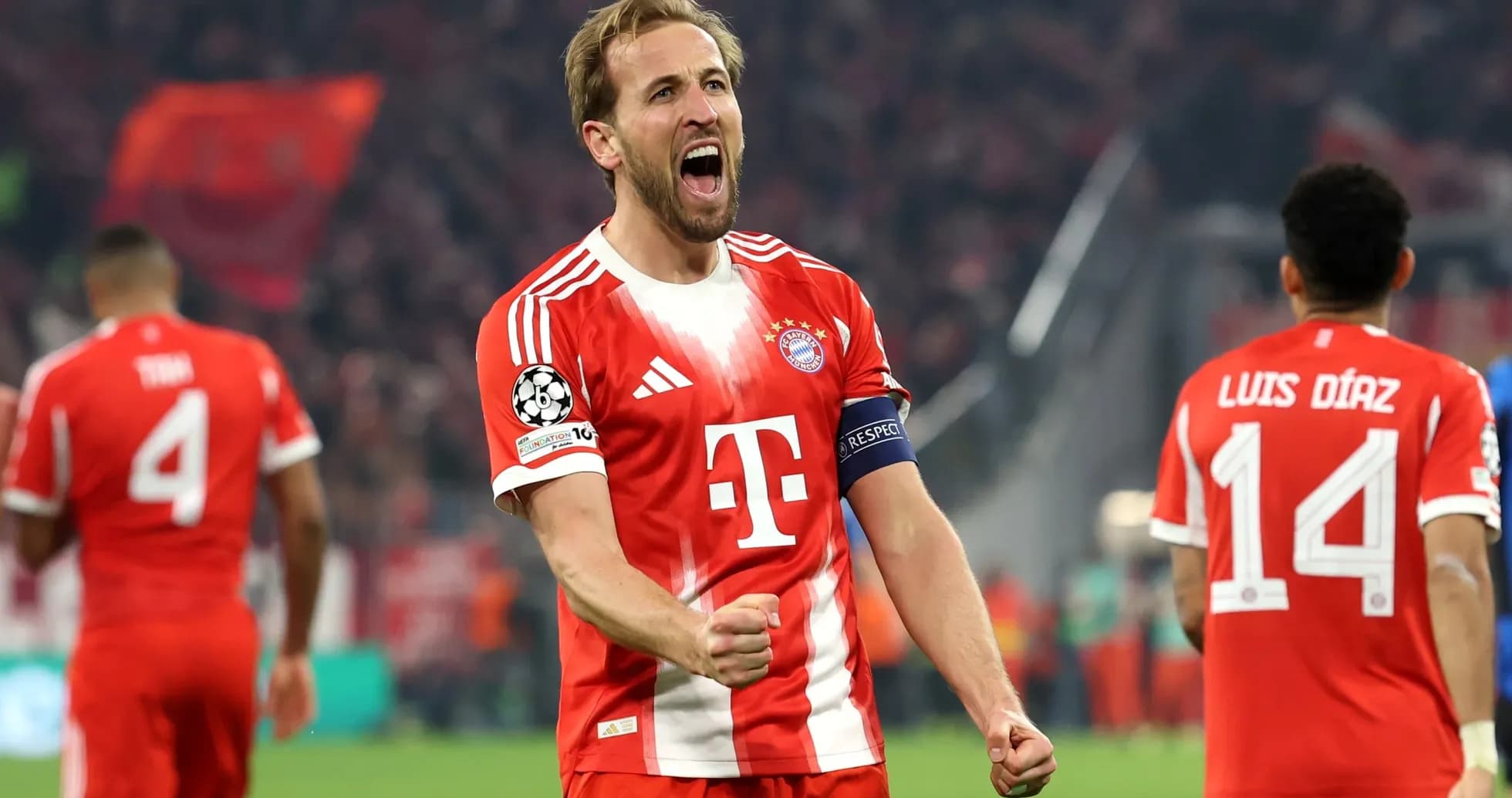
1–0 (25', Kane, penalty): Sustained Bayern pressure led to a penalty confirmed by VAR at 22'. Kane converted, rewarding Bayern’s territorial dominance and early control of the half-spaces.
2–0 (54', Kane): A classic pattern: Bayern win the ball high, combine down the right. Stanišić provided the assist, showing how the right-back’s advanced positioning and overlaps were integral to breaking Atalanta’s back three. Kane’s movement between centre-backs punished Atalanta’s poor spacing.
Substitution and immediate impact (56'): At 56', Deniz Ofli came on to replace Aleksandar Pavlović. Simultaneously, Bayern struck again:
3–0 (56', Lennart Karl): Karl’s goal, assisted by Díaz, reflected Bayern’s flank-to-flank fluidity. Díaz’s ability to drive inside from the left pulled Atalanta’s block across, freeing Karl on the far side or in the inside-right channel. The timing—immediately after a midfield change—suggests Bayern maintained their structure despite adjusting personnel.
4–0 (70', Luis Díaz): Díaz then scored, assisted by Karl, illustrating a symmetrical relationship: both wide players alternated between creator and finisher. Bayern’s repeated overloads on one side and switches to the far side disorganized Atalanta’s back three and wing-backs.
Consolidation substitutions (72' & 83'): At 72', Nicolas Jackson came on to replace H. Kane. At 72', Serge Gnabry came on to replace T. Bischof. At 72', Filip Pavic came on to replace J. Stanisic. At 83', Hiroki Ito came on to replace R. Guerreiro.
These changes shifted Bayern towards game management: fresh legs up front (Jackson), additional direct threat and ball-carrying (Gnabry), and defensive security with Ito and Pavic. Bayern could then sit a touch deeper, attack space in behind, and protect their lead.
3. Atalanta Tactical Breakdown (3-4-2-1)
3.1 Structure in Possession
Base shape:
- Back three: Giorgio Scalvini – Isak Hien – Odilon Kossounou
- Wing-backs: Lorenzo Bernasconi (left), Raoul Bellanova (right)
- Double pivot: Éderson – Mario Pašalić
- Two 10s: Charles De Ketelaere, Kamaldeen Sulemana
- 9: Gianluca Scamacca
With 29% possession and 349 passes (85% accuracy), Atalanta leaned on:
- Build-up:
- A 3+2 base against Bayern’s front press. However, Bayern’s high block often forced Atalanta long toward Scamacca.
- Wing-backs pushed high, but were frequently pinned by Bayern’s wingers, limiting their role as outlets.
- Chance creation:
- Atalanta’s 2.3 xG and 8 shots on goal show they were dangerous when they could break lines.
- De Ketelaere and Sulemana looked to receive between Bayern’s lines and attack the half-spaces, especially when Bayern’s fullbacks were high.
- Pašalić’s late arrivals into the box, especially later in the game, created overloads against Bayern’s centre-backs.
3.2 Out of Possession
Atalanta tried to maintain a 5-4-1 or 5-2-2-1 block:
- Front line:
- Scamacca led the first line but was often isolated against Bayern’s numerical superiority in build-up.
- The two attacking midfielders attempted to block passes into Bayern’s pivots, but Bayern’s rotations with Guerreiro and Goretzka regularly broke these lines.
- Defensive line:
- When pinned, the wing-backs dropped to form a back five, but the distances between centre-backs grew too large when they stepped out to track Kane or the wingers.
- This created gaps for Díaz and Karl to attack diagonally, and for Kane to find pockets for layoffs and runs.
With only 4 fouls, Atalanta were relatively passive defensively, which allowed Bayern to play through them with minimal disruption.
3.3 Substitutions & Tactical Adjustments
Double change at 57': At 57', Marten de Roon came on to replace Ederson. At 57', Lazar Samardzic came on to replace C. De Ketelaere.
- De Roon’s introduction aimed to stabilize the midfield, add defensive presence, and protect the back three.
- Samardžić provided more direct shooting and vertical passing from the left half-space, looking to threaten from distance and late runs.
Attacking changes at 71': At 71', Giacomo Raspadori came on to replace K. Sulemana. At 71', Nikola Krstovic came on to replace G. Scamacca.
- Raspadori offered more mobility and link play between the lines, helping Atalanta combine in tighter spaces.
- Krstović’s more aggressive runs in behind gave Atalanta a deeper threat against a Bayern line that had started to manage the game.
Defensive refresh at 83': At 83', Honest Ahanor came on to replace G. Scalvini.
This was a like-for-like defensive change, adding fresh legs and perhaps more aggression in duels as Atalanta tried to push higher late on.
3.4 Goal & Late Surge
4–1 (86', Lazar Samardzic): Samardžić scored, assisted by Pašalić, reflecting Atalanta’s improved attacking structure after the changes:
- De Roon’s presence allowed Pašalić to push higher as a late runner.
- Raspadori and Krstović’s movements dragged Bayern’s defenders, opening a window at the edge or inside the box for Samardžić.
- The goal underlined that Atalanta remained dangerous when able to attack a slightly stretched Bayern in the final minutes.
4. Key Tactical Battlegrounds
4.1 Wide Areas & Half-Spaces
- Bayern’s wingers (Díaz, Karl) and fullbacks (Bischof, Stanišić) consistently overloaded Atalanta’s wing-backs.
- Atalanta’s 3-4-2-1 struggled when the wing-backs were pinned deep and the outside centre-backs had to step out, opening central channels.
This is where the game was essentially decided: Bayern’s wide dominance translated into high-quality chances and crosses, reflected in their 25 total shots and 15 shots inside the box.
4.2 Central Midfield
- Bayern’s double pivot plus Guerreiro outnumbered Atalanta’s Ederson–Pašalić axis.
- The introduction of De Roon was a recognition that Atalanta were losing control centrally; by then, the damage (3–0) was largely done.
Bayern’s 93% pass accuracy and 801 accurate passes show how comfortably they circulated the ball around and through Atalanta’s midfield.
5. Goalkeeper & Box Management
- Bayern’s goalkeeper Jonas Urbig made 7 saves, meaning Atalanta managed to test him frequently despite limited possession. This underscores Atalanta’s efficiency in turning transitions into shots.
- Atalanta’s Marco Sportiello made 4 saves against Bayern’s 8 shots on goal; Bayern’s finishing and shot quality (3.61 xG, 4 goals) were decisive.
Bayern’s ability to pack the box with Kane, Díaz, Karl, and late runs from Goretzka overwhelmed Atalanta’s back line, while Atalanta’s own box presence relied more on late-arriving midfielders and quick combinations after the substitutions.
6. Tactical Summary
- Bayern used a high-possession 4-2-3-1 with aggressive fullbacks and fluid wide rotations to dominate territory, create overloads, and sustain pressure.
- Atalanta’s 3-4-2-1 produced dangerous moments on the break and after structural tweaks, but their wing-backs and midfield were overrun for long stretches.
- The timing and nature of Bayern’s goals—especially the quick succession around the hour mark—reflected superior control of wide spaces and central overloads.
- Atalanta’s late adjustments improved their attacking threat, culminating in Samardžić’s goal, but they came after Bayern had already built an unassailable lead.