Bayern München vs Real Madrid: A Thrilling 4–3 Clash in Champions League
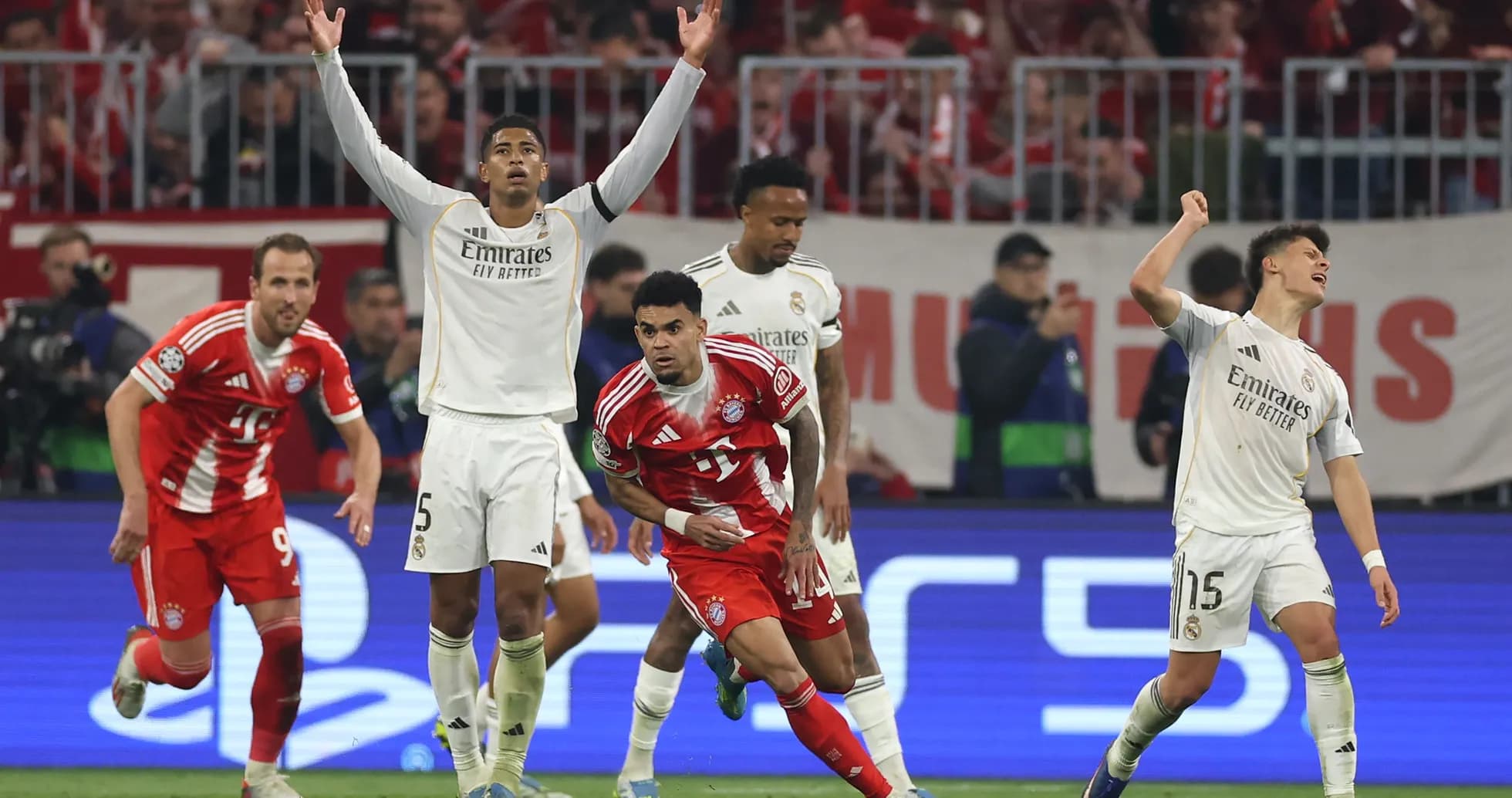
Under the lights of the Allianz Arena, a 4–3 Bayern München win over Real Madrid turned this UEFA Champions League quarter-final into a breathless, almost chaotic exhibition of attacking excess. Following this result, it felt less like a tactical chess match and more like two grandmasters agreeing to play without queens – control was sacrificed in favour of pure, unfiltered threat.
I. The Big Picture – Two Superpowers, One Wild Game
Bayern arrived as a machine in this competition. Overall this campaign they had played 12 Champions League matches, winning 11 and losing only 1, scoring 38 goals and conceding 14. That gives them an overall goal difference of +24, built on a ruthless attack averaging 3.2 goals per game and a defence that, until recently, allowed just 1.2. At home they had been even more brutal: 6 wins from 6, 20 goals scored and only 6 conceded, averaging 3.3 goals for and 1.0 against.
Real Madrid came in as a more volatile force. Overall they had played 14 matches, winning 9 and losing 5, with 33 goals scored and 20 conceded – an overall goal difference of +13. On their travels, they had 4 wins and 3 losses, with 17 goals for and 13 against, averaging 2.4 goals scored and 1.9 conceded away. This was always going to be open; it became a track meet.
The first half alone finished 3–2 to Madrid, a direct clash between Bayern’s vertical 4-2-3-1 under Vincent Kompany and Alvaro Arbeloa’s aggressive 4-4-2. By full time, Bayern had flipped it to 4–3, the Allianz Arena echoing with the sense that this tie, and perhaps the competition, now runs through their red shirts.
II. Tactical Voids – Who Was Missing, and What It Meant
Both sides were stretched by absences, but in very different sectors.
Bayern’s list of missing players – M. Cardozo, L. Karl, C. Kiala, W. Mike, B. Ndiaye and S. Ulreich – hit their depth more than their core. With Manuel Neuer fit, the loss of Ulreich mattered only as security. The injuries to squad players meant Kompany had fewer late-game options to change the tempo, but his starting XI remained intact: Neuer behind a back four of Konrad Laimer, Jonathan Tah, Dayot Upamecano and Josip Stanisic, with Joshua Kimmich and Aleksandar Pavlovic as the double pivot. Ahead of them, Michael Olise, Serge Gnabry and Luis Díaz supported Harry Kane.
Real Madrid’s voids cut closer to the bone. Thibaut Courtois was out with a thigh injury, leaving Andriy Lunin exposed behind a back line that had to live without the suspended Aurelien Tchouameni’s protection in front of it. Rodrygo’s knee injury removed a key vertical runner, and R. Asencio’s illness further reduced Arbeloa’s ability to rotate in attack. Instead, he leaned into pure talent: a front two of Kylian Mbappé and Vinicius Junior, supplied by a midfield four of Arda Güler, Jude Bellingham, Federico Valverde and Brahim Díaz.
Disciplinary history framed the edges of this contest. Bayern’s season card profile showed a clear late-game edge: 37.50% of their yellow cards arrive between 76–90', while both of their red cards this campaign had come between 46–75'. Luis Díaz himself carried a red card on his seasonal record, a reminder that his emotional edge can cut both ways. Real’s yellows are more spread, but with 20.59% between 46–60' and another 20.59% in 76–90', they are prone to losing composure as intensity spikes. Dani Carvajal’s red card earlier in the campaign underlines that this back line can be dragged into rashness.
III. Key Matchups – Hunter vs Shield, Engine Room vs Chaos
Hunter vs Shield was pure box office: Mbappé against a Bayern defence that, heading into this game, conceded most frequently between 16–30' (28.57%) and 76–90' (28.57%). Madrid’s own attacking minute profile screamed early ambush – 40.63% of their goals arrive between 16–30'. The first half followed that script: Mbappé’s movement off Vinicius and Bellingham repeatedly targeted the channels around Laimer and Stanisic, stressing Bayern’s full-backs and forcing Upamecano and Tah into emergency defending.
On the other side, Kane hunted a Madrid unit that, heading into this game, conceded 33.33% of their goals between 31–45' and 19.05% in both 46–60' and 76–90'. Bayern’s own offensive surge between 46–60' (21.05% of their goals) aligned perfectly with Madrid’s soft underbelly after half-time. Once Bayern survived the early storm, Kane began to pin Eder Militao and Antonio Rüdiger, creating space for Olise and Díaz to cut inside.
In the Engine Room, the duel between Kimmich–Pavlovic and Bellingham–Valverde was frantic rather than controlled. Valverde, with 21 key passes and 24 tackles overall this campaign, tried to close Bayern’s lanes into Kane’s feet, but Olise’s creativity – 31 key passes and 6 assists overall – repeatedly found gaps between Madrid’s lines. Güler, whose 34 key passes overall make him Madrid’s most consistent chance creator, floated into the half-spaces, dragging Pavlovic out and opening lanes for Mbappé.
Wide, it was chaos. Díaz, with 6 goals and 3 assists overall, attacked Alexander-Arnold’s flank relentlessly, while Gnabry, with 5 assists, inverted to combine with Olise. For Madrid, Vinicius (5 goals, 5 assists overall) attacked Laimer one-on-one, testing a defender who has already committed 15 fouls and taken 4 yellows this campaign. The duel was as much psychological as tactical; every isolated sprint felt like it could tilt the tie.
IV. Statistical Prognosis – A Tie Defined by Surge Windows
Following this result, the numbers suggest the second leg will be dictated by timing as much as talent. Bayern’s scoring is broadly distributed, but their peak between 46–60' and sustained threat from 31–75' collide with Madrid’s defensive fragility around half-time and in the final quarter. Conversely, Madrid’s 16–30' attacking spike and 31–45' threat meet Bayern’s early-game vulnerability, especially between 16–30'.
Layer on top the penalty narratives – Bayern perfect from the spot overall this campaign but with Kane having missed 1 penalty personally, Madrid 100.00% from 4 penalties – and this feels like a tie where xG will be inflated by individual brilliance and late-game fatigue more than controlled, repeatable patterns.
The tactical preview, after a 4–3 first-leg thriller, is paradoxically simple: whoever survives their own weakest 15-minute windows, while maximising their surge phases, will drag this quarter-final to their side. In a tie defined by Mbappé and Kane, Olise and Vinicius, the shield that bends without breaking in those storm periods may matter more than the sharpest hunter.