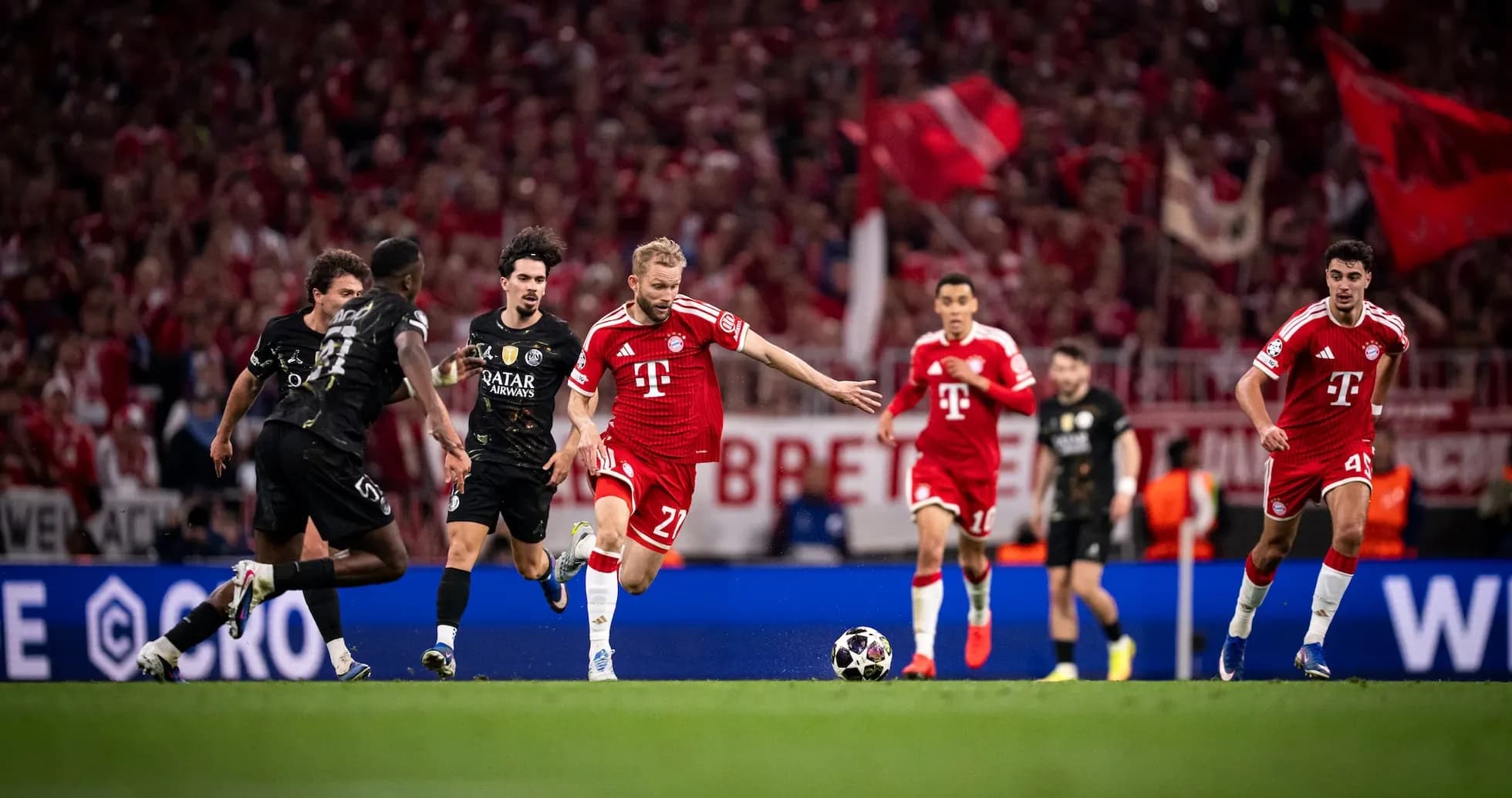
Bayern München vs Paris Saint Germain: Champions League Semi-Final Highlights
Bayern München and Paris Saint Germain produced a finely balanced Champions League semi-final first leg at the Allianz Arena, ending 1–1 after 90 tense minutes. PSG struck first through O. Dembele in the third minute, but H. Kane’s late equaliser preserved Bayern’s hopes ahead of the return leg. The pattern was clear: Bayern’s territorial and possession dominance against PSG’s compact, transition-focused 4-3-3. Bayern had 66% of the ball, more shots and higher xG (1.4 to 1.03), yet PSG’s structure and goalkeeper M. Safonov’s 5 saves kept the tie level in a match where both defences bent but rarely broke.
In the third minute, PSG’s game plan materialised immediately. K. Kvaratskhelia received and drove at Bayern’s left side before slipping a pass into O. Dembele, whose “Normal Goal” finish gave PSG a 0–1 lead with Bayern’s back four not yet settled. That early strike allowed Enrique Luis’s side to drop into a more controlled mid-to-low block, with the front three primed for transitions.
The disciplinary tone was set early as well. At 8', Nuno Mendes received a yellow card for a foul, signalling PSG’s willingness to commit tactical infringements to slow Bayern’s rhythm. Bayern’s frustration surfaced on 33', when Jonathan Tah was booked for “Argument”, reflecting growing tension rather than a direct defensive action. Just before the interval, at 45+3', Kvaratskhelia was shown a yellow card for “Time wasting”, underlining PSG’s priority to protect the 0–1 half-time lead rather than chase a second goal. The score at 45' stood at Bayern 0–1 PSG, fully aligned with the match flow: Bayern controlling possession, PSG ahead on the scoreboard.
Second Half Adjustments
The second half brought a rolling series of adjustments. At 65', B. Barcola (IN) came on for O. Dembele (OUT), a like-for-like change that preserved PSG’s wide threat but added fresh legs for pressing and counters. Bayern responded two minutes later: at 67', A. Davies (IN) came on for J. Stanisic (OUT), an attacking shift at left-back to add direct running and crossing. On 68', Kim Min-Jae (IN) replaced J. Tah (OUT), a straight centre-back swap, but one that removed a booked player and brought a more aggressive front-foot defender.
PSG then doubled down on defensive solidity at 76'. L. Hernandez (IN) came on for D. Doue (OUT), converting the left flank from a forward to a defender, and L. Beraldo (IN) replaced F. Ruiz (OUT), adding another defensive profile in the back line or as an auxiliary stopper. Bayern’s response was to inject attacking energy: N. Jackson (IN) for J. Musiala (OUT) at 79' increased the presence around Kane and threatened depth more consistently. At 85', L. Karl (IN) came on for D. Upamecano (OUT), another defensive reshuffle for Bayern, while S. Mayulu (IN) replaced N. Mendes (OUT) for PSG, freshening the left side after Mendes’ earlier booking.
The emotional temperature spiked again in the final quarter. At 78', Luis Díaz received a yellow card for “Argument”, symptomatic of Bayern’s urgency and disputes over decisions as they chased the equaliser. At 86', Marquinhos was booked for a foul, a classic tactical intervention to break Bayern’s momentum in the closing stages. Deep into stoppage time, at 90+7', Joshua Kimmich was shown a yellow card, again for “Argument”, capturing the intensity and frustration on the pitch as Bayern pushed relentlessly.
The pivotal attacking moment came at 90'. With PSG deep and under sustained pressure, Bayern finally broke through. A. Davies, whose introduction had clearly tilted Bayern’s left side higher and wider, delivered the decisive contribution, assisting H. Kane’s “Normal Goal” finish for 1–1. The late equaliser validated Bayern’s territorial dominance and specifically Kompany’s decision to introduce Davies as a dynamic overlapping outlet.
Team Structures
Structurally, Bayern’s 4-2-3-1 was built on high possession and width. The back four of K. Laimer, D. Upamecano, J. Tah and J. Stanisic initially held a relatively high line, with Kimmich and A. Pavlovic as the double pivot. Kimmich, despite his late yellow for argument, was central to Bayern’s circulation, helping them reach 570 total passes at an 87% completion rate. Pavlovic stayed deeper to protect transitions, but the early concession exposed the space between full-back and centre-back before Bayern’s rest defence settled.
Ahead of them, M. Olise, J. Musiala and Luis Díaz operated behind H. Kane. Olise and Díaz stayed wide to pin PSG’s full-backs, while Musiala drifted between lines. However, Bayern’s attacking structure only truly stretched PSG once Davies entered. His overlaps from left-back forced PSG’s right side deeper, and his eventual assist to Kane illustrated how Bayern’s wide overloads finally turned into penalty-box service of sufficient quality.
Kane’s role was classic focal point: linking play, occupying Marquinhos and W. Pacho, and attacking crosses. His late goal was a product of sustained positional pressure rather than individual improvisation, aligning with Bayern’s methodical approach.
Defensive Performance
Defensively, Bayern’s “Defensive Index” in this match was mixed. They limited PSG to 15 total shots and an xG of 1.03, but conceded from the very first high-quality chance. M. Neuer made 6 saves, slightly outperforming his xG faced given Bayern’s goals prevented value of 0.23. After the early goal, Bayern’s rest defence improved, with Kimmich and Pavlovic more disciplined in covering behind advanced full-backs.
PSG’s 4-3-3 prioritised compactness and vertical threat. The midfield trio of F. Ruiz, Vitinha and J. Neves focused on screening central lanes, forcing Bayern outside. With only 301 passes at 71% accuracy and 34% possession, PSG accepted long stretches without the ball. Their attacking threat was concentrated through Kvaratskhelia and Dembele early on, then Barcola and Kvaratskhelia later, aiming to exploit Bayern’s high line.
Defensively, PSG’s “Defensive Index” was strong under pressure. Safonov’s 5 saves, combined with a goals prevented figure of 0.23, matched Neuer’s output and ensured Bayern’s 18 shots (6 on target) yielded only one goal. The back line’s evolution—introducing Hernandez and Beraldo—created a more conservative late-game block that nearly held out until Kane’s strike.
Statistical Overview
Statistically, Bayern’s 66% possession, 18 total shots and xG of 1.4 reflect a side that largely controlled the match and created slightly better chances overall. PSG’s 15 shots, 7 on target and xG of 1.03 underline their efficiency on limited ball share. Corners (1 for Bayern, 8 for PSG) highlight PSG’s capacity to generate set-piece situations from counters and wide breaks, even with less possession.
Disciplinary totals were perfectly balanced: 3 yellow cards each. For PSG: Nuno Mendes (8', foul), Kvaratskhelia (45+3', time wasting), Marquinhos (86', foul). For Bayern: Jonathan Tah (33', argument), Luis Díaz (78', argument), Joshua Kimmich (90+7', argument). These bookings map directly onto the tactical story—PSG’s cards tied to managing game state and defensive interventions, Bayern’s mostly to disputes as they chased the game.
Overall, the statistical verdict matches the eye test: Bayern’s superior overall form on the night, in terms of control and chance volume, was counterbalanced by PSG’s resilient defensive index and lethal early transition. A 1–1 draw, with both goalkeepers recording similar saves and goals prevented, leaves the tie finely poised and tactically fascinating for the second leg.