Bayern Munich Wins Supercup: Neuer's Risk and Brown's Versatility
Bayern Munich walked out of Signal Iduna Park with the first trophy of the 2026/27 campaign and a familiar feeling: they were better than Borussia Dortmund when it mattered. A 2-1 win in the Franz Beckenbauer Supercup, built on a sharp, controlled first half, delivered an early marker from the champions.
Nathaniel Brown struck on 28 minutes, Michael Olise added a slick second in first-half stoppage time, and Bayern looked in complete command. Fabio Silva’s reply 15 minutes from the end gave BVB late hope, but not a comeback.
The scoreline told one story. Manuel Neuer, Brown’s new role, Niko Kovac’s tactical gamble and Silva’s audition told several others.
Neuer: still world class, still walking the tightrope
Risk has always been part of the Manuel Neuer package. It’s what turned him from a great shot-stopper into a generational goalkeeper. He steps out, he plays, he provokes pressure to break it. For years, Bayern have lived off that bravery.
They still do. But the margin for error is shrinking.
The clearest recent warning sign came in April, when his pass straight to Arda Güler handed Real Madrid an early Champions League quarter-final lead. In Dortmund, the pattern reappeared.
After 15 minutes, Neuer tried to thread a pass into Min-jae Kim. He misjudged it badly. The ball invited Dortmund to pounce, Kim had to clean up at full stretch, and only his sharp reaction stopped an ugly question being asked of his captain.
Late on, with Bayern nursing their lead, Neuer created his own chaos again. Kim rolled a routine back-pass towards him. Neuer shaped to let Jobe Bellingham run past him, feinting behind his standing leg. The trick misfired. Bellingham suddenly had the ball and a clear sight of a dramatic equaliser. Neuer had to fling himself at the forward’s feet to smother the danger he had created.
The recovery was outstanding. The situation never needed to exist.
Neuer has hinted this could be his final season. Bayern already have Jonas Urbig lined up as heir apparent, and the 23-year-old is expected to see more minutes this year, eased into the role while Neuer keeps the gloves for the biggest nights. But those on-the-ball lapses are no longer rare outliers. They are creeping into the conversation around every high-stakes game.
Is that enough to accelerate Urbig’s exposure in marquee fixtures? Bayern will have to answer that soon.
On the line, though, Neuer remains ruthless. Early in the second half he reminded everyone why he still starts. New BVB signing Konstantinos Karetsas twisted free and stabbed an awkward effort from close range. Neuer exploded, reflexes intact, and turned it away. The old strength is still there. The new doubt is, too.
Brown the left-back, Brown the playmaker – Bayern’s wildcard
Bayern bought Nathaniel Brown as a left-back. Vincent Kompany used him as a No. 10 in the Supercup. That alone says plenty about how he views his new signing.
With Jamal Musiala missing due to neurological issues that had already forced him off in pre-season games against Leipzig and Heidenheim, and new arrival Ismael Saibari not yet ready to start, most expected Tom Bischof to slot in behind Harry Kane.
Instead, Brown walked out as the central attacking midfielder. A full-back by trade, stationed in the tightest pockets of the pitch.
Kompany’s reasoning is clear. In his system, the full-backs often drift into the same zones as a classic playmaker. Brown reads those spaces naturally. “For us, the spaces of the full-backs are sometimes similar to those of a No. 10. He is unbelievably good between the spaces,” the coach told Sky, noting that Brown’s versatility had become vital with Serge Gnabry, Lennart Karl and Musiala all unavailable.
The performance backed him up. Brown’s game wasn’t flawless – it couldn’t be, given he has only been at Bayern a few weeks and is still learning a new role – but it was effective and brave. He moved intelligently between the lines, linked play, and, crucially, opened the scoring with a composed, eye-catching finish to claim his first piece of silverware in Bayern colours.
His emergence as a credible option at full-back, No. 6 and now No. 10 gives the champions another tactical card to play in a long season. And he is not alone.
Konrad Laimer can operate on either flank, or slide into midfield as a 6, 8 or even a 10. Josip Stanisic covers both full-back spots and can step inside as a centre-back. Bayern’s depth is not just about numbers; it’s about players who can redraw the tactical map on the fly.
Brown’s night in Dortmund underlined that better than any chalkboard could.
Kovac’s inverted wing-backs: bold idea, clear trade-off
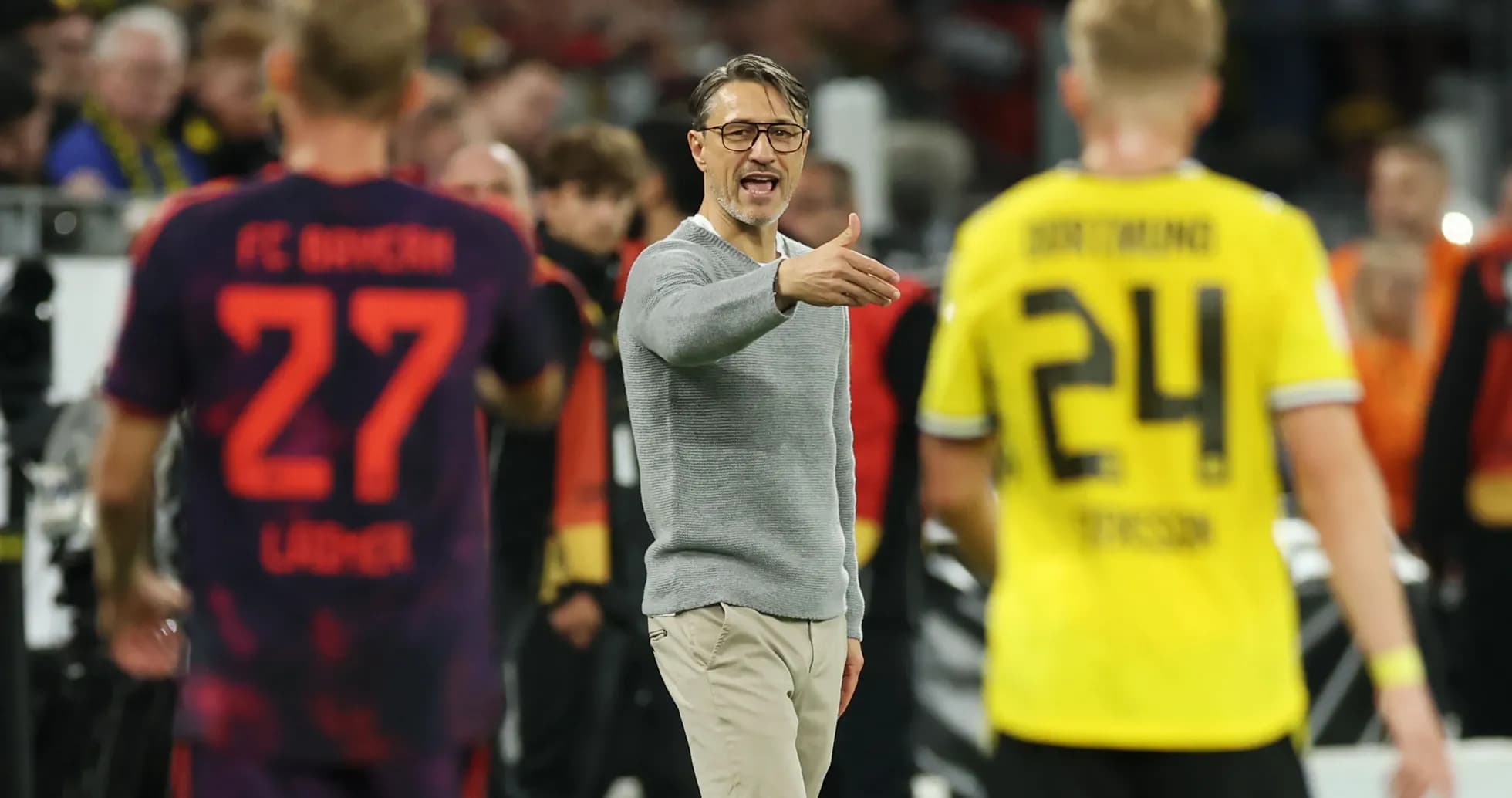
Niko Kovac is still tinkering with his Dortmund. Against Bayern, his most eye-catching adjustment came on the flanks.
Left-footed Daniel Svensson started at right wing-back. Right-footed Julian Ryerson lined up on the left. It was no accident. Kovac wants his wide players to resemble modern wingers: able to cut inside, combine and shoot, not just hug the touchline and swing in crosses.
“Every now and then we always need a player out wide who occupies someone,” he explained afterwards. If left plays left and right plays right, the attack goes around the outside and the cross follows. Switch them, and the inside channel opens.
The idea had its moments. In the first half, Ryerson, drifting into the left half-space, bent a dangerous cross towards the far post with his stronger right foot. Ramy Bensebaini flicked it in with the slightest touch of his hair, but the flag went up. Offside. Promise, but no reward.
By half-time, Kovac had seen enough. He flipped them back to their natural sides.
“Because we saw that we had to change something,” he said. “And I think it also did us good.”
The second half backed him up. Dortmund pushed Bayern deeper, attacked with more conviction down both flanks and finally got behind the defence consistently. The 2-1 goal came from exactly the kind of move the first-half experiment had limited: Svensson, now on the left, surged to the byline and cut the ball back perfectly for Fabio Silva to finish.
There was another telling moment before the break that exposed the downside. Bensebaini drilled a low ball in from the left. Svensson, arriving centrally from the right, found himself set up to use his weaker right foot. The chance was there; the technique wasn’t. He swung at air. In that exact pocket, a right-footer like Ryerson would likely have hit the target.
Kovac’s tweak gave Dortmund variety and unpredictability. It also dulled their natural strengths out wide. He has found an intriguing option for certain games, but the Supercup showed it comes with a clear cost.
Fabio Silva’s reminder – and Dortmund’s dilemma
Serhou Guirassy’s summer has gone quiet. The transfer noise has faded, and for now he looks set to stay at Dortmund. His Supercup, though, looked a lot like his more frustrating nights last season.
He ran, he pressed, he battled. He rarely threatened.
Bayern’s control and BVB’s slow build-up left Guirassy largely starved of service. No real chances, no defining moment. After a little more than an hour, Kovac turned to Fabio Silva in search of sharper movement and more penalty-box menace.
Silva delivered.
For the goal that dragged Dortmund back into the game at 2-1, he dropped off cleverly, found the right pocket, then attacked the cut-back with conviction. One touch, ruthless finish from close range. It was the kind of instinctive, penalty-area strike that had flashed through his first year in Dortmund without ever fully taking hold.
Those few minutes may have changed the conversation. Silva looked lively, aggressive and confident – exactly the traits BVB have been waiting to see consistently.
The complication sits off the pitch. Several clubs are tracking the 24-year-old, with Betis Sevilla recently viewed as the most serious suitor. Silva himself is reportedly open to a move, and Dortmund’s hierarchy would consider selling just a year after his arrival if the right offer landed.
His cameo against Bayern muddies that logic. With the summer window entering its final stretch, can BVB really afford to lose a forward who just made such a pointed case for more minutes? And if they do cash in, who arrives quickly enough – and good enough – to replace that spark?