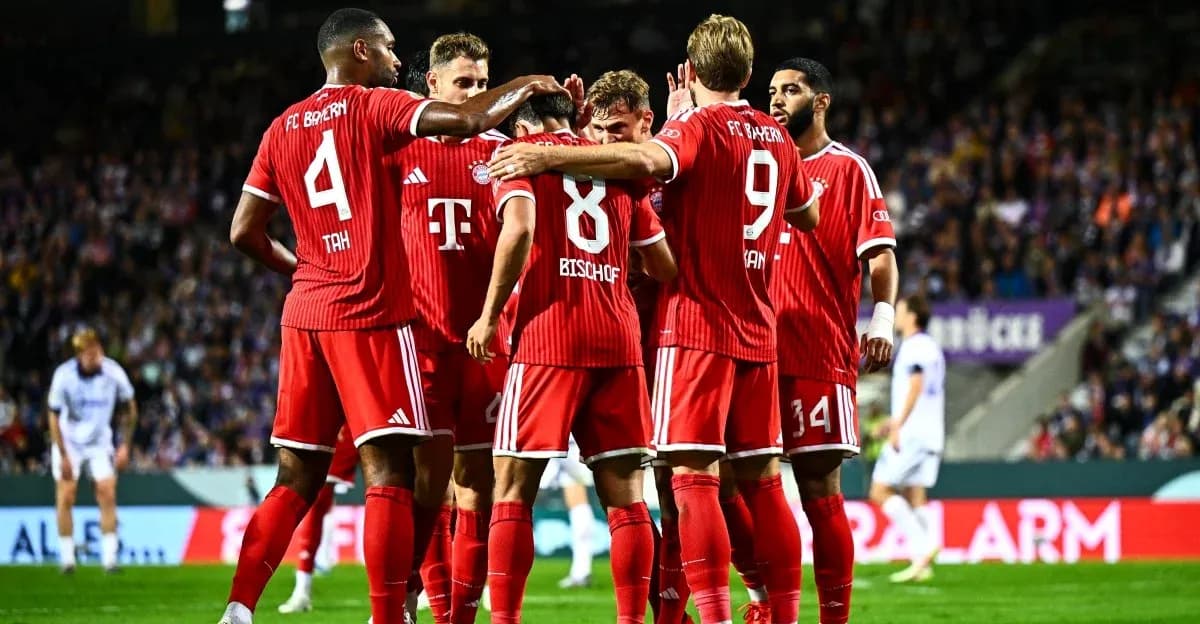
Bayern Munich Dominates VfL Osnabrück in DFB-Pokal Clash
Bayern Munich needed less than an hour to turn a tricky DFB-Pokal trip into routine business, swatting aside VfL Osnabrück 4-1 on a night that mixed chaos, control, and long stretches of lethargy.
It was one of those games: the scoreline clear, the performance anything but.
Strong XI, little mercy
There was no experimental cup lineup, no charity for lower-league opposition. Bayern travelled with a serious team and only light rotation.
Kim Min-jae started ahead of Dayot Upamecano, Josip Stanišić came in for Konrad Laimer, and Nathaniel Brown got the nod over Alphonso Davies at left-back. Tom Bischof, once the bright hope at Hoffenheim, was trusted from the off instead of Aleksandar Pavlović — and he made that decision look very smart.
No shocks. Just a clear message: Bayern were here to end this early.
Osnabrück, though, had other ideas.
A wild start and a shock punch
Five minutes in, the cup cliché wrote itself.
Jonathan Tah and Kim switched off, Tah slipped, Jonas Urbig’s positioning went all-in, and Robin Meißner unleashed an outrageous strike. The ball flew in, Osnabrück were 1-0 up, and the stadium erupted. It was a defensive car crash from Bayern, finished with a banger.
Crazy, crazy stuff. And for a moment, it felt like the Pokal might be sharpening its knife.
Bayern, though, didn’t flinch. They pinned Osnabrück back, kept the ball, and squeezed the game into one half. The hosts refused to roll over and made every channel tight, every passing lane awkward. The home crowd fed off it, noise surging with every challenge, every half-break. The tifo in the stands matched the energy: big, bold, defiant.
Ismael Saibari struggled to match that rhythm. He buzzed around with intent, showed aggression and ideas, but the execution lagged. Passes went astray, movements didn’t quite sync. It looked like a player still figuring out where he fit in this particular Bayern attack.
Kane levels, Bischof pounces
Pressure eventually snapped the game open.
In the 18th minute, Joshua Kimmich lifted a clever ball toward Harry Kane, who made a straight run into the box. The Osnabrück defender could only loop his header into the air. Kane waited, watched, and absolutely buried the dropping ball with a volley. Clinical. 1-1, and Bayern were back on script.
Five minutes later, they flipped the game completely.
Michael Olise, drifting into space, threaded a gorgeous pass into Luis Díaz. His effort was saved by Jonas Krumrey, but the rebound fell to Bischof, who arrived with perfect timing and slammed it home for 2-1.
From there, Bischof became a problem Osnabrück couldn’t solve. He ran, chased, pressed, and linked play. His work rate was relentless, his movement sharp. For a young player fighting for minutes, it was exactly the kind of performance you want your coach to remember.
At the back, things were far less convincing. Tah looked rusty, heavy in his movement, especially when forced to shift side-to-side. His partnership with Kim felt disjointed — communication off, spacing shaky, the whole backline a little too chaotic for comfort.
On the left, Brown delivered a split performance. Defensively, he was solid, disciplined, and rarely exposed. Going forward, though, he barely featured. The game didn’t flow through his flank, and when it did, he couldn’t impose himself. The much-hyped duel with Davies at left-back remains open, but this match didn’t tilt it decisively either way.
Right before the break, Krumrey produced a superb stop to deny Olise and keep Osnabrück alive at 2-1. The hosts went into halftime behind, but not beaten.
They’d earned that respect. They fought like hell. Every duel, every second ball, every chase — nothing came easy for Bayern.
Substitutions, a lull, and Olise’s moment
The second half started with the same pattern: Bayern in control, but moving at half-speed. The early-season schedule, with an English Week dropped in so soon, began to show in the legs. The tempo sagged, the urgency dipped, and the match slid toward a slow burn.
In the 62nd minute, Brown and Saibari made way for Davies and Lennart Karl. The idea was obvious: fresh legs, fresh thrust. The effect? Minimal. The game stayed flat.
Olise, though, grew into his new role. Shifted centrally as the attacking midfielder after Saibari’s withdrawal, he finally found his spotlight in the 73rd minute. He controlled a ball in tight space — with his elbow clearly involved in the process — and finished neatly to make it 3-1.
On another night, with VAR in play, that goal likely disappears from the scoreboard. Here, it stood. And with it, the contest effectively died.
The strike didn’t just kill Osnabrück’s resistance; it jolted Bayern out of their second-half stupor. The malaise that had them dragging through the half finally lifted.
Kane closes it, questions remain
By the 84th minute, Bayern were cruising. Pavlović, on as a substitute, was brought down in the box and the referee pointed to the spot. Kane stepped up, as he always does, and rolled the penalty in with total calm to make it 4-1.
No fuss. No doubt.
The final minutes drifted by, anti-climactic and slow. The job was done long before the whistle, even if the performance never quite hit the ruthless heights Bayern expect of themselves.
This won’t be remembered as a classic or a statement win. It was efficient, occasionally sloppy, occasionally sharp — the kind of early-season cup tie where cohesion is still forming and tired legs show up under the floodlights.
The upside for Bayern? They’re through. Key players produced. Bischof made a case. Olise showed his quality. Kane did what Kane does.
The downside? The Tah–Kim partnership needs work, the left-back battle remains unresolved, and the second-half energy levels hinted at a squad still adjusting to the demands of the calendar.
Next up: Schalke 04 at the weekend. The result in Osnabrück won’t define Bayern’s season.
But the way they evolve from nights like this just might.