Bradley Barcola's Journey: From Lyon Dreamer to Liverpool Star
Bradley Barcola used to talk about Liverpool when he was barely a teenager. Not about Paris, not about Madrid. Liverpool.
“As a kid, he always spoke to me about Liverpool,” recalls Amaury Barlet, one of his youth coaches at Lyon. So when the call finally came from Anfield, there was no agonising, no weighing up the market. After a £123m (€143m) agreement with Paris Saint‑Germain, Barcola himself put it simply in his first interview: he “didn’t ask any questions”.
A childhood fixation has turned into the most expensive outgoing transfer in PSG’s history and one of the boldest bets Liverpool have made on a forward since Jürgen Klopp walked through the door.
From Lyon dreamer to PSG asset
Barcola’s story does not begin in Paris. It begins at Lyon, where the academy tracks the progress of its prospects with regular interviews when they return each season. It was during one of those conversations, when Barcola was 15 or 16, that he told Barlet his dream was Liverpool.
“Maybe that changed when he was 19 or 20 ...” Barlet says. The move suggests it never really did.
His path was not the accelerated, prodigy‑in‑neon‑lights route that modern academies sometimes favour. Barcola did not leapfrog age groups. He made his Lyon first‑team debut at 19, a late arrival compared with someone like Rayan Cherki, who broke through at 16.
“He wasn’t small, but he was ... very fresh,” Barlet remembers. “He was very thin. He hadn’t yet grown. At under‑16s, he played the whole year with us, apart from a couple of games with the under‑17s at international level in April-May. He was someone we were waiting to develop on an athletic level.”
Once that physical growth came, everything sped up. Barcola debuted for Lyon midway through the 2021‑22 season and needed only one full campaign to persuade PSG to spend €45m on him. A slow burn, then a sudden ignition.
A late bloomer in a family of late bloomers
The family blueprint helped. His older brother Malcolm, now 27, is a professional goalkeeper with Ittihad Tanger in Morocco. He also came through Lyon, without making a first‑team appearance, and blossomed later than most. By today’s standards, the same description fits Bradley.
“He’s got good people around him,” Barlet says. “His parents always said the same things as us, the coaches ... I know his family. He has the perfect entourage to come through at an academy.”
That support structure shaped his character. Loyal, competitive, emotional without being destructive.
“When he was young, he had tears in his eyes; he was annoyed when he lost, but he wouldn’t criticise his team-mates,” Barlet says. “He was more annoyed with himself because he is a real competitor.”
He calls Barcola “the ideal team-mate” and “endearing”. Those traits carried through his Lyon youth days, where he formed close bonds with Castello Lukeba, now at RB Leipzig, and Billy Koumetio, who passed briefly through Liverpool and is now at Charlton.
Not always a winger, always a threat
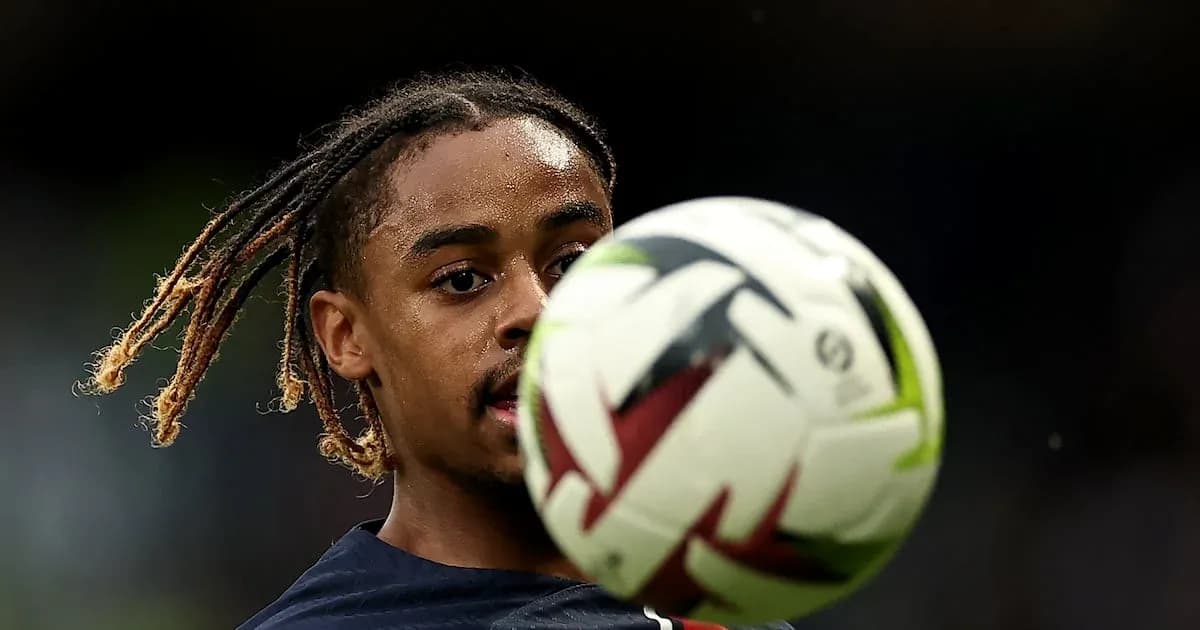
The Liverpool version of Barcola will be sold as a winger, a dribbler, a player who lives in the spaces full-backs fear. That is not how he started.
“He was a bit of a fox in the box; he scored a lot of goals,” Barlet says. “He scored acrobatic volleys, toe-pokes, left foot, right foot ... it was just his heading that wasn’t necessarily his strong suit.”
His late physical development shaped the way he played. Facing stronger defenders, he tried to beat them with timing and movement rather than wrestling them.
“Because he was playing against defenders that were stronger than him, he always wanted to get ahead of them,” Barlet explains. “He was very often offside ... he is always someone who has had a habit of making a lot of runs in behind the defence.”
That instinct never left him. It just moved wider, then higher, as he evolved into a modern wide forward.
PSG: big stage, bigger competition
By the time PSG came, Barcola was ready for the step up. In Paris he found a dressing room stacked with stars and a manager, Luis Enrique, who trusted him enough to start him in every Champions League game up to and including the last‑16 second leg against Chelsea last season.
Then the hierarchy shifted. Khvicha Kvaratskhelia arrived in January 2025. Barcola, already fighting for space in a frontline full of world‑class talent, suddenly had another obstacle. Luis Enrique’s decision to start the Georgian in his place was hard to argue with, and Barcola’s versatility – or lack of it – became a problem. He is not as effective on the right or through the middle, and the biggest fixtures began to pass him by.
He still reached the last two Champions League finals with PSG, but only from the bench. For a player whose ceiling looks higher than “impact substitute”, that was never going to satisfy.
What he did have was proof he could perform when the stage was at its brightest. Half of his goals for France – three of six – came at the most recent World Cup in North America. His club numbers backed that up. His most prolific season, 2024‑25, brought 21 goals and 21 assists.
Even that output did not shield him from criticism. A wasteful display against Newcastle in the Champions League in November 2023 prompted a French pundit to call him a “little lamb”. Barcola’s response was to shut out the noise.
“I didn’t know what was being said about me, but I knew that there would be criticism,” he told Le Parisien. “I don’t pay any attention to it, whether what they say is good or bad.”
He listens to a different circle.
“I don’t have many friends. I have very few, in fact, so when they say, ‘You’re doing something stupid,’ it is because they’re right, and if they say that I played well, it’s also because it’s true. I don’t listen to what is said on the outside. To be completely honest, it’s my friends who send me the things [being said] in the media. Sometimes we laugh about it, but it doesn’t go any further than that.”
Record sale, clean exit
By this summer, a move had become a priority. Barcola’s PSG contract ran until 2028, but his role had shrunk. He was too valuable – financially and in pure talent – to be a bit-part player.
The timing suited everyone. His World Cup performances and strong club form helped PSG secure a near €100m profit on the €45m they paid Lyon. The Liverpool deal made him PSG’s most expensive departure, surpassing the €90m received from Al‑Hilal for Neymar, and fed into a remarkable window in which the French champions generated about €350m in player sales, a Ligue 1 record.
Inside the dressing room he was well liked. The flood of farewell messages from team‑mates underlined his popularity. At club level there was no bitterness either. He wanted Liverpool, but he did not force the issue. Even his absence from early-season matchday squads was, it is understood, a protective measure by PSG rather than a punishment.
He leaves Paris with goodwill, money in the club’s accounts and a chance to finally be the main man somewhere else.
Liverpool’s missing piece?
That “somewhere else” is Anfield, and the context is stark. Andoni Iraola has endured a middling start as Liverpool manager. Performances have lacked the cutting edge that defined the Klopp era, particularly against low blocks. The team have struggled to prise open compact defences, and the crowd has felt that frustration.
Barcola arrives as a possible answer to that problem and to the new reality of the Premier League. Luis Enrique called him “one of the best dribblers in Europe”. The league is tilting ever more towards rapid, ruthless exploitation of space in transition, and Barcola thrives exactly there, driving into gaps, attacking backpedalling defenders, turning broken play into chances.
Liverpool, recently, have lacked that type of specialist. They now have one.
The price tag and the state of the team raise the stakes. A £123m signing is never just another forward, especially not at a club where the attacking line has defined the era. Iraola has made his expectations plain: he wants his wingers to be “game-changers”.
Barcola has spent years waiting for that kind of responsibility, squeezed between established stars at PSG, nudged to the bench when another big name arrived. At Liverpool, the stage is his. The question now is not whether he dreamt of this move as a teenager in Lyon. It is how quickly he can turn that dream into the reality of a new Anfield hero.