Canada's Historic 6-0 Victory Over Qatar in World Cup
Canada did not just win a World Cup match on Thursday night. It tore up a few pages of its own sporting identity.
What many fans would have gladly accepted as a steady, confidence-building victory over Qatar turned into a 6-0 demolition in Vancouver, the country’s first-ever men’s World Cup win and a statement that echoed far beyond the Pacific coast. For a nation long defined by frozen rinks and slapshots, this felt different. This felt like football.
A city drenched in red
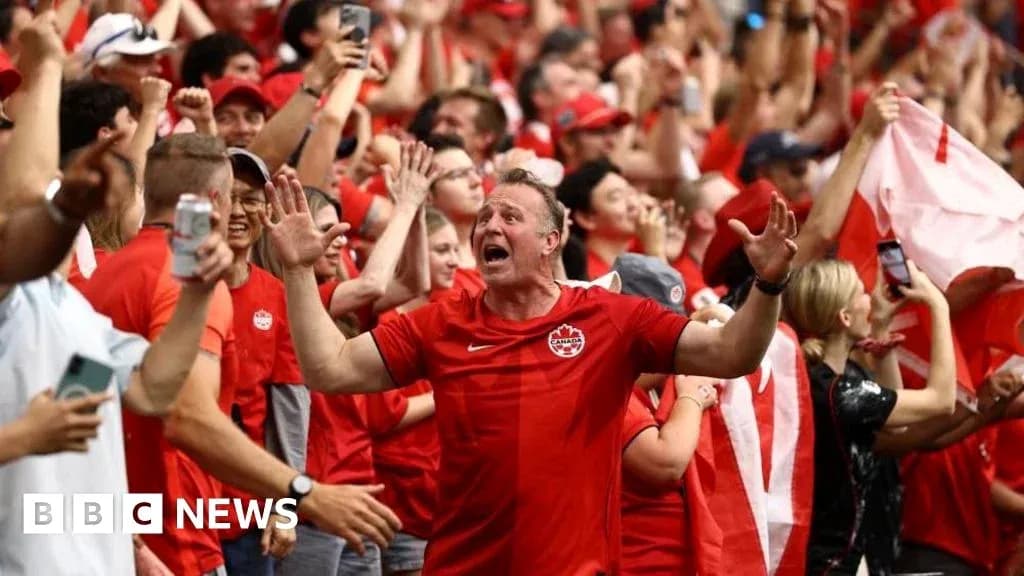
The day started like a festival. Hours before kick-off, thousands of supporters marched the “last mile” to the stadium through a haze of red smoke flares, a river of shirts, scarves and flags flowing toward a sold-out crowd of 52,000. Inside, the stands were a sea of red and white, a home crowd that did not just show up — it roared.
Across the country, the scenes matched the stakes. Granville Street in downtown Vancouver turned into an open-air fan zone. In Toronto, small neighbourhood bars packed out with people who once might have only glanced at a Canada men’s game. Now they leaned on tables, stared at screens, and lived every touch.
In one of those bars sat Dave Di Cola, a longtime believer in Canadian football, surrounded by dozens of fellow supporters. He went in with “reserved optimism,” well aware of how often hope has outpaced reality in this sport. Ninety minutes later, he had watched his national team dismantle Qatar.
Goals, red cards, and a rout
The match barely gave fans time to settle their nerves. Canada struck three times before half-time, ripping through a Qatari side that lost its composure and then its numbers, finishing with nine men after two red cards. By the closing whistle, the scoreline read 6-0, a blowout on the biggest stage.
For Di Cola and fans like him, the result felt like a turning point. Les Rouges, once dismissed as an afterthought in global football, suddenly looked like a serious contender in this tournament.
“Canada soccer has always been kind of a joke. It’s always secondary,” he said. Watching the outpouring of support in Vancouver and beyond, he admitted it “nearly brought a tear” to his eye.
Social media filled with images that captured the moment. One photograph in particular stood out: a supporter in a Connor McDavid ice hockey jersey, the “Mc” taped over and replaced with a hand-drawn “J” for Jonathan David, the hat-trick hero who scored three of Canada’s six goals. It was a neat, improvised symbol of a hockey country opening its arms to its football team.
Joy, and a brutal twist
Yet even on a historic night, Canada learned how thin the line can be between euphoria and anguish.
Midfielder Ismaël Koné, a heartbeat of this side and a driving force in the middle of the pitch, suffered a leg break that ended his tournament. The stadium’s roar turned into a hush as medics rushed on and teammates formed a protective ring around him. Qatar’s collapse on the scoreboard suddenly felt secondary.
Koné’s absence is a major blow. The Ottawa native has been central to Canada’s midfield power, and coach Jesse Marsch has spoken of him as “a big part of the heart of our team.” On Thursday, that heart took a hit.
What happened next, though, said plenty about the group Koné leaves behind. Nathan Saliba came on in his place and, not long after, hammered in Canada’s fourth goal. He celebrated by lifting Koné’s jersey to the sky, a simple, raw tribute that cut through the chaos of a 6-0 win.
By Friday morning, Koné had undergone surgery and sent his own message back to the squad. “What you guys did yesterday will stay with me forever,” he wrote on Instagram, turning his personal setback into another thread in the team’s story.
A nation watching — and believing
The performance did not just grip fans and pundits. It reached the very top of Canadian public life. In the post-match locker room, Prime Minister Mark Carney addressed the players, praising the way they had responded to the shock of Koné’s injury. He spoke of “a level of character that some people never achieve,” and he reminded them that the country — and much of the world — had been watching.
If they had not seen it live, he said, they would be catching the highlights the next day. In other words: this is no longer a niche interest. This is front-page stuff.
Canada’s sporting scrapbook is already stacked with iconic snapshots: Sidney Crosby’s golden goal at the 2010 Vancouver Olympics, the Toronto Raptors toppling the Golden State Warriors in 2019, the women’s football team climbing to the top of the podium at the Tokyo Games in 2020. Compared with those towering achievements, Di Cola is the first to admit that one group-stage win over Qatar is smaller in scale. The men’s team, he insists, still has “a long way to go.”
He is right. One night does not erase decades of underachievement or instantly place Canada among football’s elite. But momentum matters in sport, and right now it is rolling in one direction.
A sold-out stadium. A 6-0 scoreline. A hat-trick from Jonathan David. A team that lost a key midfielder and answered with resolve instead of panic. A country that once shrugged at men’s football now marching, singing, and rebranding hockey jerseys in its honour.
Next up is Switzerland, a far sterner test and a truer measure of where this Canadian side really stands. The question now is not whether Canada belongs at this level.
It is how far this newly minted “soccer nation” can ride this surge.