Celebrations in Mexico City after World Cup Opening Win
The signs were there the night before a ball was even kicked.
A late scramble for green shirts at makeshift stalls along the footpaths. Car boots flung open, hangers rattling, vendors yelling prices over the traffic. A city suddenly dressed in Mexico jerseys, almost all of them bought in a rush of nervous belief.
Down at El Ángel de la Independencia, belief turned into something louder. Hundreds gathered around the monument, draped in flags, singing, dancing, climbing on ledges for a better view of the impromptu street party. Drums, whistles, fireworks. The kind of noise that bounces off buildings and lingers in the air.
Car horns joined in, a rolling soundtrack that did not stop when midnight came and went. If this was the eve of Mexico’s opening World Cup match, the sequel was always likely to be wilder.
Beer showers on Paseo de la Reforma
The players delivered their part first. A 2-0 win over South Africa in the tournament’s curtain-raiser, the World Cup shared across Mexico, Canada, and the USA, set the tone on the pitch.
The streets took it from there.
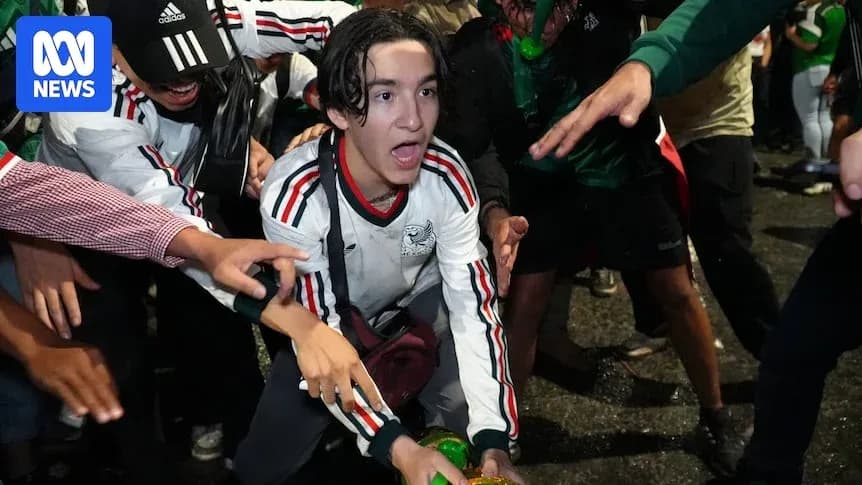
Paseo de la Reforma, usually a grand artery for the city’s traffic, morphed into a pedestrian-only carnival. A World Cup fever dream stretched across the asphalt. Fans surged down the boulevard, voices hoarse, flags tied as capes, phones held high to capture proof that they were there.
Beer flew. Plastic cups arced through the air, drenching strangers who did not mind in the slightest. Fake snow sprayed over heads and shoulders, conga lines snaked between traffic lights, and plastic World Cup trophies were hoisted with the seriousness of the real thing.
Food stalls did brisk business, the smell of grilled meat and tortillas wrapping itself around the celebrations. Street snacks, souvenirs, glow sticks flashing in neon green and white. A free concert blared from a stage, the music folding into the chants of “Mé-xi-co, Mé-xi-co” that rolled up and down the boulevard.
For an outsider, it might look like an extraordinary outpouring for a group-stage win. For Mexico, this is simply how it’s done. Any major victory by the men’s national team ends the same way: a pilgrimage to the city’s victory monument, their own version of Fed Square, perched on a hectic roundabout and built for exactly this kind of communal release.
They arrive in waves and, crucially, they stay. Mexico City parties with a stamina few can match.
Roars, cramps, and a 17-year-old’s welcome
The energy had been simmering long before kick-off.
Outside the stadium, traditional performers worked the crowd, dancers and musicians in full costume pulling fans into the spectacle. Inside, 80,000 people cranked the noise up several notches.
They sang along to the opening ceremony, with the crowd particularly locked in when Shakira appeared as the World Cup’s unofficial queen of these occasions. But that was just a warm-up. The deep, visceral roars were saved for Mexico’s goals.
Raúl Jiménez’s header, years after his comeback from a horrific head injury, detonated around the stands. It wasn’t just a goal; it felt like a collective exhale, a cathartic moment for a player and a fanbase that had held its breath for too long.
The second loudest eruption came for someone at the other end of his career. When 17-year-old Gilberto Mora stepped off the bench in the second half, the stadium reacted as if a superstar had already been confirmed, not merely promised. His name rolled around the arena, a chant in unison, a welcome usually reserved for legends or game-changers.
For many, that is exactly what he is tipped to become.
On the touchline, coach Javier Aguirre understood what all this meant. He has lived this before, as a player at the 1986 World Cup on home soil. Now, as the man in charge, he watched his squad wrestle with the same emotions.
“The start of the World Cup, is a brutal scenario, it makes your legs shake a little,” he said. “You come from the training centre to here, the people, the fans are in the street and that tells the player, ‘Wow, wow, wow.’”
The physical toll told its own story.
“Never, never in 25 matches we had one case of cramps, today we had three players with cramps,” Aguirre said. “It’s a very strong emotional state.”
His players now have to bottle that, cool it, and turn to the next group game. The supporters have no such obligation. For them, the lid is off and staying off.
“It means everything. It means a lot,” one fan said amid the celebrations. “It’s putting us back on the map. It shows that Mexico is present in the world of football.”
Infantino’s “chillax” and the bigger questions
Somewhere in all this, Gianni Infantino will have allowed himself a smile.
The FIFA president had spent the previous day bristling at criticism of his organisation in the build-up to the tournament. In a curious choice of language, he dipped into early-2000s slang and urged everyone to “chillax”.
Now the football has started, and the mood in Mexico City suggests the chill pills have been swallowed, washed down with beer and adrenaline. The party is in full swing, the soundtrack loud enough to drown out, at least temporarily, the noise around FIFA.
Infantino can breathe a little easier, for now. The scrutiny, though, is not going anywhere.
This is a football country, where the sport seeps into everyday life and an opening group win can shut down a boulevard. The same cannot be said for the other two hosts. In Canada and the United States, “soccer” still competes for space in a crowded sporting landscape.
Big games, big stars, and marquee matchups will fill the stands. That much feels safe. The real test lies elsewhere. Will high ticket prices keep fans away from the so-called off-Broadway fixtures, the matches without global icons or heavyweight nations? Will stadiums look patchy when the spotlight dims?
There is another layer in the United States. The presence of Immigration and Customs Enforcement — ICE — hovers in the background as a potential chill on the atmosphere. Will it be visible? Will it be felt? Those questions sit alongside many others that will follow this World Cup across a continent.
For now, Mexico has made its statement the way it knows best: on the pitch, in the streets, and deep into the night. The rest of the tournament has a high bar to match.