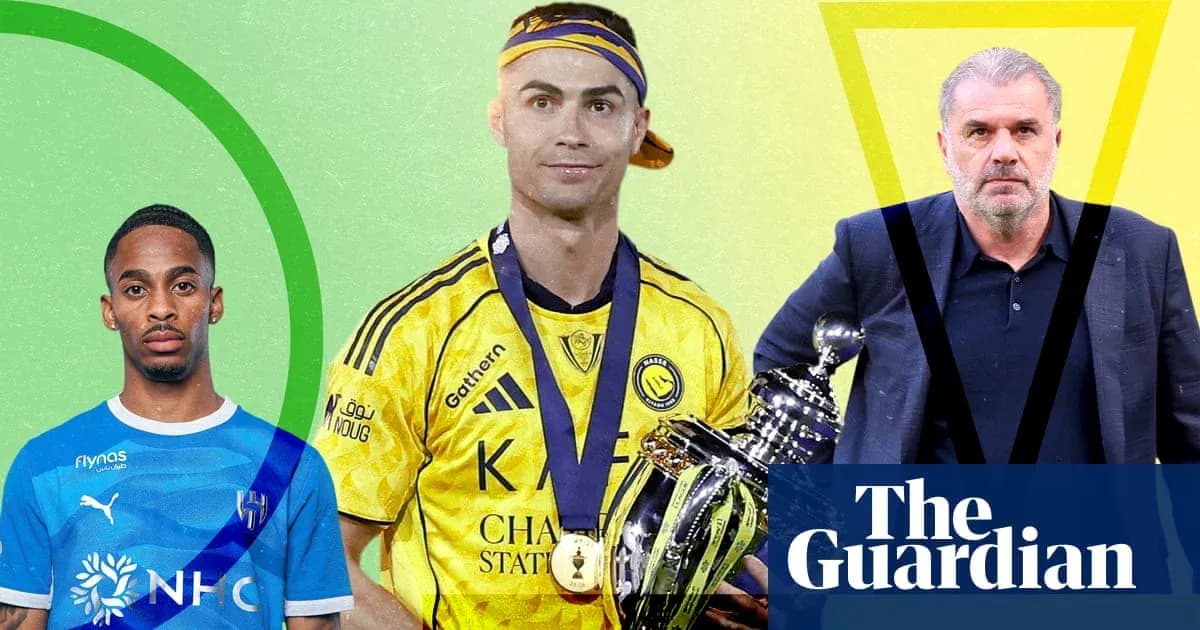
Cristiano Ronaldo's Pursuit of 1,000 Goals in Saudi Pro League
Cristiano Ronaldo is still here. Mohamed Salah is not.
The new Saudi Pro League season kicks off on Thursday without the Liverpool icon many expected to see in yellow, but with a 41-year-old chasing a number that barely seems real. Ronaldo is 24 goals short of 1,000 in his career. He already has 102 in 107 league games for Al-Nassr. On current form, that landmark is not a fantasy. It is a storyline waiting to happen before this campaign is done.
What that means for the league, though, is a little less clear.
From spending spree to soul-searching
This is year four of the great Saudi experiment. Since the $957m (£710m) splurge of the summer of 2023, the league has generated thousands of headlines, a raft of international broadcast deals and a global wave of kids in CR7 Al‑Nassr shirts.
The circus arrived. The question now is what it leaves behind.
Officials want more than clicks and shirt sales. They want a stronger domestic game, a national team that reflects the money poured into the clubs, and a league that produces players rather than simply imports them.
The recent World Cup brought that argument into sharp focus. Saudi Arabia went out early, prompting criticism at home, though draws with Uruguay and an impressive Cape Verde, plus a narrow defeat to eventual champions Spain, softened the picture later. The core question lingered: has all this investment actually improved Saudi players?
So far, the answer is harsh. The league does not export talent. Of the 26-man World Cup squad, only right-back Saud Abdulhamid, now at Lens, plays abroad. Everyone else stays home. Many do not even play enough.
Foreign stars block pathways in the glamour positions: creators, goalscorers, goalkeepers. The clubs are better, as recent success in Asian competitions shows, but the national team has yet to feel any real lift. The tension between short-term star power and long-term development is growing.
Salah stays away, strategy shifts
That is the backdrop to the Salah saga that never really was. Many expected the Egyptian to pick the Red Sea over the Black Sea and join the project rather than head to Trabzonspor. The appetite to push that deal over the line, though, has cooled in recent months, even before he chose Turkey.
Salah, at 34, remains the biggest name in Arab football. He would have been a marketing dream. But he does not fit the evolving model. The league now wants players who can still be flipped back to Europe for serious money.
Crysencio Summerville is the clearest example. The Dutch winger, 24, has become the headline signing of the summer, joining Al-Hilal for around €80m (£68m). The plan is simple: shine in Riyadh, win trophies, then one day return to Europe for another hefty fee. Ambition, for once, is not a one-way street.
Critics accuse Summerville of choosing money over ambition. They have not been paying attention to Al-Hilal’s history. Nineteen league titles. Four Asian crowns. An undefeated league campaign last season that still ended in second place. At this club, ambition is the bare minimum.
The Blues, sold by the Public Investment Fund in April, still boast Karim Benzema, Rúben Neves, Theo Hernández, Yassine Bounou, Kalidou Koulibaly and a supporting cast most European coaches would envy. Simone Inzaghi walks into a pressure cooker. Anything less than wrenching the title back from the yellow half of Riyadh will be framed as failure.
Ronaldo’s hunt and Postecoglou’s puzzle
Al-Nassr, of course, are the team to beat. Ronaldo lifted the trophy in May, then watched Jorge Jesus depart soon after to take charge of Portugal. In came Ange Postecoglou, the former Tottenham Hotspur manager, to inherit both the crown and the circus.
Postecoglou does not arrive empty-handed. Sadio Mané, Kingsley Coman and João Félix give him a frontline that can shred any defence in Asia. The problem lies elsewhere. Financial constraints have slowed recruitment, leaving gaps in a squad that must now defend a domestic title and chase the one prize that still eludes the club: a first Asian Champions League crown.
That, as much as Ronaldo’s march towards 1,000 goals, will define Al‑Nassr’s season. The Portuguese forward can still dominate a campaign by sheer force of personality and finishing. The club needs more than that. It needs continental validation.
Al-Ahli rocked, Al-Ittihad reset
The current Asian champions are Al-Ahli. Back-to-back continental titles have shifted their focus this year. The Jeddah club want to translate regional dominance into a second Saudi league title, their first since 1984. The plan looked settled. Then the coach walked.
Just days before the season opener, Matthias Jaissle left for Newcastle. On paper, the move makes sense: the Greens and the Magpies share PIF ownership. In Jeddah, the reaction was furious. Supporters felt raided, not aligned.
Marino Pusic, formerly Arne Slot’s assistant, steps into the void. It is not an appointment that sets pulses racing. He inherits a team built to win now, but with a fanbase already feeling bruised before a ball has been kicked.
Across the city, Al-Ittihad are still trying to climb out of last season’s wreckage. They, too, turned to a young German coach with RB Salzburg on his CV and a playing career cut short by injury. Jens Wissing, 38, faces a huge rebuild.
The timing of Jaissle’s departure only sharpened the glare on Ittihad. A day or so earlier, they thought they had mirrored their rivals’ approach. Suddenly, their “new idea” looked like the consolation prize. Wissing must now restore belief at a club that has forgotten how to match its own expectations.
A new “big five” and an old dilemma
Al-Qadsiah complete the emerging power bloc. Backed by Aramco and guided by Brendan Rodgers, they finished fourth last season. Improvement on that, plus a first trophy since 1984, would mark serious progress and confirm their status among the league’s elite.
That is the reality now. Saudi Arabia has a genuine “big five”: Al-Nassr, Al-Hilal, Al-Ahli, Al-Ittihad and Al-Qadsiah. Their resources and ambitions raise the bar for everyone else, but they also risk deepening the problem that started this whole debate.
If the league continues to lean on imported stars in the key roles, where do the next generation of Saudis find space to grow? The answer may shape the next decade far more than any single transfer.
For all the noise around Salah and the obsession with Ronaldo’s looming 1,000, the real test for the Saudi Pro League begins in quieter moments: team sheets, substitution boards, academy minutes. Does the money keep buying ready-made heroes in their mid-30s? Or does it finally start buying time and trust for the players who might one day carry Saudi football on their own?