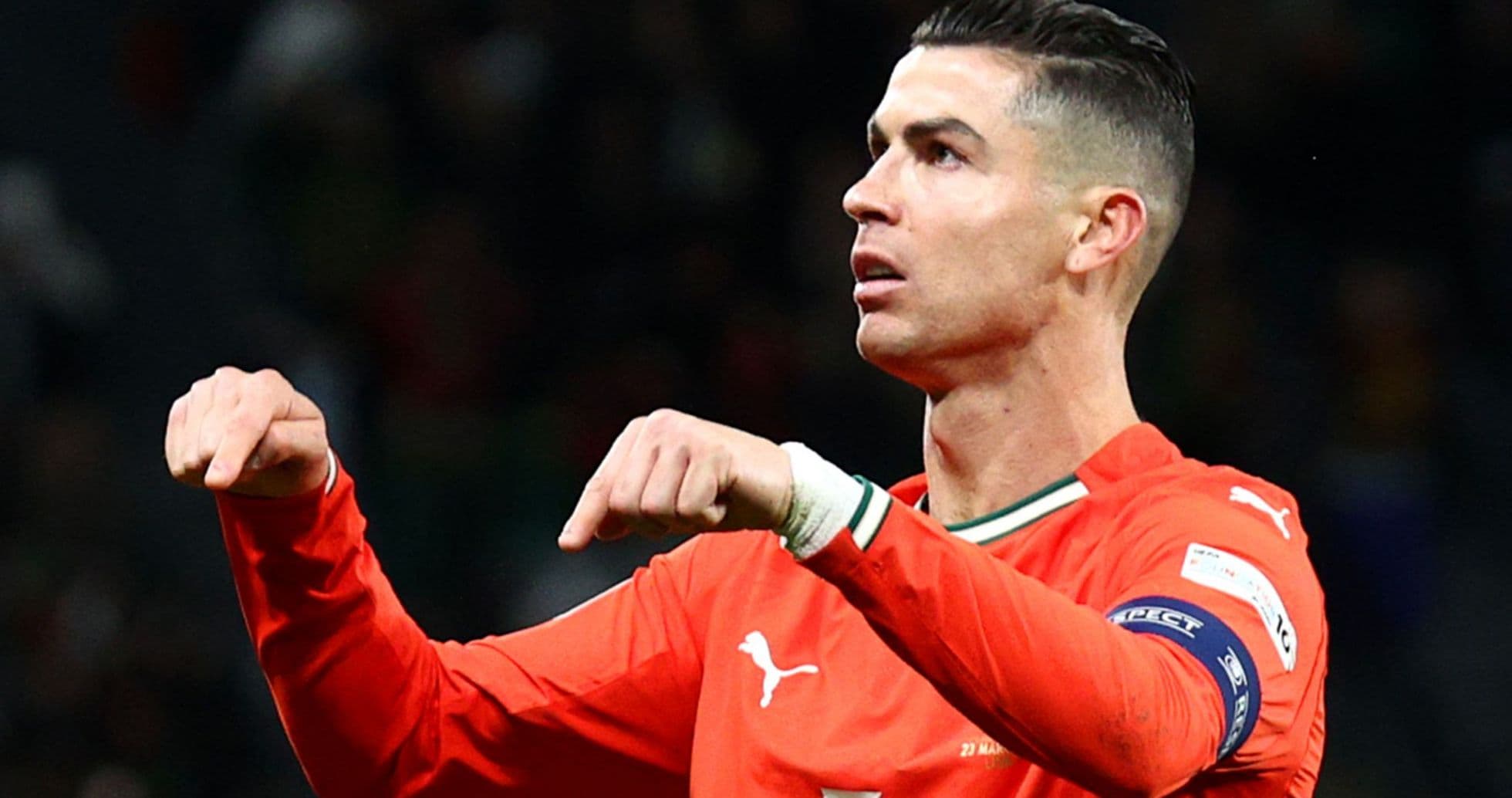
Cristiano Ronaldo: The Possibility of a World Cup Return at 41
Cristiano Ronaldo has spent two decades tearing up football’s timelines. Now, as he stares down the prospect of a World Cup at 41, the people who know him best are starting to wonder whether he might just bend the clock one more time.
Rene Meulensteen, Sir Alex Ferguson’s long-time assistant at Manchester United and a man who watched Ronaldo’s transformation at Old Trafford from promising winger to global phenomenon, believes the Portuguese icon still has room for one last grand act.
“He's 41, but obviously he's biologically probably early thirties,” Meulensteen told GOAL, speaking via Best Betting Bonuses. Strip away the science-speak and the message is simple: Ronaldo has built a body and mindset to outlast almost everyone.
This is not blind nostalgia. It’s the assessment of a coach who saw, up close, the relentlessness that turned raw talent into a Ballon d’Or machine. Meulensteen framed it in one neat line: “It's a bit of a case where the mind goes, the rest will follow.” If the hunger remains, the legs, he suggests, will do as they’re told.
The idea of Ronaldo gracing the 2026 World Cup feels outlandish on paper. By then, he would be operating in his fifth edition of the tournament, potentially as its oldest player. Yet the thought clearly lingers in his orbit. The tournament will be co-hosted by Portugal, Spain and Morocco. For a man who has always craved the biggest stages, that is not just a detail. It’s a temptation.
Meulensteen even pointed to a more personal motivation. Ronaldo’s son has already appeared on a team sheet at Al-Nassr, a small but symbolic step. “That might be one of the challenges that he still wants to do, to play with him, that would be unique,” Meulensteen said. The idea of a father and son sharing a professional pitch is the kind of storyline that would appeal to Ronaldo’s sense of legacy as much as his competitive instinct.
The equation, though, is brutally simple: stay fit, stay sharp, stay relevant. “If he stays injury free and he keeps fresh,” Meulensteen argued, the World Cup remains a realistic target. The question is whether his body can keep matching his will as the years pile up.
Nuno Gomes, Ronaldo’s former Portugal team-mate and a veteran of major tournaments himself, sees the same blend of possibility and uncertainty. Speaking to talkSPORT, he admitted that only Ronaldo truly knows how far he wants to push this. “I think only him, or maybe not even him, knows the answer because I think he is doing year by year at this age.”
Year by year. Season by season. It’s a far cry from the days when Ronaldo’s future was mapped out in long contracts and sweeping predictions. Yet even in this late-career phase, the fundamentals haven’t changed. “He's still fit to play,” Gomes insisted. “He's a really professional player and one of the players that we can point him as an example to follow for the young generations.”
The admiration is genuine, but so is the realism. The burst that once shredded full-backs has inevitably dimmed. “Of course he has his age and his capacity is reduced in some qualities, in speed for example. He's not the same Cristiano when he was 18 or 20,” Gomes said. That Ronaldo has gone. The version that remains is something different: a penalty-box predator, a specialist in the game’s most valuable currency.
“He's still capable to score goals,” Gomes pointed out, “and in football, it's the most important thing.” As long as the ball keeps hitting the net, the argument for retirement weakens. Coaches tolerate less running, fewer sprints, and a narrower role if the trade-off is a guarantee of goals.
That brings Roberto Martinez into the frame. The Portugal manager holds the tactical key to Ronaldo’s World Cup dream. “It also depends on the coach,” Gomes stressed. “Right now we have Roberto Martinez and I think he adapts the team, having him in the first 11 or not.” In other words, Portugal can still build around Ronaldo – or they can begin to move past him – but it will be a conscious, strategic choice.
Ronaldo’s own will remains the decisive factor. Does he still want to grind through every training session, every flight, every qualifier, just to stand in a World Cup line-up at 41? “I think it will depend on his will, to play more or not,” Gomes said. That internal debate may already be underway.
The emotional pull of 2026 is obvious. A World Cup partially on Portuguese soil, a chance to say goodbye in front of home fans, a final chapter written on familiar turf. Gomes leans towards that scenario. “Probably I could tell that it could be his last World Cup,” he admitted. And then came the twist that will nag at Portuguese supporters over the next few years: “Even though we know that in four years we are hosting some games. And maybe it could be an opportunity to say goodbye at home.”
Ronaldo has built a career on refusing to accept limits set by others. Age is the last and most stubborn of those limits. The stage is there in 2026, in Portugal, Spain and Morocco. The body, for now, still responds. The goals still come. The decision, as always with him, will be his.