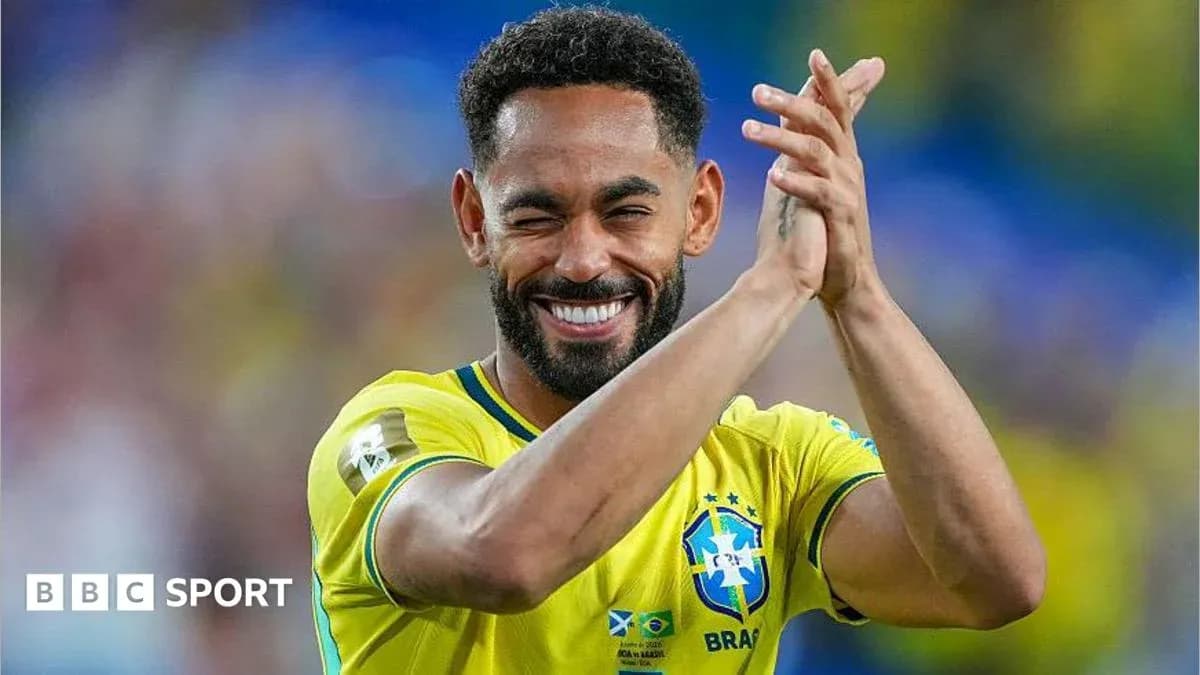
Cunha: The New Face of Brazil’s Attack at the World Cup
Brazil’s World Cup machine is finally starting to purr – and, crucially, so is its centre-forward.
Carlo Ancelotti appears to have settled on his best XI, the pieces clicking into place with each step through the group stage. Performances have sharpened, confidence has swelled, and Brazil head into the last 32 with momentum and a clear identity.
Japan will test all of that. They will move the ball quickly, they will ask questions. But Brazil arrive with answers they did not have a few weeks ago, and one of them wears the No 9 in a way the country is still learning to understand.
Cunha, the “nine-and-a-half” changing Brazil’s attack
For decades, Brazil’s idea of a centre-forward has been almost sacred. Ronaldo. Adriano. Romario. The role has usually belonged to a pure finisher, a penalty-box predator who lives off service and buries chances.
Matheus Cunha is something else entirely.
He has three goals at this World Cup, so he is no false nine masquerading as a striker. Yet he is not a classic playmaker either. Cunha operates in that in-between space – a “nine-and-a-half” – and that nuance is quietly reshaping this Brazil.
He drops off the line. He links play. He creates. He presses. He turns what used to be a fixed reference point into a moving problem for defenders.
Cunha’s movement constantly forces a decision. If his marker follows him into midfield, space opens for Vinicius Jr on one flank and Rayan on the other. If the defender holds the line, Cunha has time to receive between the lines, turn, slide passes through or shoot himself.
The effect is familiar to anyone who watched Roberto Firmino at Liverpool. Cunha’s willingness to drop deep and his work without the ball echo that style: a forward who unsettles not just with goals, but with questions.
He has embraced the dirty work too. When Brazil press, he often becomes the first midfielder, almost a temporary number six, screening passes and triggering the press. That defensive graft gives the front line balance and allows the wingers to stay higher, fresher, and more dangerous when Brazil spring forward.
From uncertainty to clarity up front
Brazil arrived at this World Cup in the unusual position of not knowing who their main striker was. For a country raised on superstar No 9s, that uncertainty felt jarring.
Even up to the Scotland game, there was no obvious first choice. Ancelotti had rotated through Cunha, Igor Thiago, Endrick, Joao Pedro and Richarlison, searching for the right blend.
Then football’s great selector – injury – intervened.
Raphinha, brilliant but constantly roaming, started the tournament as a central option, even playing as a 10 behind Igor Thiago against Morocco and capable of drifting to either wing. When he pulled his hamstring in that match, the change that followed altered the entire dynamic of the attack.
Rayan came on and stayed wide on the right. Vinicius on the left, Rayan on the right, Cunha in the middle. Two natural touchline wingers pinning full-backs back, leaving Cunha with exactly the central pockets he craves.
Suddenly, the picture cleared. Brazil’s front three made sense.
That does not close the door on others. Igor Thiago, for instance, offers a more traditional focal point – ideal when Brazil need a physical presence to pin centre-halves and occupy the box. Ancelotti now has genuine alternatives, not just names on a list.
But back home, opinion is shifting. With each game, more Brazilians are starting to believe Cunha is the answer. Opponents know his name now, they have seen his movements on tape, yet his intelligence makes him a difficult puzzle to solve even when you know what is coming.
Ancelotti’s Brazil: control without obsession
Strip away the noise and one theme keeps surfacing: this team bears the imprint of its coach.
Carlo Ancelotti’s reputation often starts with his man-management – the calm authority, the ability to handle big egos. What can get lost in that narrative is his tactical edge, his willingness to bend a system to the game in front of him rather than cling to a rigid idea of how his team must play.
This Brazil side does not chase sterile domination. They are not obsessed with 70% possession and endless passing sequences. They are comfortable without the ball, because they believe they can control the game in other ways.
Against Scotland, that plan was clear. Brazil allowed Scotland to have the ball, but they dictated where it went. They shepherded play into traps, set the lines, and then pounced with intensity at the chosen moment.
The first goal came from that approach. So did the second, controversially disallowed. They were not accidents. Brazil had scored similar goals in warm-up games against Panama and Egypt, the product of rehearsed pressing triggers, not opportunism.
They did not dominate possession. They dominated the terms of engagement.
A new identity, without betraying the old one
Every tournament brings the same debate: what should Brazil be? A possession-heavy, attacking side that overwhelms opponents, or a more pragmatic, counter-punching unit?
Under Ancelotti, the answer shifts with the opposition and the moment. With players as tactically flexible as this group, he has chosen to adapt rather than impose a single blueprint.
This is still Brazil, but not as the world is used to seeing them.
The most obvious change lies at full-back. Past World Cups were defined by flying defenders – Roberto Carlos and Cafu, Maicon and Marcelo, Dani Alves – surging forward as auxiliary wingers. This time, Douglas Santos, Roger Ibanez or Danilo take a different approach. Their runs are measured, their positions more conservative.
That caution has a purpose. With the full-backs holding their line more often, Vinicius can stay higher, closer to the areas where he is lethal, rather than constantly tracking back. When Brazil break, he is ready, not recovering.
Behind that, the back four looks secure, and the midfield has finally found its balance.
Midfield solved in time for Japan
The opening game against Morocco exposed a flaw. Casemiro, now 34, stood alone at the base of midfield and paid the price. The criticism came quickly, but the problem was structural, not individual. Expecting him to cover every blade of grass, to press and tackle across the width of the pitch, never matched his game – and certainly not at this stage of his career.
Ancelotti adjusted.
Brazil shifted from a 4-2-3-1 to a 4-3-3. That change altered everything. Now, when Bruno Guimaraes steps forward to support the attack, Casemiro has Lucas Paqueta alongside him. The defensive burden spreads. The spaces that Morocco exploited narrow.
Against Haiti and Scotland, the difference showed. Brazil controlled the central zones far better, closing passing lanes and protecting the back line. That structure will be vital against Japan, a side far more fluid and incisive in attack than either of those opponents.
The numbers underline the progress. One goal conceded in three games. Seven scored. The balance between solidity and threat, long missing, has started to appear.
From anxiety to anticipation
Before a ball was kicked, the mood in Brazil was tense. The lack of a clear No 9, the tactical doubts, the memory of past disappointments – it all fed a national anxiety.
After the first game, the worry deepened. Now, three matches later, the atmosphere has flipped. The public is smiling again, drawn in by a team that looks like it is growing into the tournament rather than burning out early.
The performances are not perfect, and nobody inside the camp will pretend otherwise. Japan will stretch them. The knockout rounds will expose any weakness that remains.
But Brazil arrive there with a settled spine, a coach in control, and a centre-forward who is rewriting the job description in real time.
For a country that has always worshipped its No 9s, the real question now is simple: are they ready to embrace a “nine-and-a-half” as the man who leads them towards the biggest prize of all?