Declan Rice's Workload: A Warning for England's World Cup Hopes
Aaron Cresswell calls Declan Rice “a freak of nature”. It used to sound like a compliment. Right now, it feels more like a warning.
Since the start of the 2020-21 season, Rice has played 360 games for club and country. Three hundred and sixty. West Ham’s European runs, England’s endless tournament cycles, Arsenal’s title and Champions League pushes. Every time the stakes rose, Rice was there, shoulders squared, lungs burning, never asking out.
On Wednesday in Yokohama, he finally looked human.
A rare off-night
England beat Croatia 4-2 in a wild World Cup opener, but Rice’s 63rd game of the season told a different story. The usual certainty around him evaporated. The midfield shape sagged. The gap between Rice and Elliot Anderson yawned open, inviting Luka Modric to wander into it and start pulling strings.
Rice dropped too deep, then was dragged out of position. England’s structure buckled. Thomas Tuchel called it “some unusual ball losses”. Diplomatic, but accurate. This was not the metronome Arsenal fans have watched all year, nor the shield that has underpinned England for six straight seasons.
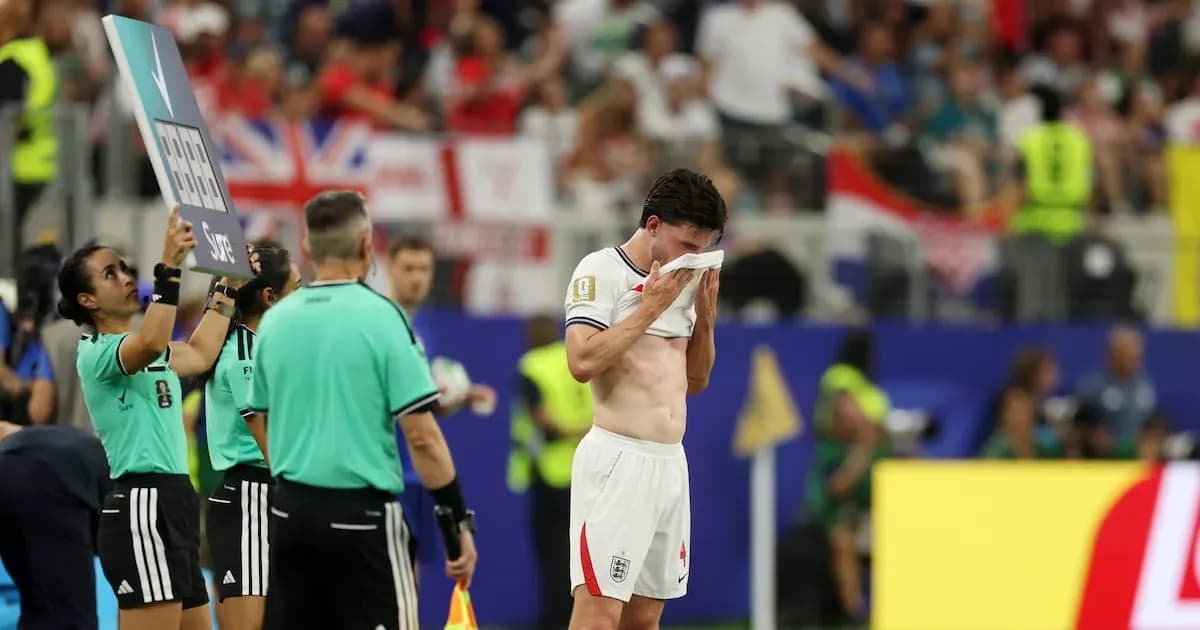
The real alarm, though, came in the 72nd minute. England were clinging to a 3-2 lead. Croatia were pushing. This is Rice territory, the moment when he usually tightens the screw and kills the game.
Instead, he walked off.
Tuchel said Rice felt discomfort in his lower back and upper hamstring. The change, he insisted, was precautionary. Rice was quick to say he will be available to face Ghana on Tuesday. On the surface, crisis averted.
But how many times can England spin that roulette wheel?
No like-for-like, no safety net
Strip this England squad back and one truth remains: there is no second Declan Rice. There is no one who does his job in the same way, at the same level.
Kobbie Mainoo is a joy on the ball, all angles and disguise, but he does not yet have Rice’s frame, his ability to dominate duels or attack set pieces. Jordan Henderson brings experience and leadership, yet at 36 he was not trusted when England wanted to maintain a high tempo against Croatia. Tuchel never even looked his way.
Tuchel’s first reaction when Rice went off was to drag Jude Bellingham back into a deeper role. For eight minutes, England flirted with disaster. Croatia poured through the middle. An equaliser felt inevitable.
That brief experiment underlined the problem: move Bellingham away from goal and you blunt your sharpest attacking weapon. Leave him high and you leave Rice’s workload untouched. Take Rice out and the entire design starts to wobble.
Then came a glimpse of something different.
Djed Spence replaced Bellingham, Reece James stepped out of right back and into midfield, and suddenly England found a measure of control.
Reece James, the unexpected pivot
If Rice’s minutes need managing, James may be the most realistic answer in the short term.
This is not a wild gamble. James has played in midfield before. He did it on loan at Wigan in 2018-19. More recently, Enzo Maresca pushed him infield at Chelsea during an 18‑month spell that reshaped the defender’s reputation. At first, there were doubts. Why move one of the league’s best right backs? The answer arrived in big games.
James excelled in the Club World Cup final last year, when Chelsea beat Paris Saint‑Germain with him operating in midfield. He then dominated Barcelona in a 3-0 win last November, partnering Moisés Caicedo, and outplayed Rice when Arsenal came to Stamford Bridge five days later.
Tuchel, who once insisted he saw James purely as a right back for England, has shifted his stance. Naming his World Cup squad, he said: “Reece James can play in the 6 because he does on a high level for Chelsea.” That line justified leaving out Adam Wharton and Alex Scott. It also revealed his hand.
James brings power, timing in the tackle and a crisp passing range. He reads danger. He can play through pressure. For a side built on flexibility, he is a key piece.
If James moves into midfield, Tuchel has cover at right back. Spence, Ezri Konsa and Jarell Quansah can all slot in. One possible configuration has Konsa tucking in almost as a third centre back alongside John Stones and Marc Guéhi, freeing Nico O’Reilly to surge forward from left back. It would give England a back line that can slide between a four and a three without a substitution.
On paper, it works. On grass, another problem lurks.
The fitness tightrope
James’s body has not always matched his talent. Hamstring injuries have stalked his career. The latest one, in March, cost him almost two months. Chelsea have had to ration his minutes, pick his games, accept that he cannot simply play through everything.
England have already lost Tino Livramento to a calf injury, Tuchel forced to call up Trevoh Chalobah in his place. A long, brutal club season has left several squad members close to the red zone. James is Tuchel’s first-choice right back, but he cannot start every game. Asking him to anchor midfield and cover the flank if Rice fades is a fantasy.
Tuchel knew this when he planned England’s World Cup build-up. The decision to fly early to Florida for a warm‑weather camp was about conditioning as much as tactics. Even then, Rice arrived late after taking Arsenal to the Champions League final. Another high-intensity night, another layer of strain on a body that rarely gets a break.
If England go all the way here and Rice never stands down, he will finish the season on 70 appearances for club and country. Seventy. That is not a schedule, it is a stress test.
At some point, something gives.
Tuchel’s looming decision
Tuchel cannot say he was not warned. The evidence is in front of him: a vice‑captain who looked leggy, a midfield that malfunctioned when he was below his usual level, and a squad built without a natural understudy.
He has versatility. He has ideas. He has James as a potential No 6, Mainoo as a technician, Henderson as a veteran, and a defensive unit that can morph mid‑game. What he does not have is another Rice.
England’s hopes of finally ending their wait for a major trophy have been built on the assumption that the “freak of nature” will keep going. The reality of modern football is pressing against that belief.
Tuchel must now decide: does he keep riding Rice until the legs say no, or does he trust his alternatives before the price of those 360 games becomes too steep to ignore?