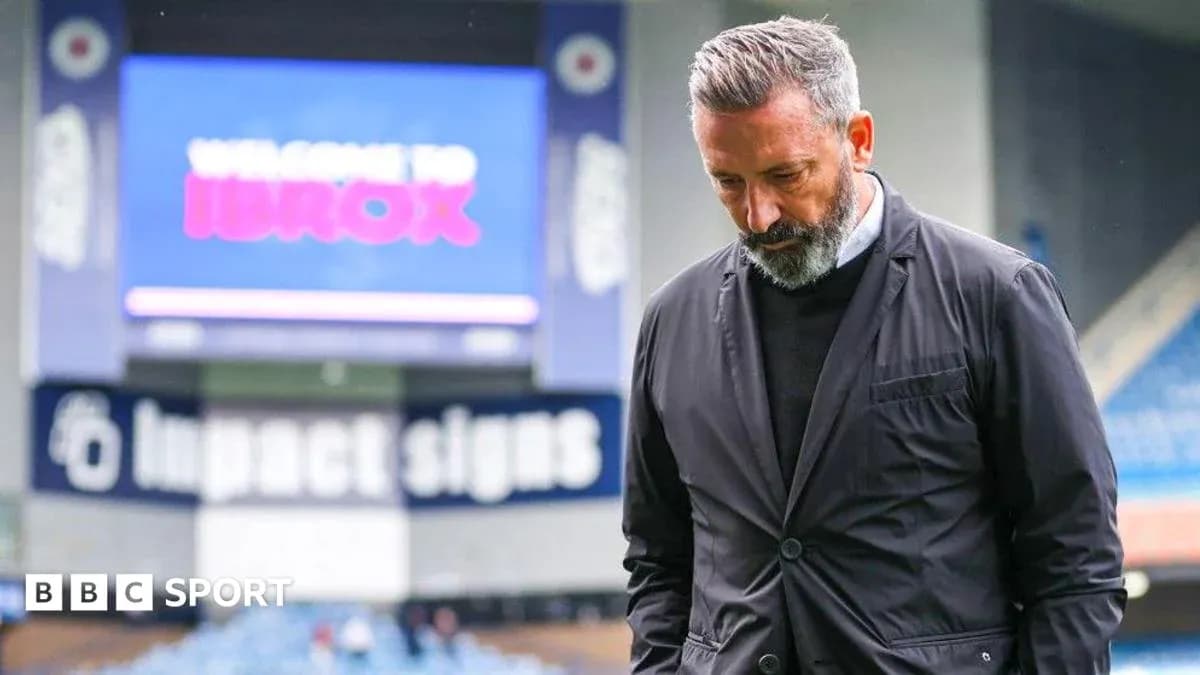
Derek McInnes: From Hearts to Rangers and the Quest for Title Glory
Derek McInnes walked into Hearts last May talking about destiny. “This is the job I felt I should have had years ago,” he said. “Everything I wanted.”
Thirteen months later, he’s gone. Not to England, not to some glamorous foreign league, but to the one place everyone always suspected he’d end up: Rangers.
Once Ibrox called, there was only ever going to be one outcome. The timing was the only detail up for debate.
Hearts’ nearly man who was never really theirs
You’d forgive Hearts supporters for being furious. A manager who came within three minutes of delivering the title, who pushed a remarkable tilt at the Premiership on a modest budget, walking away after a single season.
Yet the mood around Tynecastle isn’t quite mutiny. There’s frustration, yes, but not much heartbreak.
McInnes was always a Rangers man and always looked like one. Even as he drove Hearts to a near-fantasy finish last season, it was hard to picture him as a long-term monument in Gorgie. Not when the Rangers job kept looming on the horizon like a recurring storm.
He almost gave Hearts fans the greatest day of their lives. Almost. That word has followed him around Scottish football for a decade.
Hearts, it turns out, were a stepping stone. The job he wanted at the time, not the job he’d wanted all his life.
Control, data, and a clash of football worlds
In Edinburgh, McInnes adapted. He worked inside a club where Jamestown Analytics carry real weight, where recruitment and selection are shaped heavily by data models and long-term planning.
He never truly looked at home in that ecosystem.
McInnes is a manager who values control. At Kilmarnock and, more notably, at Aberdeen, he called the shots. At Hearts, he had to share the wheel with analysts and algorithms.
Players arriving because their numbers popped on a screen. Questions over why “their” players weren’t getting minutes. Debates about targets he liked who didn’t score highly enough on the system.
At Ibrox, the dynamic shifts. There, he will run the football department largely on his terms. He will have authority, a budget beyond anything he has previously commanded, and the freedom to build a squad in his own image.
It’s the kind of power managers crave. It’s also the kind of power that leaves them with nowhere to hide.
The carrot, the cash, and the cost of failure
You can call it disloyalty. In the cold reality of modern football, it looks like simple logic.
Rangers’ owners have already poured serious money into the club in just over a year and are ready to go again this summer, potentially in a big way. For a manager who almost won the title on what amounted to spare change, that’s a powerful lure.
McInnes arrives in a position of strength. He walks into a club desperate, angry, and tired of watching others lift the Premiership trophy. He knows the place, knows the expectations, and knows that at Rangers, talk is cheap and patience is microscopic.
Nothing short of the title will do.
Danny Rohl tried and failed. Third place brought no sympathy. Philippe Clement finished second and the support could not wait to see the back of him. That is the climate McInnes steps into: a fanbase worn out by excuses and exhausted by falling short.
The league has to be won. No amount of context, no amount of rational argument, will shield him if it isn’t.
A big personality for a big club
In many respects, McInnes is the obvious appointment.
He understands the club. He understands the league. He communicates clearly and confidently. Rangers’ hierarchy have seen up close what he can do, having watched his Hearts side give them serious problems last season.
He’s tactically astute, unafraid of big calls, and never short on self-belief. Throughout Hearts’ near-glory campaign, as club records tumbled, his messaging was sharp and unwavering. He controlled the narrative as well as he controlled the touchline.
Rangers need that. Ibrox demands a big personality, someone who can absorb the noise and still project authority. McInnes is exactly that.
But his record comes with an asterisk.
Hampden regular, medals in short supply
If there’s a theme to McInnes’ managerial career, it’s proximity to success rather than domination of it.
At Aberdeen, he turned Hampden into a second home. League Cup finals in 2013-14, 2016-17, 2018-19. A Scottish Cup final in 2016-17. A team consistently in the mix, consistently in the latter stages, consistently one step away.
Celtic were his recurring tormentor, and there’s no shame in losing to them in that era. Yet the list of cup exits to others is long and uncomfortable: Dundee United, Hibs, St Johnstone, Dundee, Hearts, Motherwell, Hearts again, St Mirren, Motherwell again, United again.
While he has gone without silverware at the top level, others outside the Old Firm have found a way. St Johnstone, Inverness, Hibs, St Johnstone again and Aberdeen have all lifted the Scottish Cup since he last won a major trophy. Ross County, St Johnstone and St Mirren have taken the League Cup.
Tommy Wright, John Hughes, Alan Stubbs, Callum Davidson – twice – Jimmy Thelin, Jim McIntyre, Stephen Robinson. Managers who, at key moments, finished the job.
McInnes has been close. Very close. But “nearly” still clings to his reputation.
The fight that defines him
Now he walks into a different kind of battle.
His duels with Martin O’Neill’s Celtic in the past were fierce, and the next chapter – up against whoever occupies the Tynecastle dugout and the familiar power in Glasgow’s East End – will be compelling.
This is the opportunity he has waited for, the one that has hovered over his career like a promise and a challenge.
He has the club he grew up with. He has the resources he has never previously enjoyed. He has the control he craves.
What he no longer has is the luxury of being the nearly man.