Diego Forlan: From Tennis Dreams to Manchester United Hero
Diego Forlan never planned on living his father’s life.
Pablo Forlan had played at the 1966 and 1974 World Cups for Uruguay. Diego wanted a racket, not boots. Tennis, not football. That was the idea until tragedy ripped through the family and changed everything.
His sister, Alejandro, was involved in a horrific car crash. Her boyfriend died. She was left paralysed. Into that chaos stepped Diego Maradona, who quietly sent money to help with the medical bills. The gesture floored a 12-year-old boy. The tennis dream faded. Football, and the chance to support his family, became the only path.
From Montevideo to Manchester
Forlan threw himself into the game. He passed through the academies of Penarol and Danubio, two of Uruguay’s giants, before crossing the Atlantic in 1995 for a seven‑month trial with Nancy. It ended with a no. No contract. No future in France.
He went back to South America, undeterred. With the help of family contacts and manager Jose Omar Pastoriza, he landed at Independiente, one of Argentina’s ‘Big Five’. It was a club made for forwards who wanted to matter.
By 1998, at 18, he was in the first team. Two-footed, lively, relentless. Forty goals in 91 games later, Europe came calling again. This time, the door would open.
In January 2002, Middlesbrough agreed a £6.9 million deal for the Uruguayan. The Premier League beckoned. Then Manchester United heard the news.
One phone call, one accent, one decision
Forlan later told the story in his column for The National. He was in the bathroom when the phone rang. His roommate was asleep, so he spoke quietly. On the other end was a man speaking fast, with a thick accent he could barely decipher.
He strained to follow. He picked out the key lines.
“We want you. It’s not just interest, we want you. You can be a great player for us. Wait for us. You will play for Manchester United.”
United matched the fee and offered a bigger salary. More importantly, Ferguson had made it personal. Middlesbrough lost their man before he had even unpacked.
United needed a No.9. Teddy Sheringham and Andy Cole had gone. Forlan arrived as the new face of the forward line’s next generation, walking into a dressing room dominated by Ruud van Nistelrooy.
He debuted a week later, coming on for the final 15 minutes of a 4-0 win at Bolton. The movement was sharp, the work rate obvious, the pace eye-catching. Van Nistelrooy liked what he saw.
“With Diego, we have got a very young and talented player,” the Dutchman said. “He’s very, very quick, has two great feet and I think at 22 years of age, he has a great future.”
But words are easy. Minutes are harder.
The drought
Forlan remained behind Van Nistelrooy and Ole Gunnar Solskjaer. He didn’t start a game until March, stepping in for the injured Norwegian against Tottenham at Old Trafford. United cruised to another 4-0 win. Forlan ran in behind, stretched the defence, caused problems.
He also missed. A lot. Clear chances. Big ones. The composure that had defined him in Argentina deserted him in England.
He finished the 2001-02 season with 18 appearances and no goals. United’s year was no better: third in the Premier League, early exits in both domestic cups, and a Champions League semi-final defeat to Bayer Leverkusen.
Still, Old Trafford warmed to him. He ran. He pressed. He chased lost causes. That counts in Manchester. Uruguay called him up for the 2002 World Cup, where he produced one of the goals of the tournament – a stunning volley against Senegal from 20 yards that screamed into the far corner.
Confidence flickered back, but not for long.
Back in Manchester, the goals still refused to come. The 2002-03 season began with Forlan stuck on the bench, entering late in United’s first six league games and both legs of the Champions League qualifier against Zalaegerszeg. Twenty-six games in, zero goals on the board.
The British press gave him a new nickname: “Forlorn”.
The penalty that changed everything
The breakthrough finally arrived in his 27th appearance, against Maccabi Haifa in the Champions League. United were 4-1 up when Forlan came on just before the hour. He buzzed around, found space, and then, inevitably, lashed one big chance high over the bar from a Van Nistelrooy pass.
Same story, it seemed. Then came the 88th minute.
David Beckham won a penalty. As captain, he picked up the ball. Forlan asked for it. Begged, really. Beckham saw the desperation in his eyes and stepped aside.
On ITV, Peter Drury captured the moment as Old Trafford held its breath. “Please. please. Anyone with an ounce of humanity says please on his behalf.”
Forlan, body language tight with anxiety, side-footed the ball low, wrong-footed the goalkeeper and found the net. 5-2. Drought over.
Beckham and his team-mates swamped him. “If I'd taken it and scored, I'd have been hated by 67,000 people,” Beckham said later. “He's been working so hard in training and in matches, and he really deserved that.”
Ferguson agreed. “Diego's movement is first-class and he deserves his goal. Even in the half-hour he was on, he created half a dozen chances. If you put that amount of effort in you should get something. Hopefully he will settle down now and get lots more. That will kick-start him I'm sure of that, he did some fantastic work.”
Forlan himself stayed cool. He spoke of adapting to the Premiership, to a new culture, to limited minutes. “The pressure is a personal one, but I'm confident the goals will come,” he said. “It would have been better to score that goal after a move but it still counts.”
He was right. The goals did come. They just arrived in bursts, and often with chaos attached.
The shirt comes off
Forlan went seven more games without scoring. Then, on October 26, he made only his second Premier League start of the season, against Aston Villa at Old Trafford.
United trailed 1-0 with 13 minutes left. There was little danger when Mikael Silvestre picked up the ball on the far side of the box, crowded by defenders. Somehow, the Frenchman dug out a cross. Forlan, inexplicably unmarked, met it with a brilliant header into the top corner past Peter Enckelman.
Nine months after joining, he finally had his first Premier League goal.
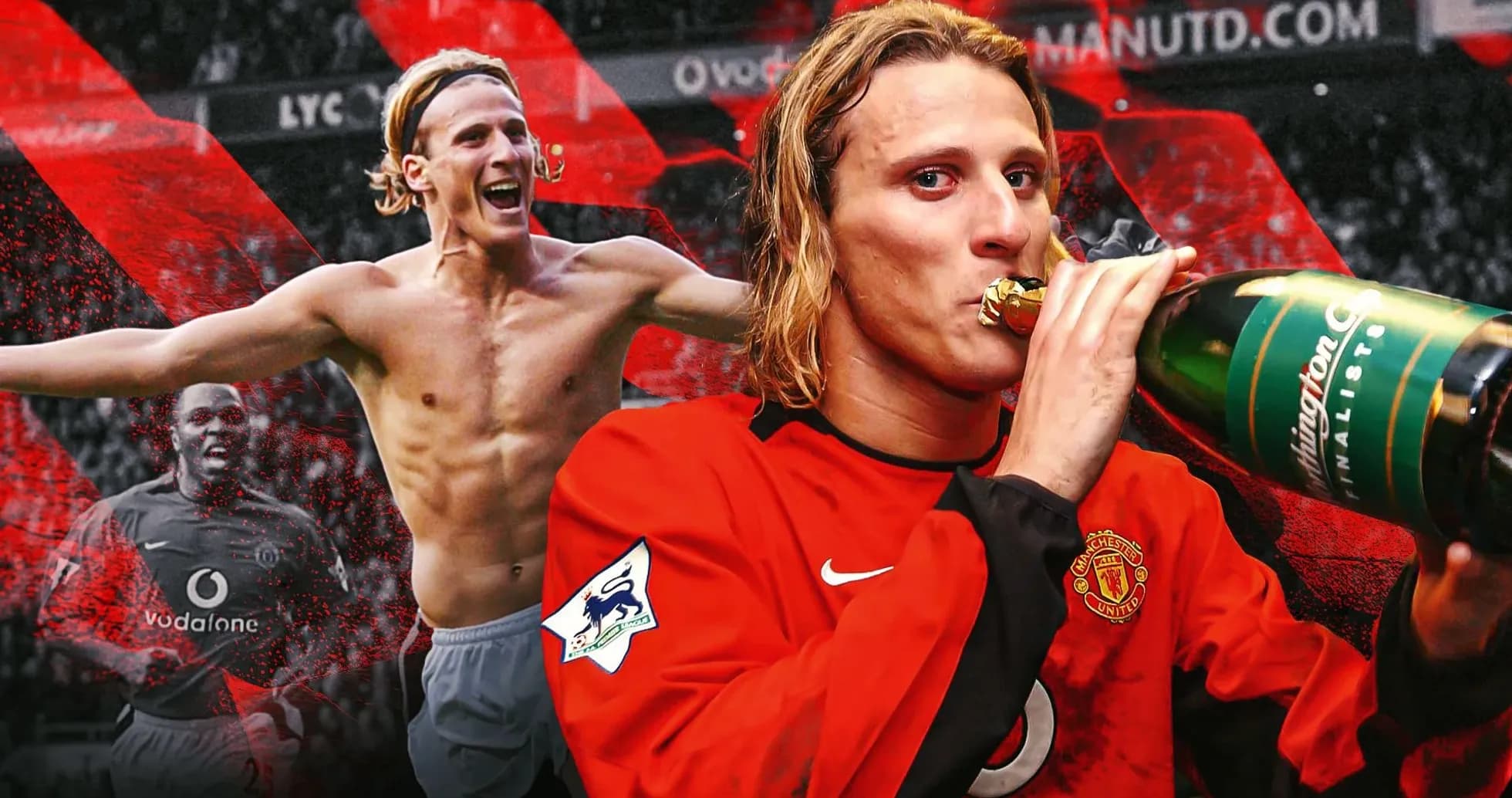
This time, the celebration matched the moment. The shirt came off. Forlan, half-lost in adrenaline, sprinted towards the Villa fans instead of the United support. After 23 league games without an open-play goal, direction was a minor concern.
A week later, Southampton came to Old Trafford. Ferguson put Forlan back on the bench. It didn’t matter.
With five minutes left and the score 1-1, Juan Sebastian Veron fed him from 25 yards. Two touches, then a thunderous drive that flew past Antti Niemi before the goalkeeper could move.
Again, the shirt was off. Again, the stadium erupted. Then came the farce. United’s Nike dual-layer kit baffled him. He couldn’t get the shirt back on. When play restarted, he flew into a challenge while still clutching it in his hands.
“I was trying to get it back on quickly, but sometimes when you are in a hurry, things tend to get worse,” he said later. “I don't know if I will do it again. We'll have to see when it happens.”
It happened again.
Anfield, and immortality
Forlan kept his place for a 5-3 win over Newcastle, supplying two assists for Van Nistelrooy. Eight days later, he started at Anfield. What followed defined his relationship with United forever.
The game was scrappy. Tight. Nervy. It felt like it would take a mistake or a flash of genius to break it open.
It was a mistake.
Jamie Carragher headed a loose ball back to Jerzy Dudek. Routine. Simple. Except Dudek let it slip through his legs. Forlan reacted first and rolled it into the empty net. As he wheeled away, instinct told him: shirt off. Memory told him: maybe not. He pulled it back down at the last second.
That goal owed everything to Liverpool’s error. His second did not.
Barely three minutes later, Ryan Giggs rode two tackles and stabbed a pass into Forlan on the edge of the box. One touch, then a ferocious strike at Dudek’s near post. The goalkeeper should have done better. Forlan’s technique, though, was flawless.
Sami Hyypia pulled one back, Fabian Barthez produced a stunning late save from Dietmar Hamann, and United escaped with a 2-1 win. But the day belonged to Forlan.
“You don’t know what you did. You will be remembered for years,” Gary Neville told him afterwards, as Forlan recalled on United’s media channel in 2022.
The fans wrote the rest. To the tune of Dean Martin’s “Volare”, they sang: “Diego, whoooah, Diego, whoooah, He came from Uruguay, and made the Scousers cry.” They were still singing it in 2017 at Sunderland, leaving Jose Mourinho baffled on the touchline.
“I knew it was something important but, you know, I didn’t know in that moment, until now, after 20 years, they would still be singing my name,” Forlan told GQ in 2019. “I get goosebumps every time I hear it. I’m not Ryan Giggs, Paul Scholes or another United legend, nor am I the only player to have scored at Anfield, so it feels a privilege to be remembered. I was getting so few minutes in the team that I didn’t even feel like I was a proper footballer until that game.”
Winter goals and late drama
December 2002 belonged partly to him. He scored in a 2-0 League Cup win over Burnley with an assured finish, then delivered the only goal in the quarter-final against Chelsea, slipping the ball through Carlo Cudicini’s legs.
He finished the month by smashing home the opener in a 2-0 league win over Birmingham City, meeting a Beckham knockdown with a crisp half-volley.
Forlan started just one more Premier League game that season, but he saved one of his most dramatic contributions for January 18, 2003, when Chelsea came to Old Trafford in a key title clash.
Arsenal had gone five points clear earlier in the day by beating West Ham. Chelsea sat three points behind United in third. The London side controlled the first half and led through Eidur Gudjohnsen’s 30th-minute strike. Then Cudicini slipped, mis-hit a pass straight to Beckham, and the England captain crossed for Paul Scholes to level.
United improved after the break. So did Cudicini, who somehow clawed a Van Nistelrooy header past the post. Chelsea clung on. Into stoppage time they went.
Then Forlan arrived.
On as a substitute for Van Nistelrooy, he drifted between the centre-backs to latch onto a perfect Veron through-ball in the 93rd minute. One smooth swing of his left boot, and the ball flew past Cudicini. 2-1. Old Trafford erupted. The shirt, of course, came off.
“That's why we always put him on for the last 20 minutes. He's become a really important player this year with important goals,” Ferguson said afterwards.
United went on to reclaim the Premier League title four months later. Forlan’s numbers – six goals and two assists in 25 appearances – looked modest. But with only seven starts, his knack for decisive moments mattered more than the raw totals.
The misfit season
The fairy tale was never meant to last.
In a 2003-04 pre-season friendly against Juventus, Forlan produced one of those misses that live forever on compilation reels: inside the six-yard box, open goal, and somehow he hit the side netting. It felt like an omen.
Ferguson shifted to a lone-striker system, building even more around Van Nistelrooy. Forlan’s space shrank. Still, he offered flashes – a gorgeous volley in a 3-0 win over Rangers in the Champions League, the winner away to Panathinaikos to secure progression, and a sharp double off the bench in a 4-0 demolition of Aston Villa.
He even collected an FA Cup winner’s medal in 2004, scoring in a 3-0 fourth-round victory over Northampton Town. Yet the misses kept piling up, including a failed penalty in that same tie. On the rare occasions he started, he failed to grab games.
In April, after a sluggish display against Leicester, Ferguson hooked him in the 57th minute. Forlan stormed towards the tunnel, a rare flash of anger from a player usually defined by quiet graft.
Then came the final straw.
The boots, the studs, and the end
Louis Saha arrived in January 2004. Wayne Rooney followed that summer. The writing was on the wall.
Forlan played 17 minutes in the 2004-05 Premier League opener at Chelsea. The pitch was wet. Ferguson told him to wear long, interchangeable studs. Forlan preferred short ones. He said he would change. He didn’t.
He slipped when clean through on goal in a 1-0 defeat. The chance went. So, effectively, did his United career.
“Ferguson wanted me to play with long studs, the interchangeable ones that suit wet pitches, but I feel more comfortable in short ones,” Forlan later revealed. “I agreed to change but I didn't and wasted a chance. Afterwards, I rushed to the dressing room to change boots but Ferguson caught me. He grabbed the boots and threw them. That was my last game for United.”
A few days later, he left Old Trafford in a cut-price £2m move to Villarreal, labelled a transfer flop by many.
Ferguson, in his autobiography, saw it differently. He admitted that Van Nistelrooy’s “singularity” had worked against Forlan. “Ruud wanted to be the No 1 finisher, that was his nature. Diego Forlan didn’t register on his radar at all, so when you put the two of them out there together, there was zero chemistry. Diego was better with a partner,” he wrote. “But he scored some priceless goals. He was a good player and a terrific pro.”
Villarreal proved the point. Given the lead role, Forlan exploded, later forming a lethal partnership with Sergio Aguero at Atletico Madrid and dovetailing superbly with Luis Suarez and Edinson Cavani for Uruguay.
Old Trafford’s unlikely romantic
United never saw the very best version of Diego Forlan. What they did see was a player who never hid.
“I remember when Diego Forlan came in, and it wasn't quite happening for him. If a player tried – and Diego did – we'd drag him with us; we'd try and help him,” Roy Keane said in 2023.
That effort, that refusal to sulk, left its mark. Forlan made the Scousers cry, yes, but his real legacy at Old Trafford lies in the way he kept running when the goals wouldn’t come, the way he threw himself into games when his place was never secure.
In an era since defined by churn and short-termism at United, his story lingers as a reminder: some cult heroes are built not on numbers, but on devotion. And on one unforgettable afternoon at Anfield, when a player who never quite fit became immortal in song.