England's Thrilling Opener: Defensive Doubts After 4–2 Victory Over Croatia
England 4–2 Croatia in the book, four goals on the board, attacking sparks all over the pitch – and yet the conversation as the dust settled was about what went wrong at the back as much as what went right in front.
This was a night that exposed both sides of Thomas Tuchel’s new England: relentless energy, depth from the bench, and a cutting edge in the final third, shadowed by familiar questions about concentration and structure without the ball.
Rooney’s cold eye on a soft first blow
Wayne Rooney has seen enough World Cup football to know a preventable goal when he watches one. The former England striker did not sugar-coat his view of Croatia’s opener.
“We could do so much better with the first goal,” he said, dissecting the move in forensic detail. Jude Bellingham, he felt, was “a bit flat-footed” as the challenge came in. John Stones, in Rooney’s eyes, should stay upright because “there’s no real danger” with Jordan Pickford set behind him.
Instead, Stones went to ground, Pickford gambled, and the whole defensive line had to shuffle. Nico O’Reilly was dragged across, Croatia worked a neat set, a sharp cut-back, and a clean finish.
From a Croatian perspective, it was a slick move. From England’s, it was avoidable.
Rooney’s glare then turned to the goalkeeper. Pickford got a strong hand on the shot but could not keep it out. “Could Jordan Pickford do a bit better? I don’t know. He gets a full hand on it. I know it’s quick,” Rooney said, before adding the line every keeper dreads: “If Jordan is getting a hand on it like he does then he’ll be disappointed.”
The message was clear. This was not about bad luck. It was about standards.
Richards: England “played into Croatia’s hands”
If Rooney zoomed in on the first goal, Micah Richards widened the lens. For the former England defender, both Croatian strikes came from England allowing the game to be played on Croatia’s terms.
“If you look at the goals Croatia scored, both could have been avoided,” he said. England’s mistake, in his view, was to drop just enough that Croatia’s technicians could get comfortable on the ball, pick passes and dictate tempo.
“What England did was played into their hands and allowed them to get their technical players on the ball and do what they wanted to do,” Richards argued.
The frustration for him was that the physical platform was there. In pure running power, England swarmed Croatia. Richards’ point was simple: if you’re that much stronger in terms of energy, you squeeze higher, ten or fifteen yards further up, and you suffocate those situations before they develop.
He looked ahead, too. With the bench stacked with willing runners, he believes “having the flexibility of the energy off the bench is going to be pivotal going forward.” The implication: England can’t afford to sit off and admire their own shape. They have the legs to be aggressive. They need to use them.
Stones, Konsa and a dilemma for Tuchel
At the heart of the tactical debate sits Tuchel’s central defensive pairing. John Stones and Ezri Konsa got the nod against Croatia, a blend of a ball-playing veteran and a trusted club lieutenant. The performance, though, was anything but settled.
Stones, short of minutes at Manchester City last season, saw plenty of the ball. He assumed responsibility for building from the back, stepping into midfield, taking risks with his passing. That is part of what makes him valuable – and part of what makes managers nervous when the rhythm isn’t quite there.
Konsa, a regular under Tuchel since the German took charge, showed glimpses of the calmness that has earned that trust. He read danger on a couple of occasions, covered space, tried to knit things together. Yet alongside Stones, he also looked just off-beat, a half-second out in his positioning, not quite in tune with his partner.
Two goals conceded in the first half will always shine a harsh light on a new pairing. Now comes the selection question that will hang over the build-up to Ghana: does Tuchel back his chosen duo, betting on chemistry to grow under tournament pressure, or does he turn to Marc Guéhi to steady the picture?
Guéhi offers a different profile – less expansive on the ball, more single-minded about defending his box – and that contrast will tempt a coach who knows knockout football can turn on a single misstep. Tuchel’s answer against Ghana will tell us plenty about how he intends this England to defend when the stakes rise.
Gordon’s grounded debut
While the back line wrestled with its shape, the front line and the bench lit up the occasion. For Anthony Gordon, this was a personal landmark wrapped inside a collective surge.
“It has been a crazy couple of weeks and that just topped it off. First World Cup game, something I have dreamed about as a kid,” the England forward told BBC Radio 5 Live. The emotion was obvious, but he quickly pushed it aside.
“Special, but it is not about me. Self-centredness is a disease and I don’t want to be a part of that,” he said. “It is about the team. Rashy came on and made an impact, Bukayo and Morgan. It is a collective.”
His reading of the match mirrored what millions watching felt. “A difficult first half – their goal came from nowhere and stunned us a little bit,” he admitted. The response, though, was emphatic. “We came out really strong in the second half and got what we wanted. They were really good and that can’t be underestimated when you look at the game.”
That last line matters. Croatia asked serious questions. England answered them with goals, but also learned where the cracks are.
Rashford’s reminder – and the United question
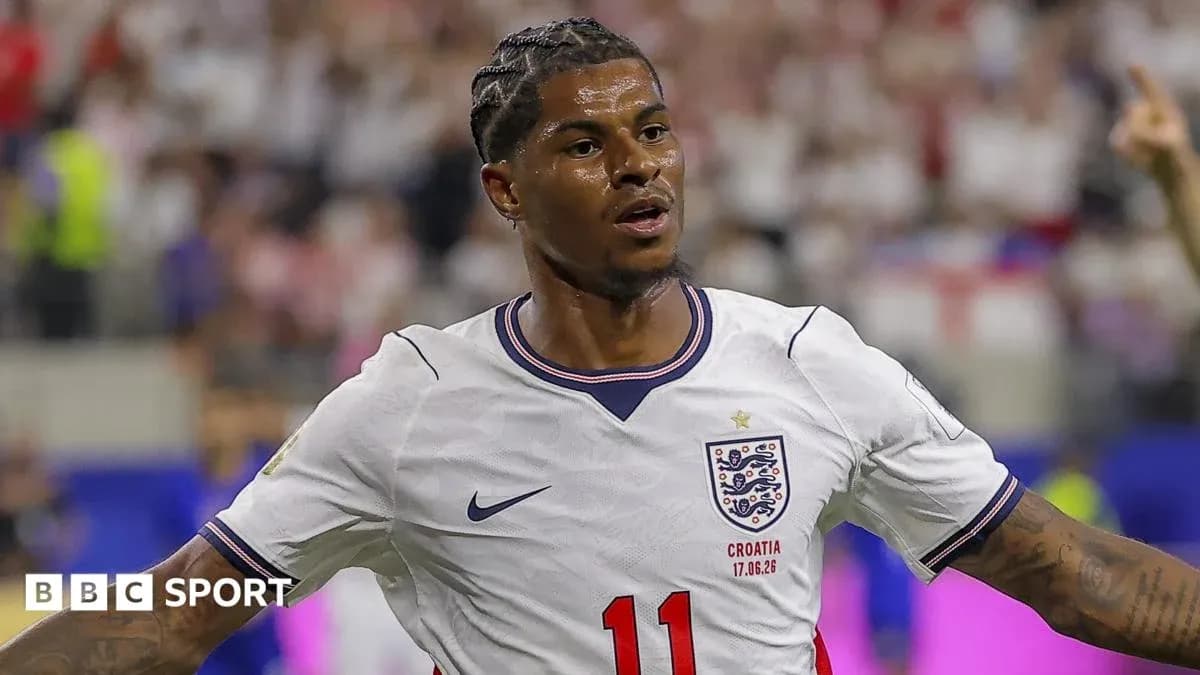
No one changed the game’s rhythm more sharply than Marcus Rashford. Sent on to tilt the contest, he delivered: a goal, a surge of threat, and a timely reminder of what he can still do on the biggest stage.
For his international manager, it was exactly the impact you want from a substitute. For his club, it complicates an already tangled summer.
On 1 July, Rashford formally reverts to being a Manchester United player after Barcelona declined to trigger a £26m clause to buy the 28-year-old. United’s stance is firm: they want £40m, they will not entertain another loan to Barça, and his £325,000-a-week wages narrow the field of potential buyers to a select few.
United cannot force him out the door. The power of a contract, and the reality of his salary, mean any move has to suit all sides. As it stands, the expectation at Old Trafford is straightforward: Rashford will report back after his mandatory three-week post-World Cup break, in time for a planned training camp in the Republic of Ireland.
There is time for the picture to shift. Performances like this one for England change conversations, reopen scouting reports, nudge sporting directors back to the table. United will see his display against Croatia as leverage. Rashford will see it as proof he still belongs at the sharp end of elite football.
England, meanwhile, will simply be glad he is here, sharp, and decisive. In a tournament where games tighten and margins shrink, a substitute who can arrive, score, and tilt the narrative is priceless.
The goals against Croatia showed what this England can be when the handbrake comes off. The goals conceded showed what they risk if the defensive details stay loose. Ghana will reveal which side of that balance defines their World Cup.