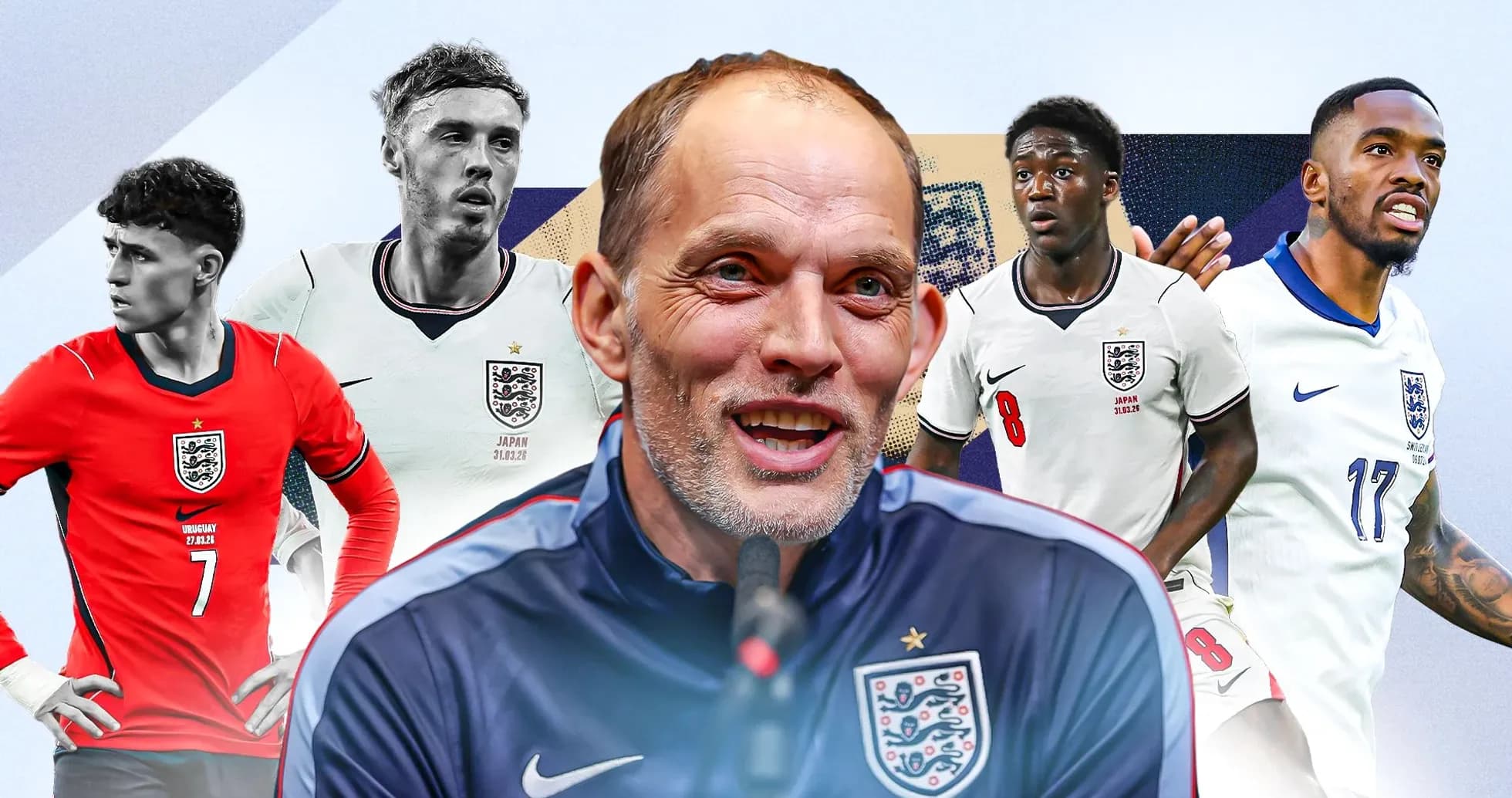
England's World Cup Squad: Tuchel's Bold Choices and Surprising Omissions
When the World Cup kicks off on June 11, it will be a year and a day since Ivan Toney last pulled on an England shirt – two lonely minutes at the end of a grim friendly defeat to Senegal at Nottingham Forest’s City Ground. He disappeared from squads after that, seemingly discarded.
Now he’s back. Not for a dead rubber, not for a camp “look-in”, but as Harry Kane’s understudy at a World Cup.
Tuchel has turned back to the 30-year-old Al-Ahli striker after a season in Saudi Arabia that yielded more than 40 goals. For 12 months, those numbers meant nothing to the England manager. Suddenly, they mean everything. Toney has also been vocal about his readiness for the North American heat. Tuchel has listened.
Big calls in the No.10 role
If centre-forward was a surprise, the real earthquake came behind Kane.
Everyone knew there would be at least one brutal decision in the No.10 position. Morgan Rogers was effectively inked in. Jude Bellingham, with his ability to float between lines and roles, was never in doubt. That left a queue of gifted playmakers: Eberechi Eze, Cole Palmer, Phil Foden, Morgan Gibbs-White.
Gibbs-White, despite his form, had long been treated as an outsider. His omission stings, but it doesn’t shock. Palmer and Foden? That’s different. Both missing the cut is a jolt that rattled social media and sent supporters scrambling for explanations.
Strip away the emotion and Tuchel’s logic is clear enough. Palmer’s season has spluttered. Injuries disrupted his rhythm, his England minutes since Euro 2024 have been sparse, and only in recent weeks has he resembled the whirlwind who first lit up the Premier League with Chelsea. Foden’s dip has been longer and more troubling, stretching back to the last Euros, where he struggled and many wanted him dropped. The decline for club and country has lingered.
Eze survives. One man left standing from a debut campaign at Arsenal that mixed promise with inconsistency, but evidently offered enough to convince Tuchel he could be trusted.
The manager knows what this looks like. Leaving out three creative talents who could turn a game from the bench is a decision that will follow him into every press conference. Yet he was blunt about why he resisted stockpiling playmakers.
“We tried to have a balanced squad and not to bring five No.10s and make them play out of position. Because whom would we do a favour with that? The player? Ourselves? I don’t think so.”
He’s nailed his colours to the mast. This is not a collection of the 26 best individuals. It’s his 26.
Mainoo’s revival and rise
Few players have swung from discarded to indispensable quite like Kobbie Mainoo.
Midway through the season, his World Cup hopes were dead. Ruben Amorim, then in charge at Manchester United, barely glanced his way. The Portuguese coach’s back-three system left no room for Mainoo, who seriously considered a January move to revive his career.
He stayed. Amorim didn’t.
Michael Carrick’s arrival as interim head coach changed everything. Mainoo walked straight back into the side, controlled games with a calm that belied his 21 years and earned a new contract as United surged into the Champions League places.
Those months have now carried him all the way to the World Cup. He has edged out Adam Wharton and James Garner to claim the final central midfield slot. Realistically, he sits behind Declan Rice and Elliot Anderson in the pecking order, but he’s on the plane. A few months ago, that would have sounded fanciful.
Trent’s bitter end – for now
If Mainoo’s story is about resurrection, Trent Alexander-Arnold’s is about a door slamming shut.
The warning signs had been there. Tuchel left the Real Madrid right-back out of his expanded 35-man squad for the March window. Even with injuries opening gaps, the manager has held firm. Djed Spence of Tottenham gets the nod instead.
For Alexander-Arnold, it caps a bruising first season in Madrid. He left Liverpool aiming to step into the Ballon d’Or conversation. Instead, he finds his England career in limbo. He hasn’t played for his country in close to a year, and with Ben White injured and Tino Livramento only just returning to fitness, this felt like the moment for a recall.
Tuchel refused to budge. He knows the criticism that will come. Alexander-Arnold’s passing could unpick any low block, his delivery remains unmatched. Yet the familiar concerns over his defending have counted against him once more.
As long as Tuchel is in charge, the road back for Trent looks steep.
Chelsea’s unexpected winner
One man quietly smiling at all this? Xabi Alonso.
The new Chelsea head coach starts work at Cobham on July 1 and, unexpectedly, will have almost his entire English contingent at his disposal for pre-season. Reece James is the only Chelsea player in the England squad. Palmer has been left out, as have Levi Colwill and long shot Trevoh Chalobah.
For Alonso, it’s a gift. Palmer needs a clean, uninterrupted summer after his injury issues. Colwill is only just back from an ACL tear that wiped out most of his season. They now get time, coaching, and rest rather than tournament chaos.
With Brazil boss Carlo Ancelotti also ignoring Joao Pedro, Andrey Santos and Estevao, Chelsea’s World Cup contingent is likely to be limited to James, Marc Cucurella, Jorrel Hato, Enzo Fernandez, Moises Caicedo, Pedro Neto and Nicolas Jackson. Manageable numbers. A rare win for a club manager in an international summer.
Maguire cut adrift
Harry Maguire saw the World Cup as the natural next step in his redemption arc.
Recalled for the last international break and resurgent in the second half of Manchester United’s season, he believed he was back in the inner circle. Tuchel thought otherwise.
The German had hinted at this in March, admitting Maguire remained low in his hierarchy and that nothing had changed his mind about the old-school centre-back. Concerns were raised over his fit in a possession-heavy side and even whispers emerged about whether he would accept a back-up role.
The reaction to his omission did little to calm that narrative. Maguire – and some of his family – vented publicly before the squad was even announced.
“I was confident I could have played a major part this summer for my country after the season I've had,” he posted on social media. “I've been left shocked and gutted by the decision.”
Tuchel will feel vindicated in his assessment of the squad’s chemistry. Maguire, meanwhile, is left to wonder where his England journey goes from here.
O’Reilly’s leap into the spotlight
If there is a fairytale in this squad, it belongs to Nico O’Reilly.
At 21, he has exploded as England’s breakout star of 2025-26, delivering 15 goal involvements from the left side of Manchester City’s defence. He has attacked, overlapped, and created like a winger, all while learning the dark arts of full-back play on the job.
Now he heads to the World Cup as the likely starting left-back.
Lewis Hall and Myles Lewis-Skelly both miss out, despite strong expectations that at least one would travel to push O’Reilly for the role. Tuchel has cleared the runway for the City man. Djed Spence is the only real alternative, and he is more comfortable on the right.
There is risk here. O’Reilly is a midfielder by trade. There is no natural, specialist left-back in the group. In a tournament where details decide everything, Tuchel has chosen to gamble on talent and versatility over orthodoxy.
He clearly believes O’Reilly can handle it.
Tuchel’s England, Tuchel’s risk
From the moment Tuchel walked through the door as England manager, he promised to pick on conviction, not popularity. He has stayed true to that. The question now is whether he has overreached.
This 26-man squad is a statement as much as a selection. It carries a clear first XI, a clear shape, and – in Tuchel’s words – “clarity”. There will be no Palmer debate, no weekly Foden referendum, no endless arguments about where Alexander-Arnold should play. The noise that has circled England camps at recent tournaments has been stripped away.
But the silence comes at a cost. Depth looks thin in key areas. Jarrod Bowen, Palmer, Alexander-Arnold, Gibbs-White, Wharton, Maguire – all could have changed a game from the bench. Instead, the responsibility falls to the likes of Jordan Henderson, Spence and Noni Madueke, players who do not carry the same aura or track record at this level.
Tuchel has the core of a team that can go toe-to-toe with anyone. The expectation is semi-finals at minimum. Anything less, and this squad announcement will be revisited as the moment the campaign began to unravel.
For now, the manager stands by his choices. The World Cup will decide whether this was bold, necessary surgery on an England side stuck in familiar patterns – or the selection that defines his tenure for all the wrong reasons.