Fenerbahçe Dominates Sturm Graz in Champions League Qualifier
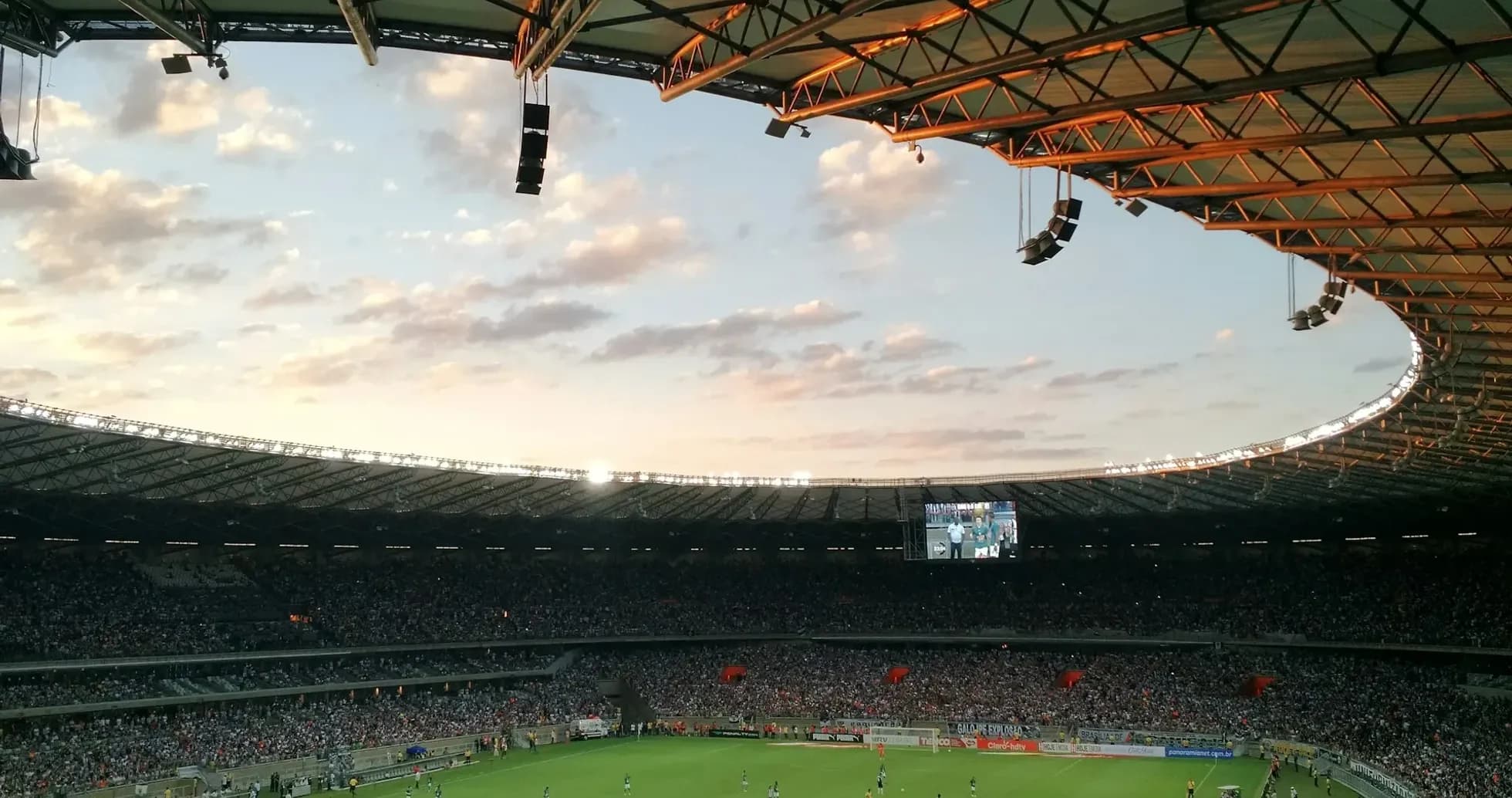
Fenerbahçe’s 2-0 win over Sturm Graz at Chobani Stadium was a textbook example of territorial dominance and structural control in a Champions League 3rd Qualifying Round tie. Ismail Kartal’s 4-2-3-1 not only secured a clean sheet but also suffocated Sturm’s 4-4-2 into a passive, reactive block. The statistical profile — 72% possession, 17 total shots to 5, and a 578–222 passing differential — underlines how one-sided the tactical battle became, especially after an assertive first half in which Fenerbahçe built a 2-0 lead and never relinquished control.
Fenerbahçe's Structure
Structurally, Fenerbahçe’s 4-2-3-1 was built on a stable double pivot of M. Guendouzi and N. Kante, who dictated rhythm and rest defence. With 578 total passes and 520 accurate (90%), the home side circulated the ball with patience, using the full width. J. Oosterwolde and N. Semedo initially provided the base width from full-back, while the line of three — K. Akturkoglu off the left, M. Asensio centrally, and M. Greenwood off the right — constantly rotated between half-spaces. Talisca acted as a hybrid 9/10, dropping into pockets to overload Sturm’s central midfield two and drag centre-backs out of their line.
Goals
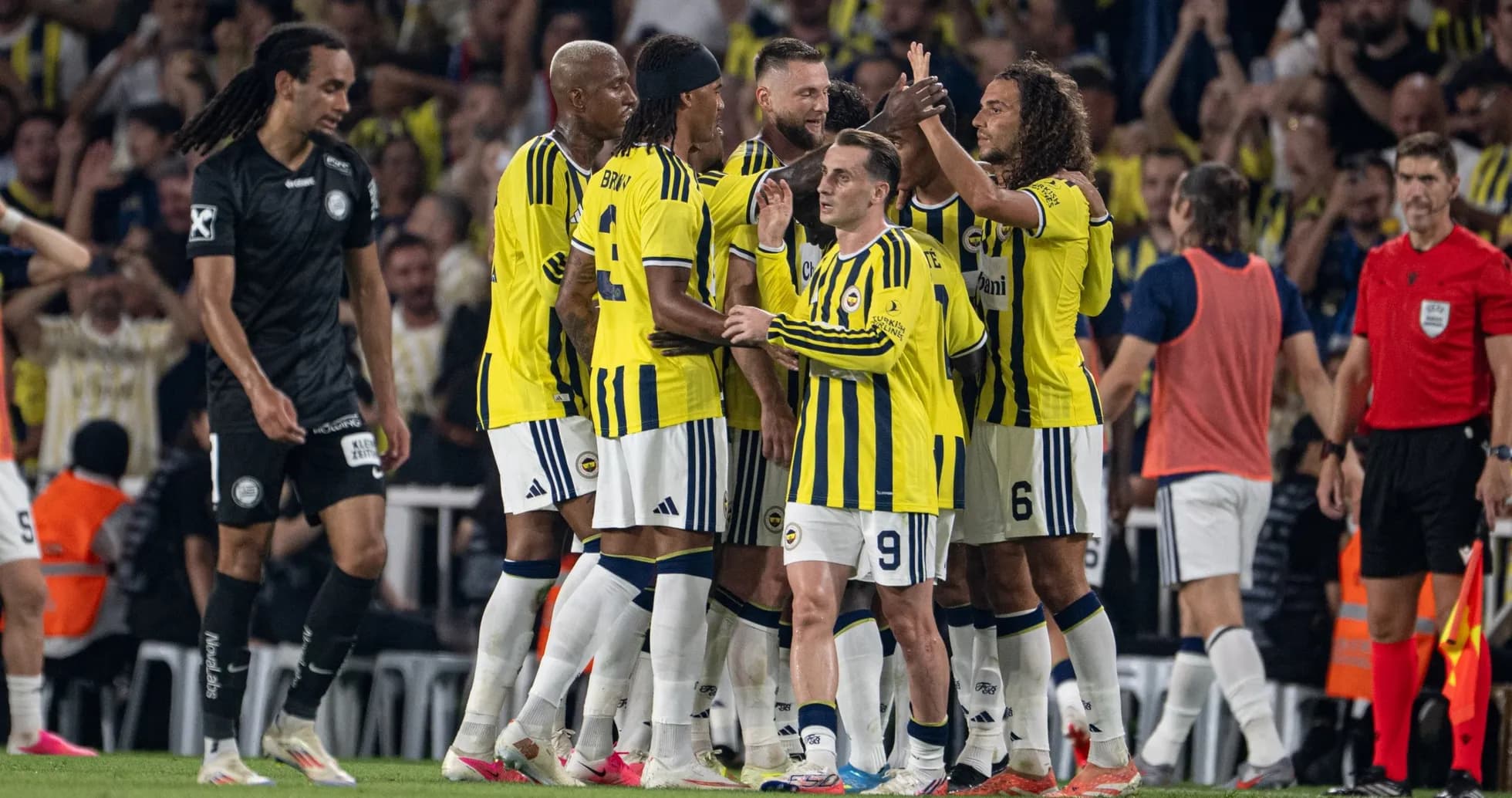
The first goal, a 9th-minute strike by Talisca assisted by K. Akturkoglu, encapsulated Fenerbahçe’s positional play: wide occupation, a third-man run, and a late arrival from the forward line exploiting a stretched back four. With Sturm’s 4-4-2 unable to screen the pivot effectively, Kante and Guendouzi repeatedly received under minimal pressure, allowing vertical passes into the attacking trio. Greenwood’s goal on 45', assisted by Asensio, came at the end of another long spell of possession, underlining how Fenerbahçe converted territorial pressure into concrete chances — 10 shots on goal and 12 shots inside the box speak to the quality of their entries.
Defensive Structure
Out of possession, Fenerbahçe were compact and efficient. Their foul count (10) remained modest despite their aggressive counter-press, a sign of good spacing rather than reckless duels. The back four, anchored by M. Skriniar and N. Ake, held a relatively high line, trusting the double pivot to delay transitions. With only 5 total shots and 1 shot on goal conceded, the defensive structure functioned as intended. Behind them, M. Gunok (Fenerbahçe) was largely protected, needing to make just 1 save; the low save count is less an indictment of involvement and more proof that Sturm were rarely allowed into finishing zones.
Sturm Graz's Struggles
Fabio Ingolitsch’s Sturm Graz set up in a 4-4-2 that, in theory, could have threatened in transition through S. Wlodarczyk and S. Jatta. In practice, Sturm’s 28% possession and 222 total passes (164 accurate, 74%) show a side forced deep and struggling to connect their lines. The double pivot of J. Gorenc Stankovic and L. Weinhandl was routinely outnumbered by Fenerbahçe’s interior rotations. Sturm’s wide midfielders, J. Hodl and S. Seidl, were pinned back by the home full-backs and wingers, leaving the forwards isolated.
Sturm’s attacking profile — 5 total shots, 3 inside the box, and just 1 on goal — reflects their inability to string together sustained possession or exploit transitional moments. Their 2 corner kicks compared to Fenerbahçe’s 4 also highlight how rarely they established pressure in the final third. D. Khudyakov (Sturm Graz) was kept busy, making 8 saves; his performance prevented a heavier defeat, especially given Fenerbahçe’s 10 shots on goal and 5 blocked efforts, which indicate repeated penetrations into dangerous zones.
Discipline and Substitutions
Discipline became a secondary storyline revealing the physical and psychological strain on Sturm. They committed 19 fouls to Fenerbahçe’s 10 and collected all three yellow cards in the match. Jon Gorenc Stankovic’s booking for “Foul” at 21' illustrated the early difficulty in coping with Fenerbahçe’s midfield rotations. Jurgen Heil’s yellow for “Foul” at 58' came as he tried to halt another progression down his flank. Axel Kayombo’s caution for “Simulation” at 65' underlined a side increasingly chasing marginal gains rather than constructing genuine chances.
Substitutions further shaped the tactical picture. At 30', A. Brown (IN) came on for J. Oosterwolde (OUT), slightly adjusting Fenerbahçe’s left-side profile but not their overall structure. After the interval, Sturm tried to refresh their front line: A. Kayombo (IN) came on for S. Wlodarczyk (OUT) at 46', then a triple change at 64' — G. Mamageishvili (IN) for S. Seidl (OUT), R. Fosso (IN) for L. Weinhandl (OUT), and N. Weiper (IN) for S. Jatta (OUT) — aimed to inject energy and ball-carrying into midfield and attack. Tactically, it nudged Sturm towards a more fluid front pairing and slightly more dynamic midfield, but Fenerbahçe’s control of possession blunted any real momentum shift.
In-Game Management
Kartal’s in-game management was conservative and game-state driven. At 69', Fred (IN) replaced M. Greenwood (OUT), and I. Kahveci (IN) came on for M. Asensio (OUT), moves that maintained technical security in the middle while adding fresh legs to protect the 2-0 lead. Late on, at 85', M. Muldur (IN) for N. Semedo (OUT) and O. Aydin (IN) for K. Akturkoglu (OUT) consolidated the structure, preserving defensive solidity and work rate on the flanks without altering the fundamental 4-2-3-1. Sturm’s final switch at 87', B. Beganovic (IN) for J. Hodl (OUT), marginally increased attacking intent but arrived too late to trouble a settled defensive block.
Conclusion
Statistically, the verdict is clear: Fenerbahçe translated a superior structure and technical level into sustained dominance. Their 72% possession, 17 shots (10 on goal, 5 blocked), and high passing accuracy illustrate a side comfortable dictating tempo and territory. Sturm Graz’s profile — 28% possession, 5 shots, 1 on goal, 19 fouls, and 3 yellow cards — reflects a team forced into deep defending and reactive challenges, with limited ability to build or sustain attacks. With both teams’ expected goals and goals prevented values absent, the clearest indicators are volume and location of shots: Fenerbahçe’s 12 efforts inside the box versus Sturm’s 3 underline the gulf in chance quality. Within the broader context of Champions League qualifying, this was a controlled, tactically mature home performance that puts Fenerbahçe in a strong position for the tie.