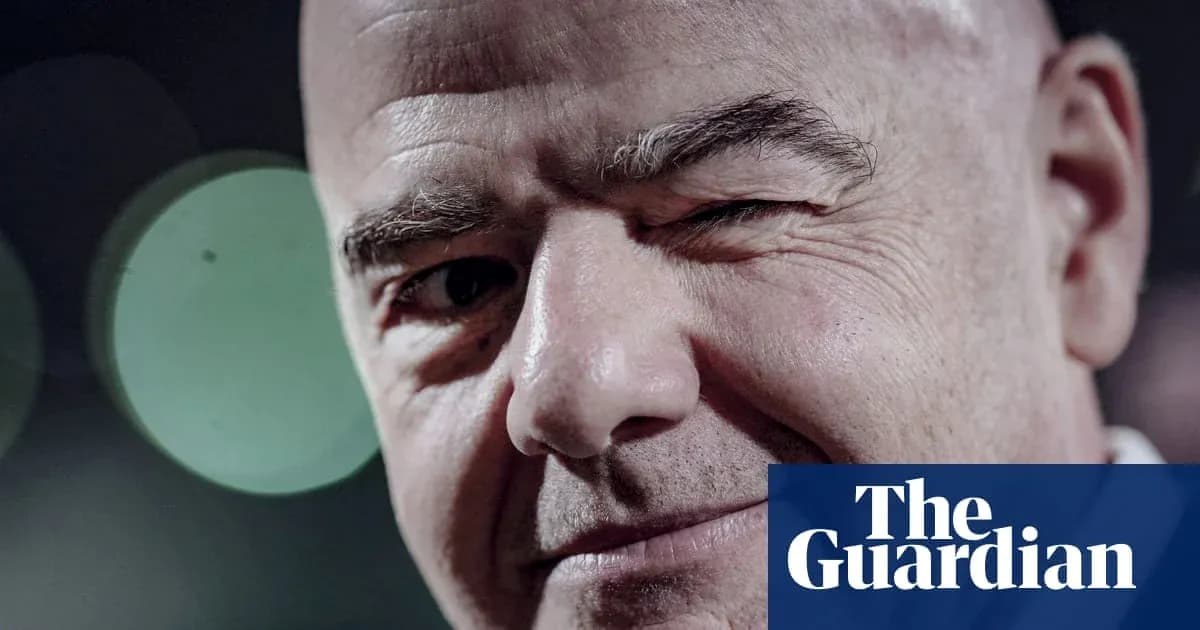
Fifa's Latest Purge: Power, Fear and Kevin Lamour's Exit
Kevin Lamour knew exactly what was coming. He said as much.
When Gianni Infantino’s scheme to parcel off a chunk of the World Cup to private investors surfaced last month – a deal critics feared could flog football’s crown jewel on the cheap – Lamour did what almost nobody at Fifa ever does. He said no.
The then chief operating officer, a senior figure held in such esteem that Erasure once named a single after him long before he entered football’s corridors of power, dismissed the proposal with brutal clarity, calling it “the project of one person”. He told colleagues the administration had been “deceived” by Infantino. And he did it on the record.
“If speaking up against my boss means I lose my job, then so be it,” he said. “I will understand and respect that decision. At least I’ll sleep well tonight.”
On Monday, Fifa made good on that unspoken threat.
“Fifa can confirm that the working relationship between Fifa and Kevin Lamour as Fifa’s Chief Operating Officer has ended on 17 August 2026,” blared a statement. “Fifa thanks Kevin for his two years of service and wishes him the best of luck for the future. No further comment will be made on the matter.”
No explanation. No detail. Just the familiar, opaque full stop.
Lamour’s stance had already helped sink Infantino’s World Cup sell-off, which was quietly shelved within days of his intervention. For a fortnight, the Frenchman will have slept with one eye open, knowing how public dissent plays out in Zurich. On Monday night, he finally slept the sleep of a man proven right – and promptly shown the door marked “Do One!”.
‘Management by Fear’
If Fifa hoped a bland statement would smother the story, they misread the room.
Lise Klaveness, the outspoken head of the Norwegian Football Association and a long‑time irritant in Infantino’s side, stepped up first. She did not bother with diplomacy.
“Now he is thrown out and we are supposed to move on,” she said. “It’s unacceptable, it’s management by fear.”
Klaveness called Lamour “the best football administrator” she has ever met and turned her fire on those who stayed quiet.
“Now we also have to call upon Fifa leadership and the administration to not submit to orders you know are not in the interests of football.”
Her words landed like a direct challenge to the inner circle – and, in particular, to Mattias Grafström. The Swedish Fifa official is understood to have carried out the sacking at Infantino’s behest, while the president continues to cling to power like a barnacle on a ship’s hull.
Grafström tried to rally staff in an internal email, framing the moment as a bump in the road rather than a purge.
“Individuals, unstable moments and unfortunate episodes come and go,” he wrote. “The institution, its mission and its responsibility towards world football continue.”
For now, though, the pattern is hard to ignore. The sackings keep coming. The message is clear. Speak up, and you’re out. The morale? That’s someone else’s problem.
Guardiola, Passion and a Painful Confession
From Zurich to a dressing room confessional.
In a new Amazon documentary, Pep Guardiola lays bare a piece of his private life to try to jolt his players out of a slump. It is raw, uncomfortable and utterly deliberate.
“Guys I want to confess something, I’m [eff]ing divorced from the most beautiful woman on your planet,” he tells them. “It’s my wife, my ex-wife – I love her unbelievably, but we lost the passion. For many reasons, we lost the passion. I love her? Yes, absolutely. She loves me? Yes, but we lost the passion.”
Then he turns the knife.
“How do you play football, because you are paid? Or because of something inside? Where is the passion? In your life, whatever you are going to do, do it with passion. I don’t want any good players. I want players with passion.”
The cameras also catch another fracture: a fierce row with Kyle Walker that exposes just how strained things became during the former Manchester City manager’s final months in charge.
Limbs in the Canton End
If all that feels heavy, Cardiff offered a reminder of why people keep coming back to this sport.
The word “limbs” gets thrown around far too easily in 2026, plastered across social media for any half‑decent celebration. But what erupted in the Canton End at Cardiff City Stadium on Monday night? That was the real thing. Proper Limbs.
Cardiff, back in the Championship, had watched their former striker Kieffer Moore put Wrexham in front early on. Their monied Welsh rivals looked set to march away with the points in front of more than 30,000 in the capital.
Cardiff huffed. They puffed. They laboured for more than 90 minutes.
Then, in the 98th minute, Rubin Colwill stepped up. One free-kick. One arrowed strike. Top corner. Bedlam.
Bodies flew everywhere behind the goal. The noise tore through the stadium. Even Brian Barry‑Murphy, Cardiff’s usually composed head coach, ended up in the crowd. It felt like a throwback: a raucous, old‑fashioned night of Championship thrill‑ball, with a script that refused to behave.
Money, Power and the Transfer Carousel
Away from the drama on the pitch and in the boardrooms of Zurich, the transfer machine rolled on.
Rodri touched down in Barcelona on Monday to complete his move from Manchester City, describing it as a “dream” to join the Catalan giants. His medical is scheduled for Tuesday. “There have been some very intense days, but I’m happy that everything has been resolved,” he said.
In west London, Chelsea’s ownership puzzle took another twist. Chair Todd Boehly and director Mark Walter are weighing up selling their shares to the majority owners, Clearlake Capital. If they do, the private equity firm would take total control of the club. No alarms there at all, obviously.
Elsewhere, Coventry have snapped up Taiwo Awoniyi from Nottingham Forest for £9m. Ipswich, eyeing momentum of their own, have moved for Abdoul Ouattara and Julio Enciso from Gary O’Neil’s old club Strasbourg. Newcastle, meanwhile, have strengthened at the back, confirming the £30m signing of defender Amar Dedic from Benfica.
On the international stage, Patrick Vieira has taken on a new challenge, appointed as manager of Senegal, the country of his birth in Dakar. A World Cup winner stepping into a role heavy with expectation.
Wages, Old Money and Distractions
The game’s financial chasm keeps provoking letters and laments.
One reader calculated that if the average Premier League player pockets around £5m a year – roughly £100,000 a week – then in seven days he “gets (hardly earns)” more than Jimmy Greaves did across his entire career. Go back to the eras of Tom Finney, Jackie Milburn and Nat Lofthouse and the gulf yawns wider still.
Another correspondent, desperate for anything to take his mind off the football, found solace in Beniamino Gigli, the Italian tenor, after Rob Smyth had been laying into a dud film rather than the great singer himself.
And then there was Anthony Brady, spotting a Wizard of Oz moment in a previous column’s “insert name here” gag, catching a glimpse of the machinery behind the curtain. He walked away with the day’s prizeless letter nod.
Memory Lane: Champagne, Cigars and a Different World
One image lingers amid all the noise.
Leeds United, Don Revie crouched at the front, celebrating their first league title in 1969. Nine players. Four bottles of champagne. Two cigars. One cigarette.
By modern standards, it looks almost restrained. By Fifa’s standards, it looks like another planet. The question now is simple: in a game run by fear, money and private deals, how long can anyone like Kevin Lamour last – and who dares to be the next to say “so be it”?