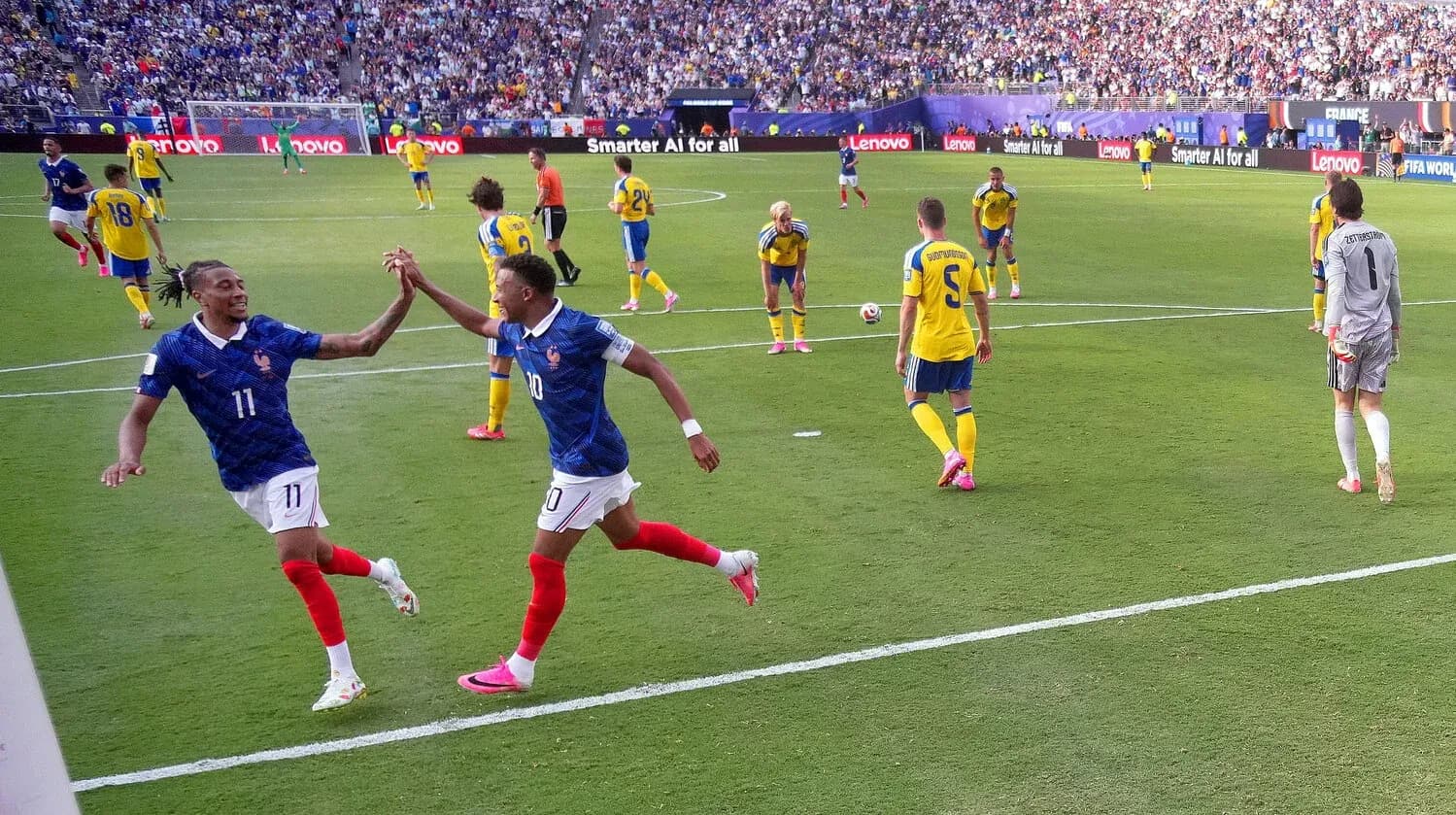
France Dominates Sweden 3-0 in World Cup Round of 32
France’s 3-0 win over Sweden at MetLife Stadium in this World Cup Round of 32 tie was a controlled, tactically coherent performance built on structural superiority in and out of possession. Didier Deschamps’ 4-2-3-1 consistently overwhelmed Graham Potter’s 4-4-2, turning a modest xG edge (3.17 to 0.65) into a dominant territorial and chance-creation display.
I. Executive Summary
France imposed themselves from the outset, using a double pivot and an aggressive three-man line of attacking midfielders behind Kylian Mbappé to pin Sweden deep. With 61% possession, 25 total shots and 9 corners to Sweden’s single corner, France converted their control into a 1-0 half-time lead and pulled away after the break. Sweden’s 4-4-2 offered sporadic counter-attacking outlets through Viktor Gyökeres and Alexander Isak, but they were largely isolated and starved of service.
II. Scoring Sequence & Disciplinary Log
There were no cards in this match, so the tactical story is told entirely through goals and substitutions.
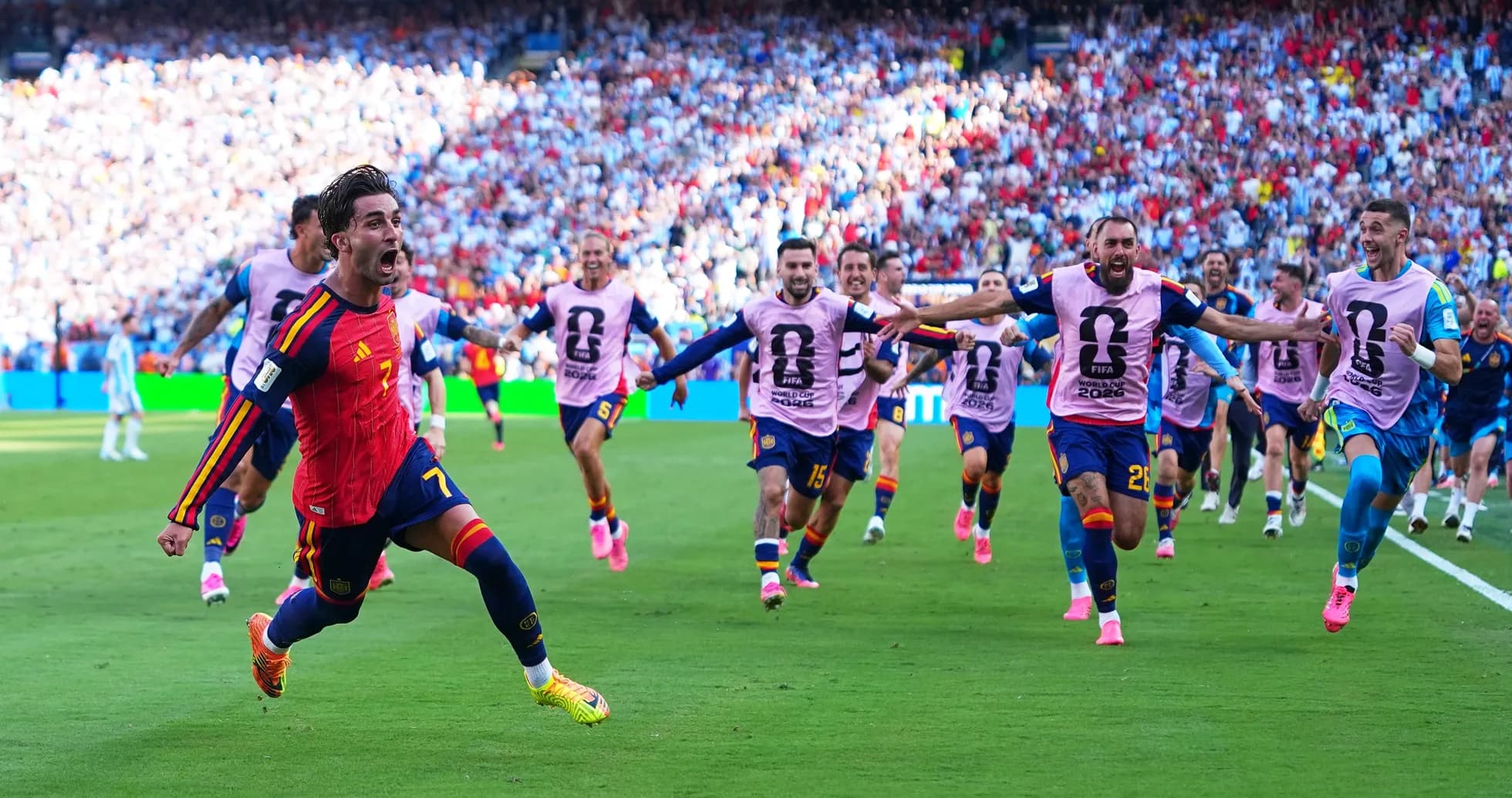
France broke through at 45'. Mbappé drifted from his nominal centre-forward zone into the left half-space, exploiting the channel between Victor Lindelöf and Daniel Svensson. Ousmane Dembélé, starting as the right-sided midfielder in the band of three, drove infield and threaded a vertical pass into Mbappé’s run. The finish – France’s first goal – reflected the pattern of the half: wide overloads, quick switches, and then direct penetration into the box.
At 53', France doubled their lead. Bradley Barcola, operating from the left of the three behind Mbappé, attacked the inside channel while Michael Olise moved into a central playmaking pocket. Olise’s assist to Barcola rewarded France’s consistent attempts to get their “10” free between Sweden’s midfield and defence; the 4-4-2 block could not compress vertically quickly enough once the first line was bypassed.
The third goal at 74' again underlined the same structural issue. Olise, now fully dictating between the lines, found Mbappé’s movement against a retreating back four. Mbappé’s second goal sealed the 3-0 scoreline and effectively ended the contest.
All substitutions followed in the context of this control rather than as reactions to crises. Sweden reshaped their midfield and wide areas from 66' onwards, while France rotated full-backs and attackers from 75' to manage energy and protect the lead. With no yellow or red cards, the match tempo was dictated more by tactical adjustments than disciplinary interruptions. Card count: France 0, Sweden 0, Total 0.
III. Tactical Breakdown & Personnel
France
Deschamps’ 4-2-3-1 was the game’s defining structure. Aurélien Tchouaméni and Adrien Rabiot formed a stable double pivot, allowing the full-backs Jules Koundé and Lucas Digne to advance and stretch Sweden’s wide midfielders. This width created the platform for Dembélé (right), Olise (central) and Barcola (left) to operate in tight pockets between the lines.
In possession, France often resembled a 2-3-5: Dayot Upamecano and William Saliba stayed as the rest-defence pair, with Tchouaméni dropping between or beside them as needed, while Rabiot joined the first line of circulation. The advanced line of five – full-backs high and wide, three attacking midfielders plus Mbappé – constantly forced Sweden’s back four and midfield four into deep, narrow positions.
The shot profile reflects this: 25 total shots, 16 inside the box, and 12 on target. France’s ability to enter the area repeatedly was a direct consequence of the positional play between Olise and the wingers. Dembélé’s assist for the opener came from his freedom to invert and act as an additional playmaker, while Barcola’s goal came from classic weak-side occupation of the half-space when Sweden’s block shifted towards the ball.
Out of possession, France pressed selectively rather than relentlessly. The double pivot screened passes into Gyökeres and Isak, forcing Sweden wide where Koundé and Digne could engage aggressively, backed by Saliba and Upamecano’s cover. France committed 14 fouls – a controlled figure given their territorial dominance – and rarely allowed Sweden to build sustained attacks.
Mike Maignan (France) faced 3 shots on target and made 3 saves. With France’s defensive structure limiting Sweden to just 8 total shots and 1 shot from outside the box, Maignan’s workload was more about concentration than heroics. The goals prevented figure of 1.16 underlines that when Sweden did create, the chances were of reasonable quality, but Maignan’s interventions were decisive.
France’s passing network was clean and efficient: 551 total passes, 485 accurate at 88%. This technical security underpinned their ability to recycle attacks and keep Sweden pinned back, especially after going 1-0 up.
Sweden
Potter’s 4-4-2 was designed for compactness and counter-attacks, but the structure was stretched horizontally and vertically by France’s occupation of the half-spaces. The front pair, Gyökeres and Isak, were often disconnected from the midfield line of Anthony Elanga, Lucas Bergvall, Yasin Ayari and Elliot Stroud. With only 39% possession and 352 passes (280 accurate, 80%), Sweden rarely built through the thirds; instead, they looked for direct balls into the channels and quick transitions.
Their 8 total shots, 7 inside the box, show that when they did break through, they reached dangerous areas. However, the low xG of 0.65 indicates those chances were either rushed or from tight angles, a by-product of having to attack quickly against a set French back line.
Defensively, Sweden’s wide midfielders were overloaded. France’s 9 corners to Sweden’s 1 reveal how often the Scandinavian side was forced to scramble clearances in their own third. The back four of Svensson, Gustaf Lagerbielke, Lindelöf and Gabriel Gudmundsson struggled to track the constant rotations of Mbappé and the three attacking midfielders, especially once fatigue set in during the second half.
Jacob Widell Zetterström (Sweden) was one of the few Swedish positives. He faced 12 shots on target and made 9 saves, with a goals prevented value of 1.16, indicating he significantly limited the damage relative to the quality of chances France created. Without his interventions, the scoreline could have been heavier.
Substitutions
Sweden’s double change at 66' – Besfort Zeneli (IN) came on for Elliot Stroud (OUT) and Taha Abdi Ali (IN) came on for Lucas Bergvall (OUT) – aimed to refresh the midfield and add more ball-carrying threat. Later, Benjamin Nygren (IN) for Yasin Ayari (OUT) and Mattias Svanberg (IN) for Daniel Svensson (OUT) at 82' suggested a shift towards more attacking profiles and fresh legs on the flank. Gustaf Nilsson (IN) for Alexander Isak (OUT) at 89' was a late attempt to add aerial presence, but by then the game state was fixed.
France’s changes were primarily about load management and maintaining intensity. At 75', Malo Gusto (IN) came on for Jules Koundé (OUT) and Désiré Doué (IN) came on for Ousmane Dembélé (OUT), keeping the right flank dynamic. Theo Hernández (IN) for Lucas Digne (OUT) at 78' maintained attacking thrust from left-back. At 85', Jean-Philippe Mateta (IN) came on for Michael Olise (OUT) and Rayan Cherki (IN) for Kylian Mbappé (OUT), shifting France into a more conservative, yet still technically gifted, attacking configuration to close out the match.
IV. The Statistical Verdict
The numbers align closely with the eye test of France’s dominance. Their 61% possession and 551 passes at 88% accuracy reflect sustained control of tempo and territory. The shot volume (25 total, 12 on target, 16 in the box) and xG of 3.17 are consistent with a three-goal output, especially against a Sweden side forced into a low block and reactive defending.
Sweden’s 8 shots and xG of 0.65 show they did find occasional routes to goal, largely via direct play and quick counters, but lacked the sustained possession or structural support to trouble France consistently. Their 10 fouls versus France’s 14 underline that the game was not excessively physical; instead, France used tactical fouling in midfield to manage transitions, while Sweden’s main issues were positional rather than disciplinary.
Goalkeeper metrics sharpen the tactical picture. Mike Maignan (France) made 3 saves, matching Sweden’s 3 shots on target, and his goals prevented figure of 1.16 suggests that the few Swedish incursions were genuinely threatening but well handled. Jacob Widell Zetterström (Sweden), with 9 saves from 12 shots on target and the same 1.16 goals prevented, was heavily exposed by the volume and quality of French attacks.
Set-piece data – 9 corners for France to 1 for Sweden – reinforces the territorial imbalance. France repeatedly forced Sweden to defend deep in their own box, while Sweden rarely sustained pressure long enough to generate restarts in advanced areas.
In season-context terms, France’s performance matches the profile of an elite side comfortable dictating knockout football: high possession, high shot volume, controlled risk in transition, and efficient finishing roughly in line with xG. Sweden’s output is that of an underdog whose defensive organisation could not withstand the technical and positional superiority of a top-tier opponent, despite commendable goalkeeping and occasional counter-attacking promise.