Genoa vs Napoli: Serie A Season Opener Analysis
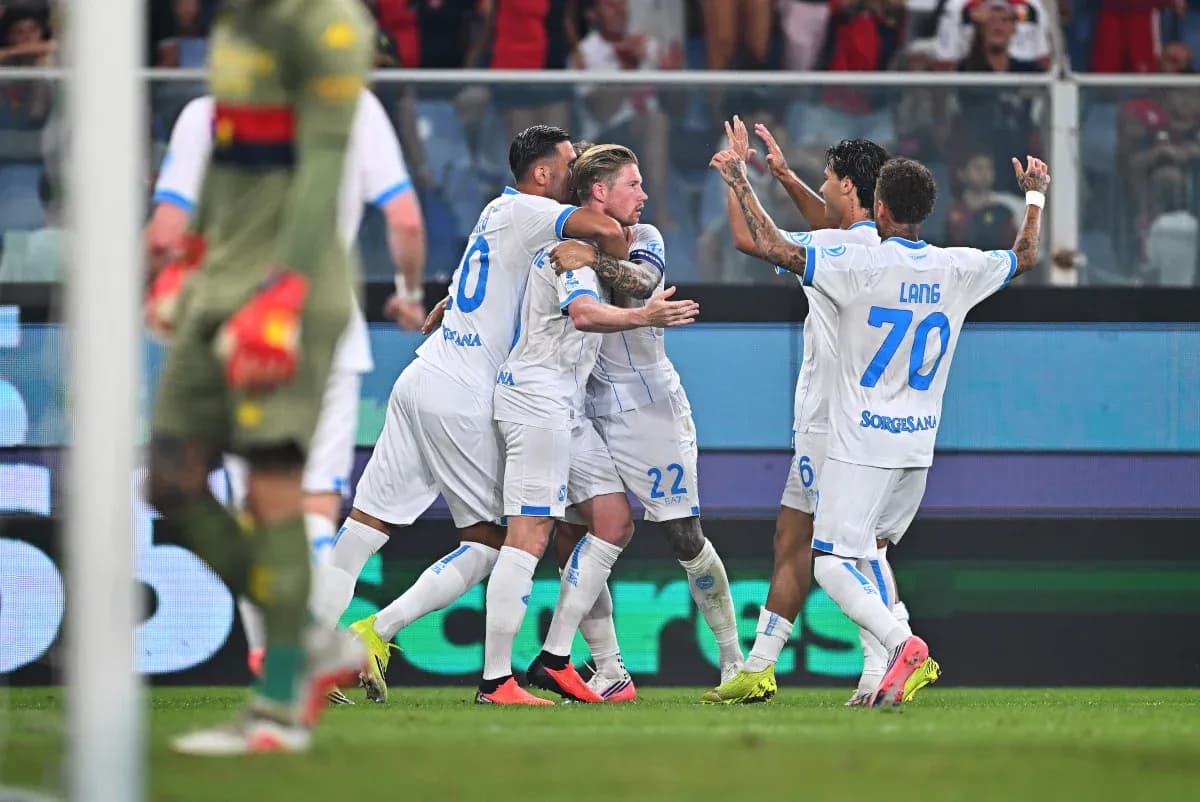
Under the humid August lights of Luigi Ferraris, Genoa’s return to Serie A began with a blunt reminder of the division’s new hierarchy. Napoli, retooled and ruthless, left Genova with a 2–0 win, three points, and an early statement of intent, while Genoa were left rooted in 18th with zero points and a goal difference of -2 after their opening match. On their travels, Napoli sit 2nd with three points and an away goal difference of 2, already projecting the calm authority of a side built for the Champions League places.
This was not a cagey curtain-raiser. Daniele De Rossi committed to his 3-4-2-1, trusting the structure that has defined Genoa’s rise. J. Bijlow anchored a back three of A. Marcandalli, L. Ostigard and J. Vasquez, with B. Norton-Cuffy and M. E. Ellertsson stretching the pitch as wing-backs. Inside them, M. Frendrup and Amorim formed a double pivot behind the creative duo of T. Baldanzi and Vitinha, tasked with feeding L. Colombo as the lone striker.
Opposite, Massimiliano Allegri’s Napoli arrived with a familiar shape but a refreshed soul. The 4-3-3 was marshalled by A. Meret in goal, a back four of G. Di Lorenzo, A. Rrahmani, R. Marin and L. Spinazzola, and a midfield triangle of F. Anguissa, S. Lobotka and S. McTominay. Up front, M. Politano and Alisson Santos flanked R. Hojlund, a front line built for vertical surges rather than sterile possession.
The absentees told their own tactical stories. Genoa’s list was heavy: E. Havel (thigh), H. J. Traore (muscle) and L. Venturino (knee) all missing, depriving De Rossi of depth and alternative profiles in midfield and defence. For Napoli, A. Buongiorno, L. Marianucci and P. Mazzocchi (all knee injuries), plus M. Folorunsho (inactive), trimmed Allegri’s rotation at the back and in the half-spaces. Yet where Napoli could still summon K. De Bruyne, A. Vergara, B. Gilmour, N. Lang, David Neres and L. Lucca from the bench, Genoa’s replacements were more about work rate and structure than game-changing flair.
The disciplinary ledger underlined the power dynamics. Genoa’s season card profile already shows two yellow cards in total, with 100.00% of them logged outside standard minute ranges in the data, hinting at scattered, possibly late frustration rather than targeted tactical fouling. L. Ostigard, who has 1 yellow card and 2 fouls committed in his single appearance, personified that edge: combative, brave, but often operating on the limit as he tried to hold Napoli’s transitions together. Napoli, by contrast, have just one yellow card in total so far, arriving between 46-60 minutes (100.00% of their bookings), neatly aligned with a classic Allegri pattern: tighten the screws early in the second half, absorb, then strike.
Key Duels
Within that framework, the key duels decided the night.
In the “Hunter vs Shield” narrative, Genoa’s front three never quite became hunters. Colombo’s role as the tip of the 3-4-2-1 demanded he pin Rrahmani and Marin while Baldanzi and Vitinha attacked the inside channels. But Napoli’s defensive record speaks loudly: on their travels they have conceded 0 goals, with an away average of 0.0 goals against, and a clean sheet already banked. Di Lorenzo and Spinazzola compressed the wide lanes, while Rrahmani’s aerial authority and Marin’s positioning denied Genoa the direct route. Bijlow and his back line, by contrast, already carry 2 goals against at home, an average of 2.0 at Luigi Ferraris. The -2 home goal difference is not catastrophic on its own, but it frames the challenge: Genoa have failed to score in total this campaign, with 0.0 goals for on average both at home and overall, and the margin for error behind them is thin.
If Genoa’s attack never truly hunted, Napoli’s did—late. The season data shows that 100.00% of Napoli’s total goals so far have arrived in the 76-90 minute window, a pure late-game surge. Allegri’s blueprint is clear: use the first hour to manipulate structure and fatigue, then unleash quality from the bench. The presence of De Bruyne and Vergara in the league’s early scoring and assist charts is telling. Each has 1 goal and 1 assist in total, both having come off the bench, each with a rating of at least 8.0. De Bruyne’s 24 passes at 79% accuracy and 2 key passes, coupled with Vergara’s 90% passing, 1 key pass and 4 tackles, suggest not just creativity but control and counter-pressing from the second wave. When Genoa’s back three tired and the wing-backs’ recovery runs slowed, Napoli’s late substitutions turned territorial pressure into incision.
Engine Room Battle
In the “Engine Room” battle, Frendrup and Amorim were asked to cage Lobotka and deny McTominay those surging, second-line runs. Early on, Genoa’s compact 3-4-2-1 kept Napoli’s midfield trio facing their own goal, forcing circulation rather than penetration. But the depth of Allegri’s options changed the tenor. With B. Gilmour and A. Vergara available to rotate into midfield, and De Bruyne capable of dropping between the lines to overload central spaces, Napoli could constantly refresh the tempo. Genoa, without H. J. Traore’s dynamism or Havel’s technical security, gradually lost the ability to play through the first press. The consequence was predictable: longer clearances, more duels, and more defending for Ostigard and Vasquez, who nonetheless showed resilience—Ostigard’s 52 passes at 92% accuracy and 1 blocked shot underline a defender trying to build and protect simultaneously.
Defensive Numbers
Defensively, Genoa’s numbers are stark but not yet damning. Overall they have conceded 2 goals in total with an average of 2.0, and they have 0 clean sheets and 1 match where they failed to score. Napoli, by contrast, have a perfect defensive line: 0 goals conceded in total, an average of 0.0 both away and overall, and 1 clean sheet in 1 away match. Their under/over profile reinforces the picture: on their travels they have been over 0.5 and 1.5 goals for, yet under every defensive threshold from 0.5 to 4.5, a statistical portrait of a side that scores enough and concedes nothing.
From a statistical prognosis perspective, the patterns are brutally clear. Genoa’s structure is coherent, but without goals the 3-4-2-1 becomes a survival system rather than a launching pad. Their home attack has yet to register a single goal, and their disciplinary profile hints at reactive rather than proactive aggression. Napoli, meanwhile, marry late-game offensive spikes—100.00% of their goals in the final quarter-hour—with total defensive control. With no penalties taken or missed by either side so far, the margins have been decided entirely in open play, where Napoli’s superior bench and midfield intelligence have tilted the balance.
Following this result, Genoa’s season opens with a warning: the shape is there, the fight is there, but the cutting edge is not. For Allegri’s Napoli, the message is more ominous for the rest of Serie A: even at 0-0 after 75 minutes, this is a side built to win matches in the final act, with De Bruyne and Vergara already writing themselves into the early-season script as the late-game authors of a new Neapolitan project.