Germany's Transformation from Villains to Heroes in Brazil 2014
For decades, Germany were the villains.
They ruined fairy tales, not wrote them. In 1954, they broke the hearts of Ferenc Puskas’ legendary Hungary in Bern. Twenty years later, they stopped Johan Cruyff’s spellbinding Netherlands in Munich. Two of the most gifted European sides the game has seen, both denied their coronation by the same cold, efficient machine in white.
By the early 1980s, the image was cemented. The 1982 World Cup in Spain brought “The Disgrace of Gijon”, that shameful non‑aggression pact with Austria which squeezed Algeria out. Then came Harald “Toni” Schumacher’s brutal collision with Patrick Battiston in the semi-final against France. Sympathy? Not for Germany. They became the ruthless villains who still walked away with the silverware.
And they did. Euro 1980. The 1990 World Cup. Euro ’96. Gary Lineker’s famous line captured the mood: “Football is a simple game. 22 men chase a ball for 90 minutes, and in the end, the Germans always win.” Efficient, relentless, widely disliked.
Yet something shifted with the new millennium. The 2006 World Cup on home soil – the “Sommermärchen”, the summer fairy tale – changed how the world saw Germany and, crucially, how Germany saw itself. The hosts opened their doors, smiled, sang, then fell just short against Italy in the semi-finals. Four years later, a young, fearless side lit up South Africa in 2010, hammering England and Argentina before bowing out to eventual champions Spain. They didn’t just win games; they won admirers.
Red, black and a charm offensive
The campaign started months before a ball was kicked. In February 2014, the DFB unveiled a new away kit: bold red and black hoops, a clear nod to Flamengo’s iconic shirt. For a country whose away colours had traditionally been green, with the occasional red or black, this was a striking break from tradition.
“Your jersey for Rio,” ran the slogan.
Mesut Ozil embraced it straight away. “The new jersey looks great and reminds me of the Flamengo Rio de Janeiro kit,” he said. “It’s sure to bring us luck for the World Cup in Brazil.” It was more than a marketing line; it was the opening move in a calculated charm offensive.
Brazil responded instantly. The shirt hit a nerve in a football‑mad country where Flamengo, the “red and black nation”, dominates the landscape. Local paper O Dia quoted one fan who summed up the mood: when the German jersey in Flamengo’s colours appeared, he decided he would support Germany.
Excitement turned into a buying frenzy. Within weeks, the shirt was a bestseller in Brazil. Shops in Rio de Janeiro ran out. Counterfeits spilled onto the Copacabana. Back in Munich, Bastian Schweinsteiger posed at Bayern’s training ground in an original Flamengo jersey, feeding the growing bond.
A German expat in Rio, Bernhard Weber – better known as MC Gringo – spotted his moment. Inspired by the shirt, he recorded “Deutscher Fussball ist geil, beweg’ dein Hinterteil” (“German football is awesome, move your bum”). In the video, he danced through Rio’s streets, beaches, markets and favelas, switching between Portuguese and German, wearing the red and black Germany shirt, a Flamengo cap, and flanked by a scantily clad Brazilian woman. The song soon became a staple on Brazilian TV and in beach bars. Germany, of all teams, were suddenly part of the soundtrack of a Brazilian summer.
When Joachim Low’s squad finally landed in Brazil in early June, they moved into the purpose‑built Campo Bahia and went to work on and off the pitch. Schweinsteiger and Manuel Neuer danced with locals to a Bahia club anthem. The entire squad showed up at community events. They didn’t hide behind fences and tinted windows.
“You can tell that the DFB team has taken an interest in Brazil and is making a lot of effort,” Brazilian journalist Renato Costa told Deutsche Welle. The old stereotype of distant, aloof Germans didn’t fit this group.
Winning games, winning locals
On the field, Germany started like a team intent on backing up the charm with substance. A 4-0 dismantling of Portugal in their opening game, driven by a Thomas Muller hat-trick, announced their intent. A wild draw with Ghana followed, a reminder that this World Cup would not be simple. Then came the first outing for the red and black away kit in a controlled win over the United States that sealed top spot in the group.
They were not untouchable. Algeria pushed them to the brink in the last 16, forcing extra-time before Germany finally scraped through. The machine could still stutter.
Brazil were also flirting with disaster. The hosts topped their group, then survived a nerve-shredding penalty shootout against Chile in the last 16. The country exhaled as the Selecao advanced, and in the middle of those celebrations, two Germans joined in. Videos of Schweinsteiger and Lukas Podolski waving Brazilian flags and roaring with home fans went viral. The villains of old were dancing in the streets.
Brazil edged past Colombia in the quarter-finals but paid a heavy price. Neymar, the country’s talisman, suffered a back injury and was ruled out of the tournament. At the same time, Germany headed to Rio de Janeiro – Flamengo territory – for their quarter-final with France at the Maracana.
Flamengo’s story is woven into Brazilian football history. Founded as a rowing club, it quickly shifted its weight behind football. In the 1930s, Leonidas, Brazil’s first true superstar and top scorer at the 1938 World Cup, became the club’s icon. In 1981, Zico led Flamengo to their first Copa Libertadores and then a Club World Cup triumph, dismantling Liverpool in Tokyo. From Mario Zagallo to Bebeto, Romario to Ronaldinho, Adriano to Vinicius Jr, the roll call of Flamengo greats reads like a history of Brazilian attacking flair.
After lean years, success returned. The Brazilian league in 2019 and 2020, the Copa Libertadores in 2019 and 2022, the Copa do Brasil in 2022 and 2024. Surveys now put Flamengo’s support at around 47 million fans – more than a fifth of Brazil’s population. They call themselves “the red and black nation”.
Into that universe stepped Schweinsteiger and Podolski, posting a photo from a balcony overlooking Rio’s beach, both wearing Flamengo jerseys. The message was clear: Germany weren’t just visiting Brazil; they were embracing its biggest club.
Podolski, especially, threw himself into the relationship. Throughout the tournament he tweeted in Portuguese, shared photos with Ronaldo and Ronaldinho, and engaged Flamengo fans online. Even after the World Cup, he kept the connection alive. Flamengo tried to sign him multiple times over the next decade.
“Everyone knows that I have loved Brazil since the World Cup, and especially the Flamengo club,” he told Globo Esporte.
Germany’s first match at Flamengo’s home, the Maracana, ended in a tight 1-0 win over France, Mats Hummels rising to head in the decisive goal. The semi-final loomed. Brazil awaited.
The night of 7-1 and a nation that chose its rival
By the time the teams met in Belo Horizonte, Germany shirts had become part of the Brazilian landscape. Local media reported that more than half a million Germany jerseys had been sold in the country, most of them in the red and black design. Sports daily Lance even urged readers to send in photos of themselves in the German Flamengo-style shirt. Back home, adidas admitted sales were “exceeding all expectations”.
What followed on the pitch barely needs retelling. It remains one of the most astonishing nights in World Cup history.
Muller. Klose. Kroos. Kroos again. Khedira. After just 29 minutes, the scoreboard read Brazil 0-5 Germany. The Estadio Mineirao dissolved into stunned silence, then tears. A semi-final, on home soil, turned into a humiliation of historic proportions.
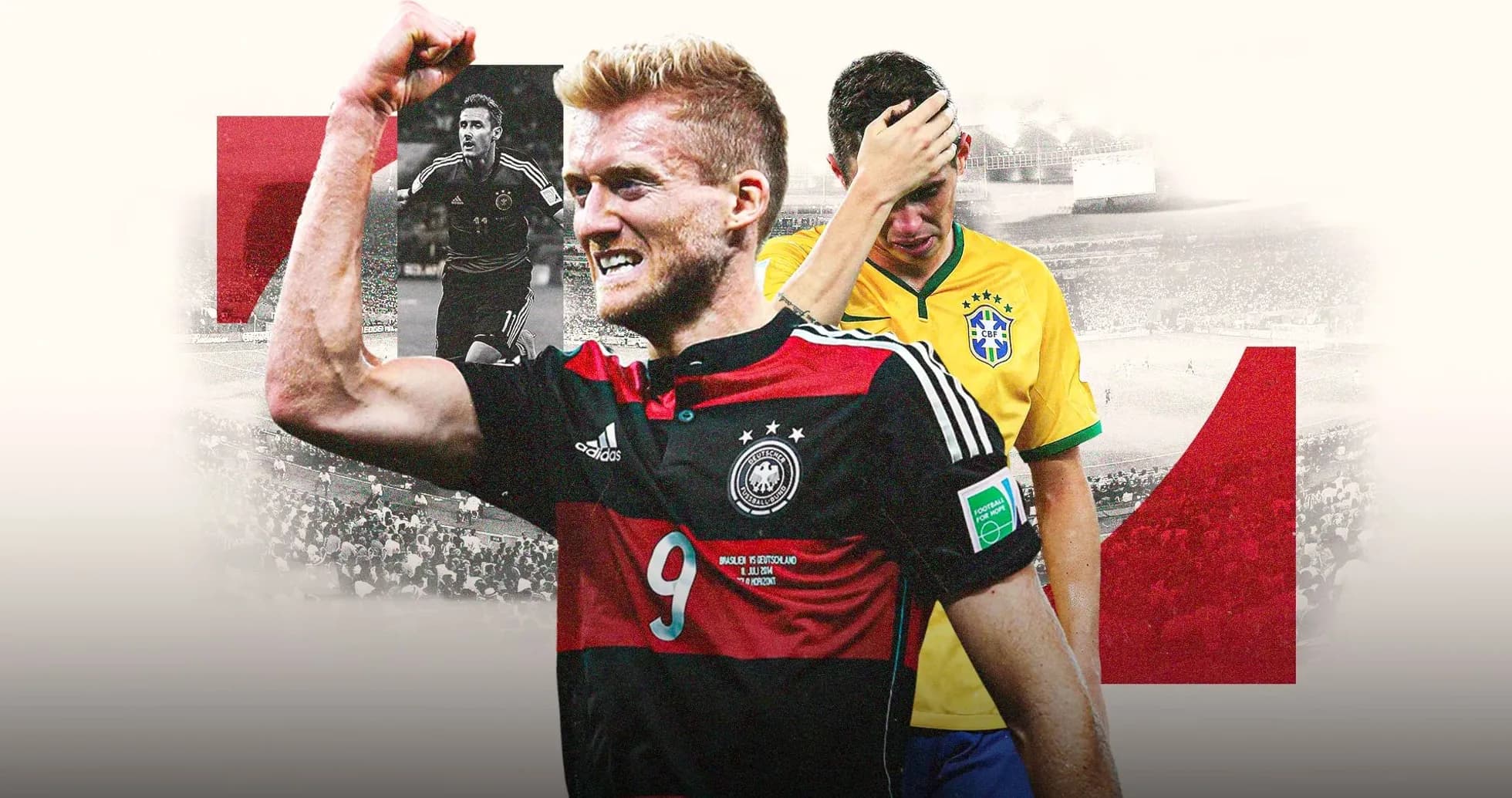
At half-time, Low told his players to show restraint. They listened, but not completely. Substitute Andre Schurrle added two more in the second half. Only Oscar’s late goal softened the final blow: 1-7. A scar that will never fully heal.
Germany’s response off the pitch matched their dominance on it. The DFB posted a message in Portuguese on social media: “Since 2006, we know how painful it is to lose a semi-final in your own country. We wish you all the best for the future.” Attached were images that cut through the noise: Schweinsteiger consoling David Luiz, Muller patting Dante on the back, Philipp Lahm comforting Oscar, and one photograph that came to define the night.
An elderly Brazilian man, moustached, in tears, clutching a replica World Cup trophy in the stands. Later, he handed that trophy to a young German fan. The man was identified as Clovis Acosta Fernandes, a devoted supporter who had followed Brazil around the world. This, almost certainly, was his most bitter night.
After the match, he posted an old picture on Facebook: himself with Franz Beckenbauer at the 1990 World Cup. Beneath it, in German, he wrote: “I hope that on Sunday you will lift the trophy in the sacred temple of football, the Maracana.”
He wasn’t alone. Across Brazil, a consensus formed. The humiliation of the semi-final did not turn the country against Germany. It turned them towards them. Their opponent in the final would be Argentina, the old rival, the neighbour whose footballing shadow looms large. In that context, Germany suddenly looked like the lesser of two enemies – and, for many, a team to be actively backed.
The Brazilian portal UOL went even further, declaring that Germany were “more Brazilian than Brazil” thanks to their attacking style and, yes, those red and black shirts. O Estado de Sao Paulo hailed the Germans’ “exceptional behaviour”, saying they had learned to understand the spirit of the region. Lance, looking ahead to the final, ran a simple line: “We are all Germany.”
A title – and a new kind of legacy
In the final at the Maracana, Germany walked into a cauldron that felt oddly split. Their travelling support was loud, but the noise from Brazilian fans backing them against Argentina gave Low’s side an unexpected second home.
The match itself was tight, tense, defined by missed chances and near-misses. Lionel Messi searched for his moment; Germany hunted for theirs. It came deep into extra-time. Andre Schurrle surged down the left and whipped in a cross. Mario Gotze cushioned the ball on his chest and volleyed past Sergio Romero.
1-0. Germany’s fourth World Cup. A golden generation finally crowned, in the “sacred temple” Clovis had mentioned.
They had done more than win a trophy. They had rewritten their image in the very country that worships football like no other. The team that once symbolised cold efficiency left Brazil with warmth, affection and a surprising army of new fans.
Podolski, fittingly, posed with the World Cup trophy in a Flamengo jersey, red and black wrapped around gold. For the “red and black nation”, a little piece of their identity stood on the podium that night.
Germany came to Brazil to chase a title. They left having captured something far rarer: the hearts of a country that had every reason to hate them, but chose, instead, to sing their name.