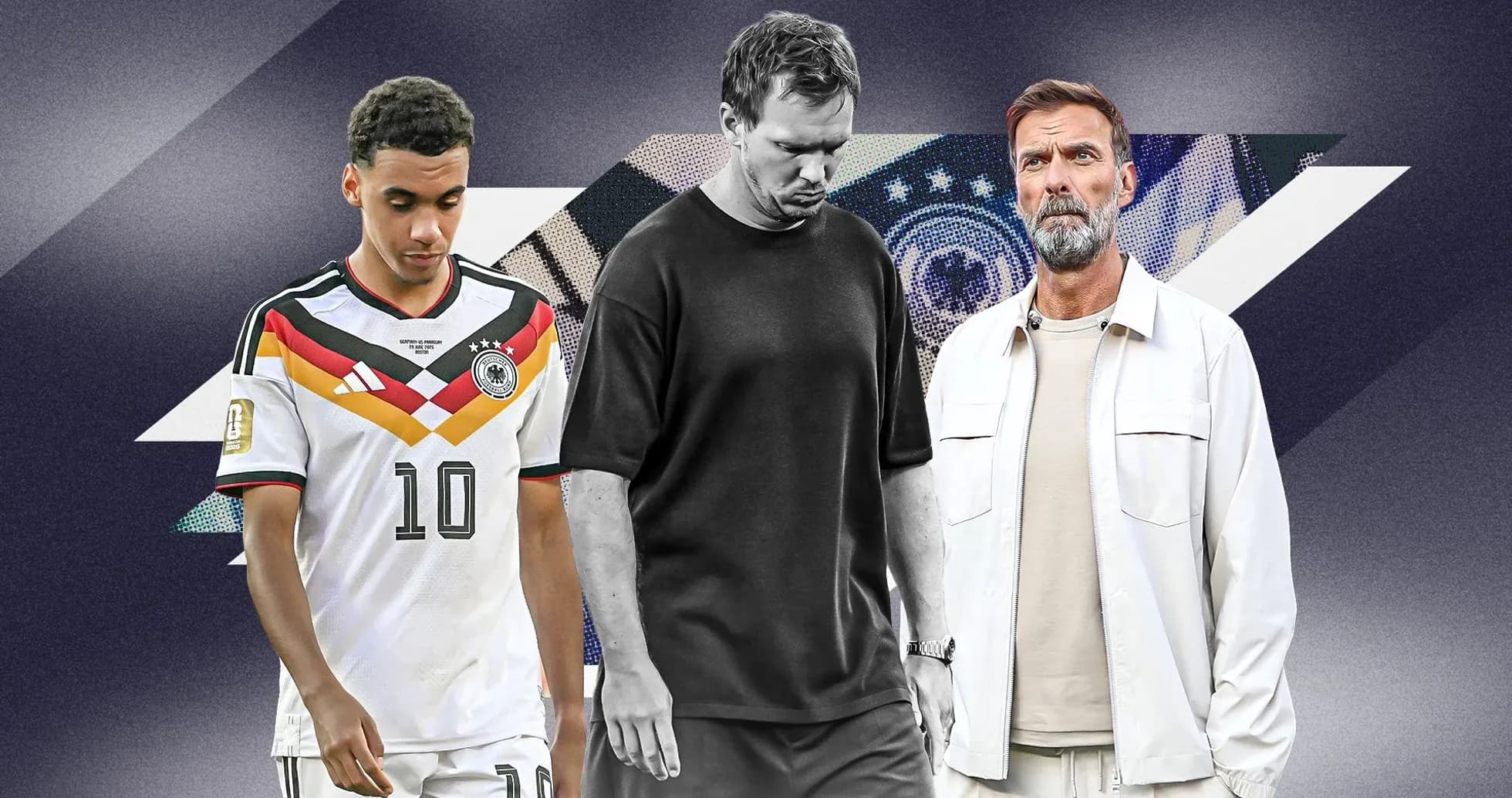
Germany's World Cup Woes: The Need for Change
Germany once again finds itself staring into the same abyss – and this time, there can be no hesitation.
When the 2018 World Cup collapsed in on Joachim Löw, the warning lights flashed bright red. Defeats to Mexico and South Korea sent the defending champions home in the group stage and should have closed the book on a glorious 12-year reign. Instead, sentimentality won. Löw stayed. Germany drifted. Three years later, they limped out of Euro 2021 in the last 16 against England and only then did he walk away.
The pattern repeated with Hansi Flick. He rode a wave of optimism into Qatar, only to crash out in the group stage again, undone by a defeat to Japan after taking the lead. Once more, the expectation was clear: the coach would go. Once more, the DFB blinked. Flick clung on until the autumn of 2023, when a string of poor results finally forced the federation’s hand and opened the door for Julian Nagelsmann.
The DFB cannot afford a third act of the same play.
From golden hope to spent force
Nagelsmann’s arrival in September 2023 felt like a reset. Young, sharp, tactically adventurous, with a track record at RB Leipzig and Bayern Munich, he was billed as the man to drag Die Mannschaft back to the summit of the world game.
At Euro 2024 on home soil, he did something vital: he made Germany relevant again at a major tournament. The team reached the quarter-finals, the football was vibrant in spells, and a fractured relationship between players, coach and supporters briefly healed. After eight barren years, it felt like a foundation.
The exit to eventual champions Spain hurt, though, and Nagelsmann wasted no time in raising the stakes. The 2026 World Cup, he declared, was his next target. For a moment, it sounded like natural ambition from a coach riding a crest of popularity, the most admired national team boss since Löw in his prime.
That version of Nagelsmann feels like a long time ago.
Across the last two years, he has burned through his goodwill at a startling speed. The low point came in Foxborough on Monday, when Germany’s World Cup campaign ended with a whimper against Paraguay – a performance that was not just poor, but predictable.
A coach who talked too much – and delivered too little
Nagelsmann’s problems did not start on the pitch. He chose, almost compulsively, to use press conferences and interviews as a stage for detailed individual critiques of his own players. Every few weeks, another name, another analysis, another sharp edge.
What might have been framed as straight-talking quickly began to look like something else: a craving for attention, a need to control the narrative. Some statements were clumsy, others simply untrue. Promises about roles and responsibilities were made and then quietly broken. When challenged, Nagelsmann often lost his composure and lapsed into a patronising tone, a pattern that surfaced repeatedly during this World Cup.
Those words would have been easier to stomach had his decisions been flawless. They were not.
Toni Kroos’ triumphant return for the Euros had hinted at a coach capable of brave, clean calls. Yet for this World Cup, Nagelsmann dragged 40-year-old Manuel Neuer out of international retirement, despite repeatedly insisting he had no such plans. The move undercut Oliver Baumann, who had been exemplary throughout qualifying, and it was handled clumsily from start to finish. Neuer did nothing that Baumann could not have done. The supposed upgrade never materialised.
Then there was Joshua Kimmich. Germany’s captain became a symbol of Nagelsmann’s indecision, shunted between right-back and central midfield, even within the same match. In the defeat to Paraguay, that positional flip-flopping summed up a coach unsure of his own structure.
A World Cup without identity
Germany’s World Cup showing was a slow-motion failure. It did not come out of nowhere. The team had shown no real evolution since the Euros. Apart from a brief second-half surge against minnows Curaçao, they laboured through the tournament.
The problems were stark. Up front, Germany lacked invention and punch. At the back, they looked brittle and easily unsettled. Against Ivory Coast, Ecuador and Paraguay – none of them superpowers – they floundered. On pure sporting terms, this campaign cut even deeper than 2022, when at least a draw against Spain offered a hint of resistance.
The players did what players often do in such moments: they stood together and took collective responsibility, even going out of their way to absolve Nagelsmann of blame. That solidarity is admirable, but it does not change the core truth. It is the coach’s duty to provide a coherent plan. With a squad full of high-level talent, he never truly did.
His in-game management only underlined the problem. Substitutions against Ecuador raised eyebrows. The decision to start super-sub Deniz Undav against Paraguay, stripping him of the very impact that made him valuable, felt like a misread of both player and moment. The pattern was clear: a coach reacting, not dictating.
Klopp in the studio, Klopp in the air
If there was a particularly cruel twist for Nagelsmann, it came not from the opposition but from the television gantry. Every tactical flaw, every structural weakness, was dissected on air by the man many see as his ideal successor: Jürgen Klopp.
“You have to attack down the wings. There’s no alternative,” Klopp told Magenta TV after Germany’s elimination. He pointed to the obvious: the quality of players like Florian Wirtz and Jamal Musiala, the gap between their club form and what they produced at this World Cup, and the psychological imbalance between a Paraguay side with an opportunity and a German team weighed down by expectation.
“Everyone in the stadium thought: Now they’ll turn it around! But we didn’t. We let them off the hook,” he said, before turning his gaze towards the DFB: “We can talk about the DFB. We absolutely have to change a few things.”
For many supporters, that “change” has a name. Klopp, now Red Bull’s head of soccer, is the dream ticket: the ex-Liverpool and Borussia Dortmund boss stepping into the national team dugout, leading Germany into Euro 2028 and the 2030 World Cup. His appointment would trigger a surge of euphoria across German football.
Klopp, as ever, chose his words carefully when asked about it in Boston.
“I haven’t thought about that yet. I understand that when the national coach position is discussed, my name is mentioned in some form. But it’s not the moment to really talk about it. There’s nothing to say about it. I have a job that I enjoy very much. As far as I know, it’s not a part-time job.”
No commitment. No rejection. Just a door left slightly ajar.
No more waiting
Inside the Germany camp, Nagelsmann still has public backing. Senior players have spoken up for him. Sporting director Rudi Völler has offered support. On paper, the DFB could point to continuity and argue for patience.
They have been here before. Twice. Each time, they waited. Each time, the rot spread.
This is where the federation must finally break its own cycle. They have to move on from Nagelsmann, and they have to do it quickly. Not because he is a bad coach, but because this version of Germany under him has hit a ceiling and shows no sign of breaking through it.
Klopp may or may not be the answer. He may decide that his current role suits him too well, or that international football does not fit his rhythm. But one thing is certain: Germany cannot assume that their brightest hope will sit by the phone indefinitely.
The DFB’s next call will define the next decade. The question is whether they make it in time.