Germany's World Cup Nightmare: A Historic Crash in Boston
Germany’s World Cup crash in Boston will live long in the country’s footballing nightmares. Not just because Paraguay, ranked 41st in the world, sent them home on penalties. Not just because it was the first World Cup shootout defeat in their history. But because one of the men billed as the future of the team, Florian Wirtz, walked off as one of the central symbols of a golden promise gone badly flat.
A historic fall, one kick at a time
Julio Enciso lit the fuse. His first-half strike put Paraguay in front and turned what many in Germany expected to be a routine step into the knockouts into a street fight under the Boston lights.
Germany did respond. Wirtz, under the microscope all tournament, bent in the kind of teasing cross Liverpool thought they were paying £116million for. Kai Havertz met it with a deft glance, and the 2014 champions were level. For a moment, the script looked familiar: German nerves steadied, German quality rising.
Then came the chaos.
Jonathan Tah thought he had written the escape act. His finish looked set to drag Germany over the line, only for VAR to rip it away. Officials judged Paraguay goalkeeper Orlando Gill had been fouled in the build-up. German celebrations froze mid-air, replaced by disbelief and fury.
The game staggered to penalties. Germany’s old sanctuary. Their stage.
Not this time.
Havertz stepped up first and saw Gill read him and parry. Nick Woltemade, the Newcastle forward, followed and suffered the same fate. Paraguay twice had the chance to finish it, but Antonio Sanabria and Fabian Balbuena blinked from 12 yards.
Germany, somehow, were still alive.
Then Tah, already the nearly man of normal time, ballooned his kick over the bar. Jose Canale did what German players have done to so many others down the years: walked up, kept his nerve and buried his penalty. Paraguay 4-3 Germany in the shootout. A nation stunned.
Wirtz in the firing line
The inquest began before the players had even left the pitch. Florian Wirtz, despite his assist, found himself in the crosshairs.
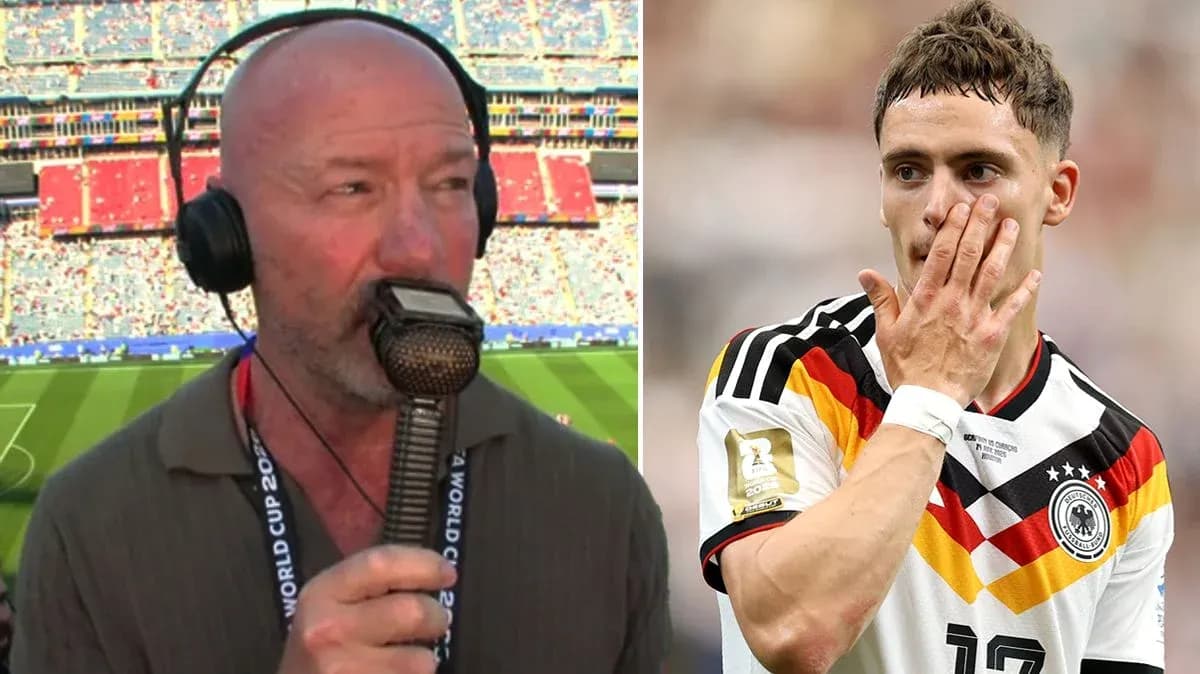
On Netflix’s The Rest is Football, Alan Shearer didn’t bother dressing it up. He grouped Wirtz among a cluster of big names who, in his view, shrank when the tournament demanded more.
"They've got the quality in names and on paper, but they just didn't deliver," the former England striker said, before going through the cast list.
"You look at [Leroy] Sane, not a great season. [Denis] Undav they had to bring in to try and give them some oomph in and around the penalty area. Wirtz has had a terrible season at Liverpool, he hasn't performed again at this World Cup.
"So it's alright saying they've got the quality, but the quality wasn't there. We've seen them put seven past Curacao, well that's alright - but when it really mattered, the quality wasn't there at all."
When Micah Richards pointed to Wirtz’s £116m move to Liverpool as proof of his ceiling – “he’s got the quality” – Shearer cut straight back: "What's he done this season?"
Richards pushed back, unwilling to let the criticism become a character assassination. "He's a superstar. We've not seen the best of him, totally agree with that, but we can't say he's not a good player.
"Havertz has scored in Champions League finals [in 2021 and 2026]. He's just won the Premier League. Tah gets his big move and goes to Bayern Munich, [Antonio] Rudiger at Madrid is a consistent performer. Young [Nathaniel] Brown doing really well. So I agree in terms of what they produced, I think that's very fair to say. But we can't say this German team hasn't got quality."
That is the heart of the German dilemma. The names scream pedigree. The performances scream something else entirely.
A pattern Germany can’t ignore
This wasn’t a one-off bad night. It was the latest chapter in a grim trilogy.
Germany smashed Curacao 7-1 in their opener, a scoreline that now feels like a cruel illusion. They edged Ivory Coast 2-1, then lost 2-1 to Ecuador. The old aura – inevitability, control, ruthlessness – never truly appeared. When the stakes rose in Boston, the cracks split wide open.
It is now three consecutive World Cup finals campaigns without a last-16 appearance. For a country that once treated quarter-finals as a bare minimum, that is more than a blip. It is a rebranding, and not the kind anyone in the DFB wants.
Nagelsmann digs in as legends circle
Julian Nagelsmann knows exactly what this means. He didn’t pretend otherwise.
"When you exit the World Cup after you play Paraguay it is very bitter. It is very hurtful," he said. "This is the third elimination in a row, so we are not part of the first-class teams any more.
"If we're going to do a survey today in Germany, people are not going to speak about me positively obviously. I did feel the support in the stadium. I don't think everyone in Germany will agree with me staying on and continuing as manager of the team.
"I'd like to praise all the German fans who came to the stadium. I expected a totally different reaction from them but it was amazing and impressive the way they supported us, even after the defeat.
"I'm not going to step back only because we are eliminated. If the DFB [German Football Association] want me to continue, I am going to continue. I know how the industry works and a lot of people now want me to leave. I want to continue if the German FA wants me to."
Defiant words. They landed with a thud among some of those who once wore the shirt.
Thomas Hitzlsperger, on BBC One, didn’t spare him. "It's hard to explain how Germany got into this tournament with so many problems. It's unacceptable. It doesn't look good for Nagelsmann. In the last few months, he hasn't dealt with situations well. With the expanded World Cup format, to go out so early would be tough to take for any big nation."
Arne Friedrich, on BBC Radio 5 Live, went even further. "If you consider the whole tournament, the way we played, it is a deserved loss. Nagelsmann has to face the consequences. It is very disappointing, but that is sport. I would definitely say the journey continues without Nagelsmann."
The verdict from the old guard is brutal: this is not just a bad campaign; it is a failure that should cost the coach his job.
Where do Germany – and Wirtz – go from here?
Germany’s first World Cup penalty shootout defeat, their first shootout loss in any international tournament since 1976, will echo for years. It cuts at the very mythology the national team built over generations: that when the pressure peaked, they held their nerve while others crumbled.
Now it is Germany blinking, Germany misfiring from 12 yards, Germany going home early.
For Nagelsmann, the next few weeks will decide whether he gets the chance to repair this broken image or becomes another casualty of a decline no one in German football seems able to halt.
For Florian Wirtz, the glare will be just as fierce. Liverpool paid for a player expected to shape eras, not disappear in defining moments. The talent is obvious. The questions, after Boston, are louder.
Is this just a brutal lesson on a big stage, or the first warning sign that German football’s next generation might be carrying more hype than substance?