Gianni Infantino Under Siege: Uefa's Legal Challenge
“Tom, can you get me off the hook? For old times’ sake?”
“Sorry. Can’t do it.”
For years, the idea that Gianni Infantino might actually be brought down felt like fantasy. Football’s own untouchable. The man in charge of the world’s game, wrapped in layers of power, protocol and pliant congress votes.
This week, that changed. Not because of another outraged column. Not because Mikaël Silvestre added his name to the chorus of disapproval. Because hard power finally walked into the room.
Infantino has been under siege for almost six weeks, ever since revelations emerged of his covert attempt to sell off football’s shared global crown jewels – the World Cup rights – in a deal that also carried vast personal financial upside. The Fifa president, charged with guarding the game’s greatest asset, is accused of trying to cash it in.
The noise since then has been constant: talk of his reputation turning toxic, of support draining away, of a rival candidate emerging before the next presidential election in March. Yet power like his doesn’t just evaporate. It burrows in. It survives. It waits for the storm to pass.
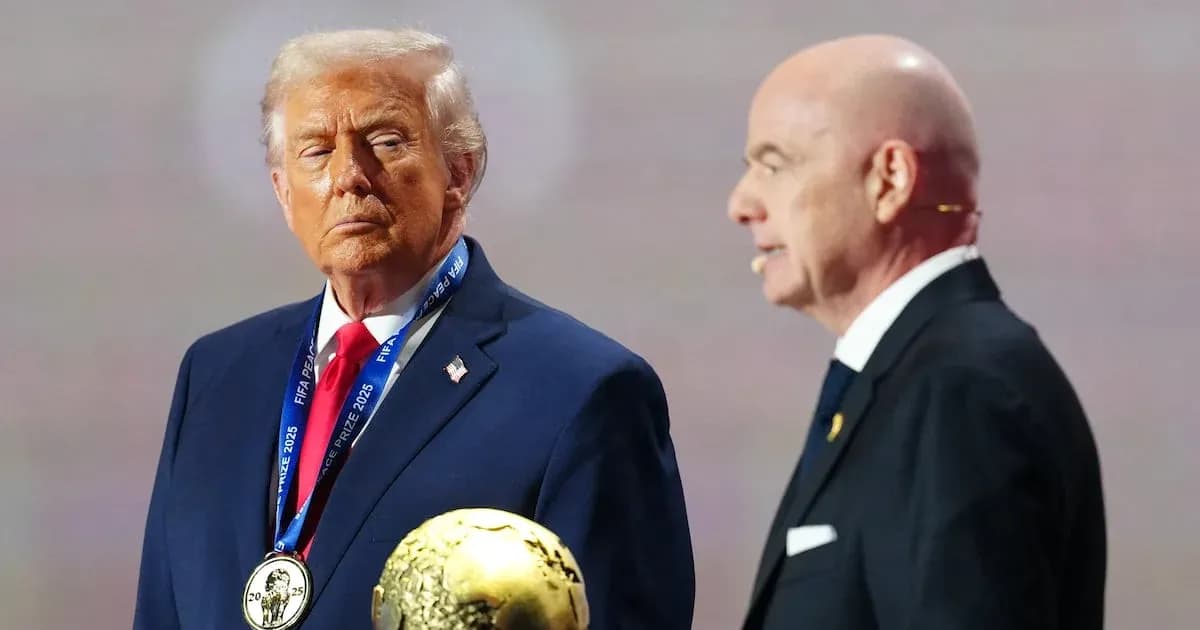
For now, he remains the man who sold the world. Twice. Once to global capital, once to Donald Trump – in exchange for flattery, a peace prize push and a place at the fringes of American political theatre.
Give it a month, the thinking went, and Infantino would be back on the stage, arms whirling at a lectern, talking about caring and sharing, equality and fraternity, sprinkling in a little fiscal stimulus. The familiar act. The painted-on calm. Those flat, unblinking eyes behind the papier-mache mask of power.
You don’t buy me out. I buy you out.
But something shifted when Uefa moved from words to law. Its lawsuit, accusing Fifa and Infantino of “criminal mismanagement” over an alleged undervaluing of World Cup rights, may never have been designed to win outright. It looks more like a chess trap, a zugzwang: force the king to move, when every square is dangerous.
The key is discovery. The dreaded word in every boardroom.
This week, the first crack appeared. Josh Kushner, the finance figure behind the Fifa Forward deal and brother of Jared Kushner, was named as a party to discovery in Florida. The money man, linked by family and politics to the Trump inner circle, suddenly wanted daylight between himself and the project.
Kushner issued a statement. He said he “would not have gotten involved” in Fifa’s plans had he known the full picture. He called the whole thing regrettable. On the surface, mild. Between the lines, a clear step back from the protective embrace that had once surrounded Infantino.
He also hired Alex Spiro, the lawyer you call when the stakes are nuclear. The man who defended Elon Musk after the “pedo” slur. The man who stood for Alec Baldwin after a fatal on-set shooting. That is not a casual choice. That is a shield being raised.
Fifa’s own legal response this week carried the same nervous energy. The organisation dismissed the entire affair as a “smear campaign”, then immediately gave away its real fear by stressing its urgent intention to resist discovery.
Because discovery is brutal. It is the opening of the box: internal memos, WhatsApp messages, emails fired off from the golf course after lunch. It is the paper trail of power, laid out on a table.
No one on Infantino’s side wants that. Certainly not anyone whose orbit touches Trump. History tells them why.
Trump’s early backing of Infantino last month came with a flourish on Truth Social. He warned that removing the Fifa president “for any reason” would be a terrible move. Even then, it sounded less like an oath of loyalty and more like a conditional nod. Since then, silence.
The sense now is of a slow walk away. The old images of the Infantino–Trump bromance – the two of them laughing like catalogue models in a Brooks Brothers knitwear spread – feel like relics. The gleaming bald operator to power, alongside his indulgent patron, a man who always looks like a giant, honey-glazed, deep-fried portion of American food that has learned to speak and compliment tall, handsome men.
The problem with Trumpian backing is simple: it never truly belongs to you. It belongs to the moment. There is no ideology, no shared creed, just a ledger of winners and losers. If you slide towards the wrong side of that divide, the trapdoor opens.
The Guardian once listed Trump’s enemies and ex-allies who later faced charges, investigations, exile, or public humiliation. It made grim reading. Michael Cohen, who once said he would “take a bullet” for Trump, ended up imprisoned, disbarred and politically marooned. Jeff Sessions, the attorney general who called Trumpism “a movement”, was tossed aside and branded weak, confused, dumb, an idiot, a disgrace, even “mentally retarded”.
You’re in until you’re not. And when you’re not, the fall is swift.
This is the shadow now creeping across Infantino’s world. The corridors that once felt crowded suddenly seem empty. Fewer cops on the doors. Fewer people willing to stand on the ward and say: he’s with us.
The legal heart of it is stark. Uefa accuses Fifa and its president of criminal mismanagement over the sale of World Cup rights, arguing they were significantly undervalued. Alongside that, Infantino is alleged to have stood to gain a vast personal salary from the structure of the deal. The case asks a blunt question: what exactly was going on inside Fifa when those contracts were drawn up?
To answer it, Uefa wants discovery not only from Fifa but from Thrive Capital, Kushner’s firm, and Greg Maffei, the Trump donor and deal adviser who was part of those talks. All of them will have documents, notes, messages from that period when Infantino enjoyed intoxicating access to the upper tiers of American power.
The image that springs to mind is the Club World Cup trophy: jagged, sharp-edged, unsettling. You can imagine a secret compartment hidden in its base, full of things you’d rather not see. Do you really want to open it? And once you do, can you ever pretend you didn’t look?
“Please, Mike, don’t do this, don’t do this to me.”
“Today I settle all family business. So don’t tell me you’re innocent.”
Infantino is not sitting still. He is out on the road, touring Fifa’s outer provinces, shaking hands, counting votes, trying to shore up the base. Saudi Arabia has offered backing, but even that came with a telling caveat – support “at this time …”, nothing more.
There is a Fifa congress in November. On paper, that is where power is confirmed or challenged, where votes are tallied and mandates renewed. In reality, the question now is whether the ballot box is still the real battlefield.
Sepp Blatter and Michel Platini both looked unassailable once. It took a single “disloyal payment” allegation to knock them off their pedestals. One transfer of money, one unexplained transaction, and the whole edifice collapsed.
So this will simmer. Legal cases drag on. Many fade. Some explode. Uefa does not need a courtroom victory to change the landscape. It just needs to keep turning the screw, to show it will rake the coals and force open the drawers.
Because once the documents start to flow, once the emails and messages spill out, the question for Infantino will be brutally simple: is there anywhere left to hide?