Hapoel Beer Sheva Dominates FK Crvena Zvezda in UEFA Qualifier
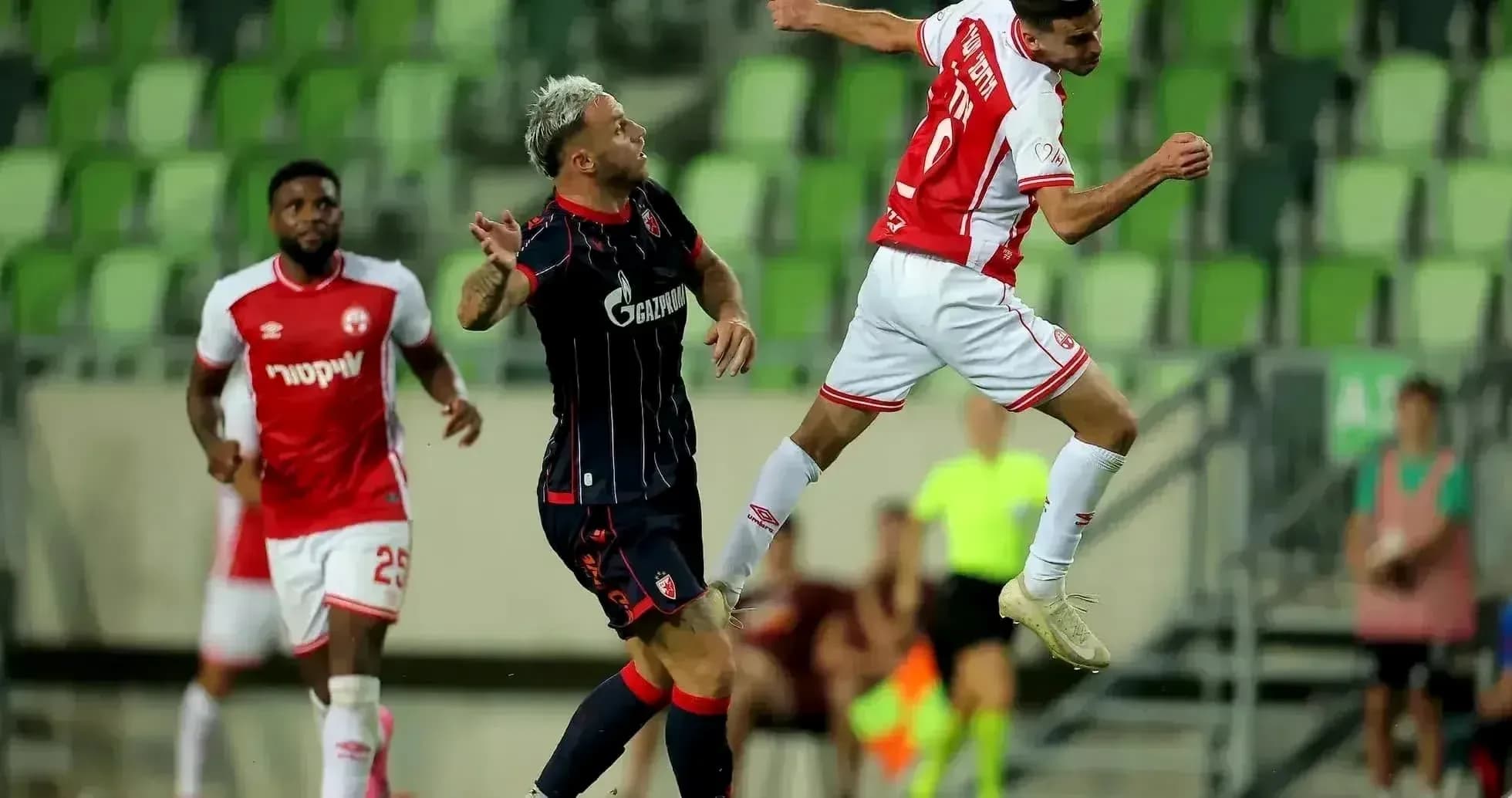
FK Crvena Zvezda’s 0-2 home defeat to Hapoel Beer Sheva at Stadium Rajko Mitić in the UEFA Champions League 3rd Qualifying Round was defined by a stark structural imbalance. The visitors’ 4-3-3, built on long, controlled possession phases, completely suffocated a Zvezda side nominally set up in a 4-2-3-1 but unable to progress the ball. With Hapoel Beer Sheva holding 96% of the ball to Zvezda’s 4%, the game became a prolonged defensive exercise for the hosts, further compromised by two red cards. The Israeli side translated their territorial dominance into six shots on goal and two well-timed strikes after the break to take full control of the tie.
First Half
FK Crvena Zvezda’s 4-2-3-1 was, in theory, balanced: Matheus in goal behind a back four of Seol Young-Woo, D. Luckassen, S. Erakovic and N. Tiknizyan; a double pivot of T. Elsnik and R. Krunic; O. Bukari and V. Kostov flanking Bruno Duarte, with J. Enem as the central forward. In practice, the structure never connected. With only 3 corner kicks and 2 shots on goal, Zvezda’s attacks were sporadic and direct, often bypassing midfield. The double pivot was pinned deep, forced into a purely protective role, and the front four were left chasing long balls rather than combining between the lines.
Hapoel Beer Sheva’s Tactical Approach
Hapoel Beer Sheva’s 4-3-3, by contrast, was textbook territorial control. O. Marciano in goal was protected by a back line of G. Mizrahi, Miguel Vitor, I. Rotman and P. Amador. In front of them, E. Peretz, Lucas Ventura and N. Yehoshua formed a three-man midfield that dictated rhythm and spacing. Up front, J. East and Z. Ahmed flanked central striker I. Zlatanovic. The midfield triangle was the key: Lucas Ventura’s positioning allowed Beer Sheva to recycle possession relentlessly, while Peretz and Yehoshua alternated between advancing into half-spaces and dropping to create overloads in the first phase.
The possession split — 96% to 4% — underlines just how extreme Beer Sheva’s control was. Zvezda’s inability to string passes together meant they could not push their block up; the back four were constantly defending their own third, and full-backs Seol Young-Woo and Tiknizyan rarely advanced in sync. This isolated Bukari and Kostov, who were often forced to press wide alone rather than as part of a coordinated front line. Without sustained possession, Zvezda’s 4-2-3-1 collapsed into a low 4-4-1 or even 4-5-0 shape, with Bruno Duarte and J. Enem starved of service.
Turning Points
The turning points were disciplinary and tactical. The first half ended goalless, but the pattern was already clear: Beer Sheva patiently circulating, Zvezda chasing. At 46', Dejan Stankovic moved aggressively, with M. Arnautovic (IN) coming on for J. Enem (OUT) and M. Abu Fani (IN) replacing T. Elsnik (OUT). The intention was to inject more verticality and ball-winning into midfield and freshen the front line. However, the red card to D. Stankovic at 57' immediately undermined any structural adjustment, leaving Zvezda down a man and even more stretched.
Beer Sheva capitalised on the numerical and territorial superiority. At 61', I. Zlatanovic finished a move supplied by J. East, a logical outcome of sustained pressure and central occupation. Zvezda tried to respond with further changes: M. Ivanic (IN) for V. Kostov (OUT) at 62' and later M. Cham (IN) for O. Bukari (OUT) at 73', plus A. Katai (IN) for N. Tiknizyan (OUT) at 80'. These substitutions hinted at a switch toward more creativity and risk on the flanks, but with so little of the ball, the new entrants were largely restricted to defensive running and transitional moments rather than structured attacks.
Beer Sheva’s Bench Management
Beer Sheva’s bench management was more about maintaining control than changing the game’s direction. H. Kanaan (IN) replaced G. Mizrahi (OUT) and M. Abu Rumi (IN) replaced N. Yehoshua (OUT) at 66', refreshing the right side and midfield legs while preserving the 4-3-3 shape. Later, D. T. Diop (IN) came on for I. Zlatanovic (OUT) at 76', and in stoppage time O. Davidzada (IN) for P. Amador (OUT) and A. Ohana (IN) for J. East (OUT) at 90+2' allowed Beer Sheva to close the game with fresh energy in wide and defensive zones.
The second goal at 79' — J. East scoring from an E. Peretz assist — encapsulated Beer Sheva’s tactical superiority: a midfielder arriving in a pocket to play the decisive ball, a wide forward exploiting space, and Zvezda’s back line unable to compress distances quickly enough after yet another defensive phase. By then, Zvezda were not only a man down but also physically and mentally drained from defending for almost the entire match.
Discipline and Tactical Landscape
Discipline further tilted the tactical landscape. Hapoel Beer Sheva picked up 2 yellow cards (I. Rotman for "Holding" at 22', Lucas Ventura for "Roughing" at 63'), but these were isolated incidents within an otherwise controlled pressing scheme — 5 fouls total for the visitors. FK Crvena Zvezda committed 10 fouls and suffered 2 red cards, the second to M. Abu Fani for "Roughing" at 90+2', which compounded their numerical inferiority in the closing stages. The expulsions forced Zvezda to defend even deeper and abandon any realistic chance of a late comeback.
Statistical Overview
In statistical terms, the shot profile reinforces the tactical story. Hapoel Beer Sheva produced 6 shots on goal from a platform of almost uninterrupted possession, plus 1 blocked shot, showing they consistently reached dangerous zones. FK Crvena Zvezda managed only 2 shots on goal and 2 blocked shots, a meagre return for a home side in a European qualifier. The equal number of corner kicks (3-3) is misleading; Beer Sheva’s corners came as the culmination of sustained pressure, while Zvezda’s were rare moments of relief.
Overall, Beer Sheva’s 4-3-3 functioned as a high-control, low-risk system that smothered Zvezda’s 4-2-3-1. The visitors’ midfield triangle dictated tempo, their front three provided depth and width, and their back line rarely had to defend large spaces. Zvezda’s structural idea was not inherently flawed, but with almost no possession, frequent fouls, and two red cards, it never had a chance to manifest. The 0-2 scoreline accurately reflects a match where tactical control and discipline were overwhelmingly in Hapoel Beer Sheva’s favour.