Inter Dominates Monza 4–1 in Serie A Opener
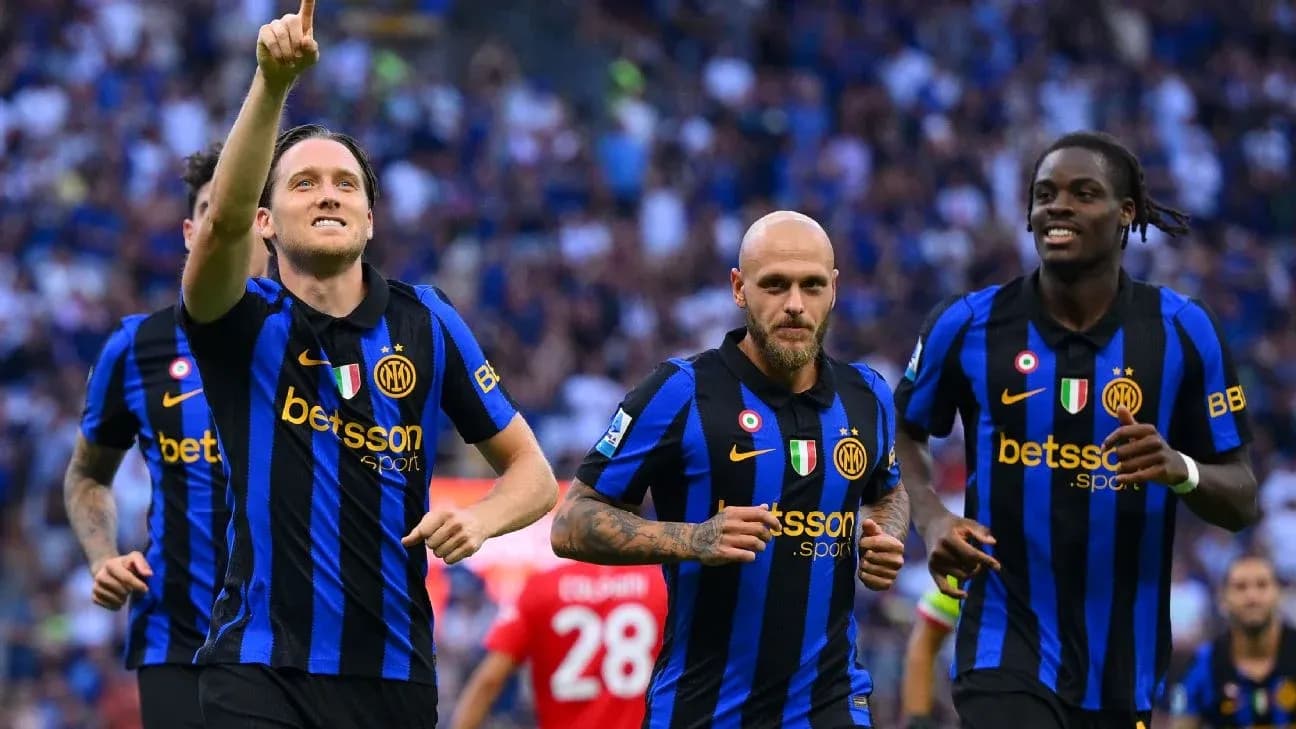
San Siro’s first Serie A night of 2026-27 ended with a statement: Inter 4–1 Monza, a scoreline that mirrored the gulf in structure, experience and depth between a polished contender and a patched‑up visitor.
I. The Big Picture – Inter’s early authority, Monza’s reality check
Following this result, Inter sit 1st with 3 points, a goal difference of +3 (4 goals scored, 1 conceded) from 1 match. At home they have played 1, won 1, scoring 4 and conceding 1. Monza, on their travels, leave Milan 20th with 0 points and a goal difference of −3 (1 goal scored, 4 conceded) from 1 away match.
Cristian Chivu’s 3-5-2 was as orthodox as it was ruthless. J. Martinez in goal, a back three of Y. Bisseck, M. Akanji and A. Bastoni, with F. Dimarco and A. Diouf as wing‑backs flanking a central trio of N. Barella, H. Calhanoglu and P. Zielinski. Up front, the new‑look strike partnership of F. Esposito and L. Martinez offered contrasting profiles: a tall, link‑up forward beside a more explosive runner.
Ivan Juric answered with a 3-4-3: S. Pizzignacco behind a youthful defensive line of E. Kouadio, L. Lucchesi and A. Carboni; S. Birindelli and A. Bakoune wide, with F. Ondoa and M. Mout central. The front three of A. Colpani, G. Varela and R. Mangas was built to counter, not to dominate.
Over 90 minutes, Inter’s season‑opening numbers tell a blunt story: overall they average 4.0 goals scored and 1.0 conceded per game, with no clean sheets but a clear attacking edge. Monza’s mirror is harsh: on their travels they average 1.0 goal for and 4.0 against, failing to keep a clean sheet and already carrying the heaviest away defeat, 4–1.
II. Tactical Voids – Suspensions and absences shape the chessboard
Both sides arrived with notable absentees that quietly redrew their tactical maps.
For Inter, H. Mkhitaryan was suspended, while D. Spence and M. Spinacce were unavailable. Mkhitaryan’s absence removed a veteran tempo‑setter and late‑runner from midfield, nudging Chivu toward a more vertical, physically dynamic trio built around Barella’s energy, Calhanoglu’s orchestration and Zielinski’s timing. It also opened a clear lane for A. Diouf to start wide and then drift inside, a choice that would define the game’s rhythm.
Monza’s list was longer and more brutal. E. Akinsanmiro (muscle injury), P. Ciurria (inactive), L. Colombo (injury), D. Mota (suspended), M. Pessina (knee injury), D. Thiam (suspended for yellow cards) and I. Toure (knee injury) all missed out. Juric was stripped of his natural reference points: Pessina’s leadership and control in midfield, Mota and Colombo’s presence in the final third, and Ciurria’s work rate between the lines. Instead, an 18‑year‑old M. Mout was asked to anchor and connect, and G. Varela had to be both outlet and finisher.
Disciplinary trends underline the strain. Inter’s yellow cards this season have come in two distinct bursts: 50.00% between 31–45 minutes and 50.00% between 46–60 minutes. It is a side that tightens the screws around half‑time, pressing more aggressively and accepting bookings as the cost of control. Monza’s cautions, by contrast, are late and reactive: 50.00% between 61–75 minutes and 50.00% between 76–90 minutes, a sign of chasing games and making tired, last‑ditch interventions.
III. Key Matchups – Hunter vs Shield, Engine Room battles
Hunter vs Shield: Inter’s front line vs Monza’s back three
F. Esposito’s emergence as both scorer and creator was the night’s defining “hunter” story. With 1 goal and 1 assist from 3 shots (1 on target), plus 43 passes and 2 key passes, he blurred the line between number nine and facilitator. His duels record – 9 contested, 6 won – shows how often he pinned or rolled Monza’s centre‑backs, especially L. Lucchesi and E. Kouadio, to open corridors for runners.
Monza’s “shield” struggled. Kouadio, who finished with 2 tackles and 7 interceptions, read danger reasonably well but was repeatedly dragged into wide and high zones, leaving gaps behind. Lucchesi posted 2 tackles, 1 block and 4 interceptions, yet his 4 fouls and yellow card reflected how often he arrived a fraction late, forced to foul rather than front‑foot defend. Together, they could not compress the space between the lines quickly enough once Inter broke the first press.
On their travels, Monza’s average of 4.0 goals conceded is the raw statistical echo of that structural fragility. Inter at home, averaging 4.0 goals scored, simply magnified it.
Engine Room: Calhanoglu and Zielinski vs Mout and Ondoa
In midfield, the duel was more cerebral. H. Calhanoglu’s 60 passes at 93% accuracy, 1 key pass, 1 tackle, 1 block and 1 interception show a regista who both dictated tempo and protected transitions. His yellow card underlines how aggressively he stepped into duels, accepting risk to keep Inter high. P. Zielinski, with 64 passes at 87% accuracy and 1 goal, was the late‑arriving threat Monza never fully tracked, ghosting into pockets behind M. Mout.
Mout, for his part, produced a quietly impressive resistance: 35 passes, 1 key pass, 3 tackles and 2 interceptions. He read play and competed well in duels (4 contested, 3 won), but with F. Ondoa more of a balancing presence than a true controller, Monza’s double pivot was constantly outnumbered by Inter’s interior rotations and Diouf’s inside runs.
A. Diouf, top of the assist charts with 2 assists, 35 passes at 94% accuracy and 3 key passes, was the hinge of Inter’s design. Starting nominally wide, he repeatedly stepped into the right half‑space to overload Mout, forcing Monza’s wing‑backs to choose between protecting the flank or collapsing centrally. Every time they hesitated, Inter found a free man.
On the flanks, S. Birindelli and A. Bakoune were pinned deep by Dimarco and Diouf. Birindelli’s natural attacking instincts were blunted; without high, wide outlets, Monza’s counters rarely escaped their own half cleanly.
Up front, G. Varela fought a lonely battle. His 1 goal from 3 shots, plus 11 passes at 90% accuracy, shows quality when the ball did reach him, but with only 1 of 9 duels won he was often isolated, receiving under pressure with little support from Colpani or Mangas.
IV. Statistical Prognosis – Inter’s structure, Monza’s climb
Even with only one round played, the statistical contours are stark. Inter’s overall record – 1 win from 1, 4 goals scored, 1 conceded, no penalties taken or missed – speaks of a side that creates from open play, leans on rehearsed patterns and accepts defensive risk to maintain territorial dominance. Their lack of a clean sheet is a minor blemish compared to the fluency shown.
Monza’s early numbers are a warning light. Overall they have played 1, lost 1, with 1 goal for and 4 against, no clean sheets and no penalties. Their disciplinary pattern – yellow cards piling up late, with key defenders like Lucchesi and Kouadio booked – hints at a team defending too deep and too reactively.
From a tactical lens, Inter’s 3-5-2 under Chivu already has a clear spine: Bisseck as the assured ball‑playing defender (66 passes at 95% accuracy, 1 goal, 2 interceptions), Calhanoglu as the metronome, Diouf as the creative engine and Esposito as the multi‑tool forward. Around them, options such as J. Stones, B. Pavard, Carlos Augusto, M. Thuram, Luis Henrique, A. Bonny and J. Iddrissou offer layers of flexibility for future rotations and in‑game adjustments.
Monza, conversely, must weather this early storm. The return of leaders like M. Pessina and attacking references such as D. Mota and L. Colombo will be crucial to lift them from the relegation zone and to turn M. Mout and G. Varela’s promising individual displays into points.
Following this result, the story is simple: Inter look every inch a Champions League‑bound heavyweight; Monza, stripped of key pieces and stretched in every line, leave San Siro with a lesson in the margins that separate survival from ambition.