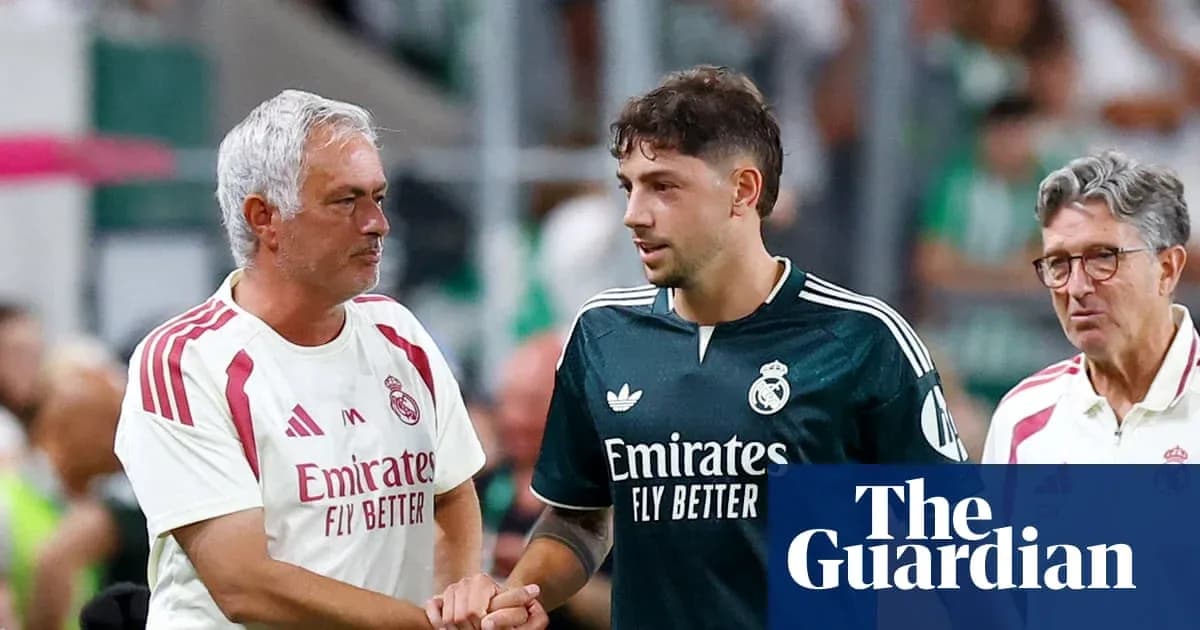
José Mourinho's Return to Real Madrid: A New Era or Nostalgia?
José Mourinho walks back into Real Madrid and, somehow, the story is exactly the same and completely different.
Back in 2010, he arrived to hunt down a Barcelona side ruling Spain and Europe. Spain were freshly crowned world champions, a Barça midfielder had scored the winning goal in Johannesburg, and their opponents had tried to kick them off the pitch. Fourteen years on, Mourinho returns to face another Barcelona who have just won back‑to‑back La Liga titles. Again, he has a glittering squad. Again, the job is to knock Barça off their perch.
Florentino Pérez is still the constant in the background, and this time he has done it his way. Last summer, chief executive José Ángel Sánchez was said to have driven the doomed Xabi Alonso appointment. After that collapse, Pérez seized control. He promised Mourinho’s return if he was re‑elected in June’s snap elections. He won, and in classic Pérez theatre, the club announced Mourinho’s comeback on the opening day of the World Cup.
Not everyone sees this as a simple nostalgia play. Jorge Valdano, who shared those turbulent first Mourinho years from upstairs at the Bernabéu, underlined just how much the landscape has shifted. “Almost 15 years have passed: football is no longer the same, society is not the same, Florentino is no longer the same, and Mourinho certainly won’t be either,” he told A Bola. The context has changed. The expectation hasn’t.
What has not changed is Mourinho’s appeal as the man of order in a club drifting towards disorder. Even after Alonso was sacked in January, the slide continued under Álvaro Arbeloa. The season turned ugly. In May, Federico Valverde ended up in hospital needing stitches after a bust‑up with Aurélien Tchouaméni. Days later, Madrid surrendered the league in the clásico and finished the campaign without a trophy. By then, an online petition demanding Kylian Mbappé’s exit had somehow hit 30 million signatures. Vinícius Júnior, down to the final 12 months of his contract, lived with constant speculation over his future.
Madrid needed a disciplinarian. They got the original.
The rebuild has not been flawless. A £129m bid for Julián Álvarez was rejected by Atlético Madrid. Barcelona look better placed to prise Rodri from Manchester City. Yet the mood around Valdebebas has shifted from panic to poise. Mourinho started working a month before his contract officially began. There has been no grand unveiling, no fireworks. Just a stern line delivered in a short in‑house interview: “It’s not about working at Real Madrid, it is working for Real Madrid.”
The soundbites are mostly saved for his new Netflix documentary. The club have skipped the usual global summer circus and instead played a handful of low‑key friendlies across Europe. For once, the noise has been turned down.
One decision mattered more than any other. After months of Arsenal whispers, Vinícius signed a new six‑year deal. Madrid’s statement was blunt and proud: “Vinícius has become one of the most important players in one of the most successful periods in our history.” Mourinho’s tactical puzzle is obvious. He must fit Vinícius, Mbappé and Jude Bellingham into a coherent, ruthless system. And then there is the new galáctico: Yan Diomandé, a £115m winger who, only last year, was playing for Leganés B in Spain’s fifth tier.
Diomandé’s story is already woven into the Bernabéu’s fabric. He made his Leganés first‑team debut there in March 2025. “Who makes their debut at 18 against Real Madrid? It was a dream. And then it was a nightmare,” he wrote in the Players’ Tribune this summer, while lighting up the World Cup for Côte d’Ivoire. The piece was a raw tribute to his sister Roxane, who died aged 15 after her drink was spiked at a party, just weeks after his La Liga debut. That grief, that edge, comes with him to Madrid.
On the pitch, Mourinho has been handed players who look tailor‑made for his methods. Marc Cucurella will back up Diomandé and Vinícius down the left. Bernardo Silva brings intelligence and control. Ibrahima Konaté offers power at the back. Denzel Dumfries adds width and aggression. Carlos Espí, a 6ft 4in striker, gives Mourinho a classic reference point up front. The squad is stacked with star quality, yet the Portuguese coach remains the biggest attraction of all.
His return to the Bernabéu is a comeback few predicted when his Premier League spells fizzled out and his tour of Europe delivered mixed results. The turning point came last season, when he masterminded Benfica’s extraordinary Champions League escape against Madrid, capped by goalkeeper Anatoliy Trubin’s late goal. That night dragged him back into the elite conversation.
The glow did not last unblemished. After Vinícius accused Benfica’s Gianluca Prestianni of racist abuse – Prestianni was later banned by Uefa for “homophobic conduct” – Mourinho’s comments were condemned by Kick It Out as “a form of gaslighting”. Arbeloa summed up the paradox neatly: “Mourinho is Mourinho.”
Back in Madrid, any lingering tension with Vinícius has been publicly dismissed. “It has gone very well, getting to know the new coach … Mourinho wants me to be as I have always been: happy, cheerful and playing my football,” Vinícius said on returning for pre‑season. For now, there is no sign of a rift.
La Liga Reunion
La Liga itself feels like a reunion tour. Racing Santander are back in the top flight for the first time since 2012 and have brought home one of their prodigies. Sergio Canales, now 35, left Racing at 19 to join Mourinho’s Madrid in that fevered summer of 2010. “I’m still struggling to believe this is real,” he admitted last month. Deportivo and Málaga have also hauled themselves back from the third tier to La Liga for the first time since 2018. Depor’s headline signing is a 37‑year‑old Pierre‑Emerick Aubameyang, a name that still carries weight, even if his peak years are gone.
At the top end, familiar faces remain in familiar dugouts. Diego Simeone starts his 15th full season in charge of Atlético Madrid and will cross paths with Mourinho again in a Madrid derby that suddenly feels like a throwback. Atlético have moved into the post‑Antoine Griezmann era by investing heavily, including signing Lee Kang‑in from Paris Saint‑Germain and handing him Griezmann’s No 7 shirt.
Manuel Pellegrini, the man Mourinho once replaced at the Bernabéu, continues to quietly build at Real Betis. Villarreal, another of Spain’s five Champions League representatives, have turned to Iñigo Pérez after his impressive work at Rayo Vallecano.
Further north, Real Sociedad’s American coach Pellegrino Matarazzo will try to build on the club’s Copa del Rey triumph in April. Across the Basque divide, Athletic Club have gone German again. Edin Terzic takes over the hottest seat in Bilbao, the first German coach there since Jupp Heynckes in 2003. Heynckes left him with a line that captures the club’s soul: “Athletic is the only club where a handshake is more important than a signature.”
And yet, for all the noise around Madrid’s reset, Barcelona still start as favourites.
They have lost Robert Lewandowski to Major League Soccer in the US and still have a gap at centre‑forward, with Atlético refusing to budge on Álvarez. Anthony Gordon has come in to replace Marcus Rashford and will battle the injury‑prone Raphinha for the left‑wing slot. On the right, with respect to Karim Adeyemi, there is no genuine contest. Lamine Yamal, who did not quite explode at the World Cup as many had forecast, returns from America as a world champion and, crucially, still only 19. He is expected to be the ringleader again if Hansi Flick is to emulate Pep Guardiola’s three‑in‑a‑row.
The first clásico comes at the Camp Nou at the end of October. Mourinho against Barcelona again. A league tilting on the old fault line. Has the game really moved on from 2010 – or is Spain about to relive one of its most combustible rivalries, with new stars, new scars and the same old stakes?