Joshua Brenet: From Dutch Prodigy to Curaçao's Key Player
The road from Willemstad’s sun to the German touchline runs through a maze of second chances, disciplinary breaches and a stubborn refusal to disappear. On Sunday night in Germany, Curaçao’s right flank will be patrolled by a man who has already burned through more lives than most professionals get in a career: Joshua Brenet.
He is 32 now, wearing Curaçao’s blue and yellow, but his story is stitched into the fabric of Dutch football and, awkwardly, into the CVs of the two men in the opposite dugout: Julian Nagelsmann and Alfred Schreuder.
A kingdom’s distant heartbeat
Curaçao is still formally part of the Kingdom of the Netherlands, a Caribbean outpost whose footballing influence has long since migrated north. Generations of Curaçaoans settled in Dutch cities, and their children and grandchildren now form the spine of the national team that FIFA finally recognised in 2010.
Of the 26 players in this World Cup squad, only one was actually born on the island: Tahith Chong. The winger who once lit up youth pitches at Manchester United, then faded through loans and a brief, unhappy stint at Werder Bremen, now at Sheffield United. He is the poster boy, the export.
But Curaçao’s squad is threaded with familiar names for German football followers. Six of them have passed through the Bundesliga or its fringes. Gervane Kastaneer once wore the red of 1. FC Kaiserslautern, Riechedly Bazoer the green of VfL Wolfsburg, Roshon van Eijma turned out for Preußen Münster, while Jürgen Locadia and Brenet both landed at TSG Hoffenheim. Each arrived with varying levels of promise. Not all left with their reputations intact.
Nagelsmann’s gamble that blew up
Brenet’s leap from PSV Eindhoven to Hoffenheim in 2018 was supposed to be a clever, modern signing. A three-time Eredivisie champion, a full-back with energy, two caps for the Netherlands, and a €3.5 million fee that looked sensible in a market gone wild. Nagelsmann pushed for him. On paper, it fit.
On the pitch and in the dressing room, it fell apart quickly.
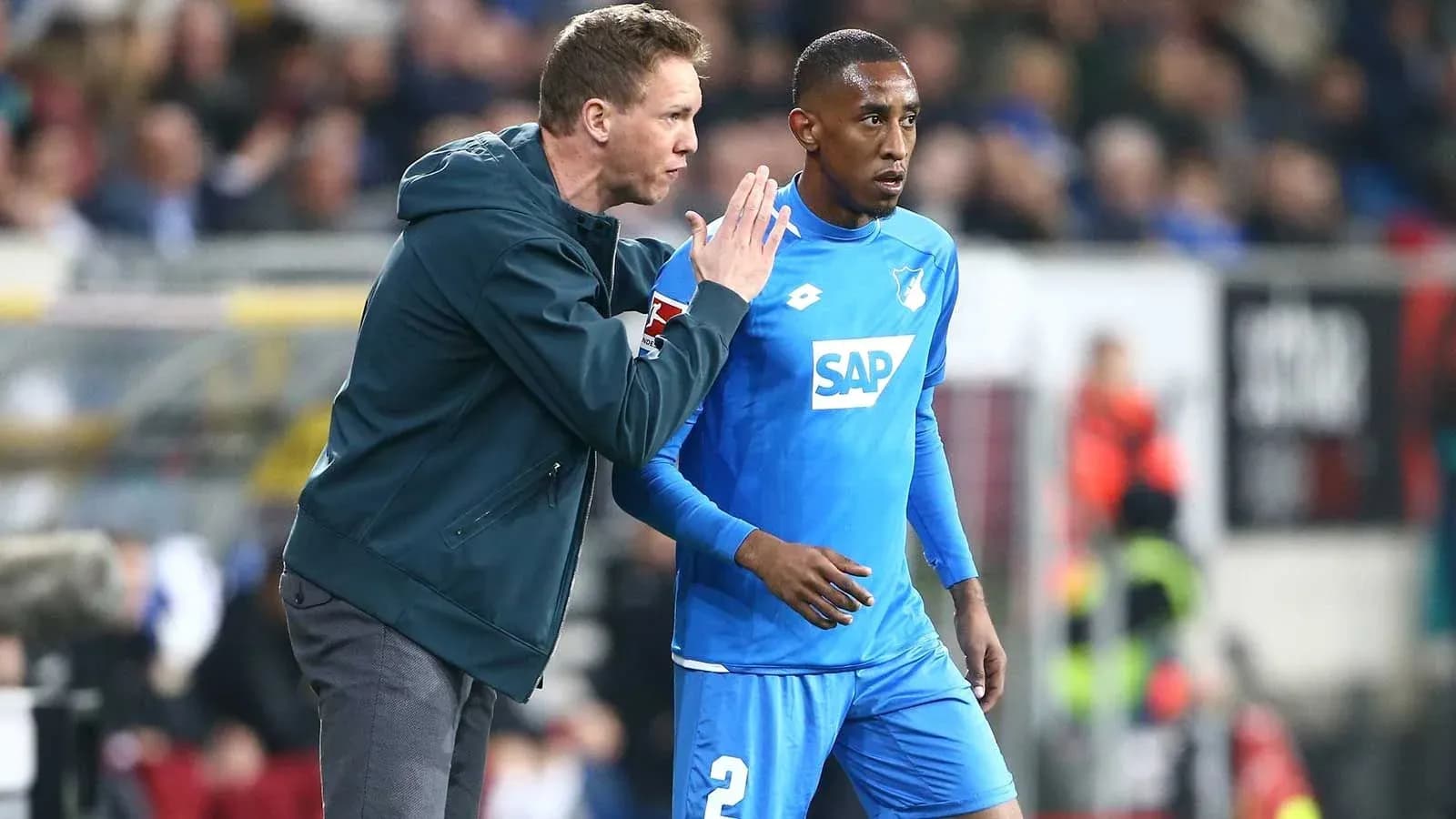
Brenet spent the first Bundesliga matches after his move watching from the bench. Then came Hoffenheim’s first-ever Champions League game, a historic night against Shakhtar Donetsk. In the build-up, he skipped a video session. Nagelsmann’s response was ruthless: he dropped him from the squad.
The coach did later bring him back into the fold, but the trust never truly returned. Brenet’s appearances became sporadic, flashes rather than foundations. When Nagelsmann left, Alfred Schreuder arrived and simply stopped using him. Sebastian Hoeneß pushed him further down, all the way into the reserves in the Regionalliga Südwest.
The pattern was hard to ignore. Repeated disciplinary problems. Chronic lateness. A reputation sliding from “talented but raw” to “trouble not worth the time.” Hoffenheim tried to move him on and found no takers until 2022, when he finally left for Twente Enschede on a free.
Redemption on the pitch, chaos off it
Back in the Netherlands, the football came easily again. At Twente, Brenet reminded people why top clubs had once fought for his signature. He attacked with conviction from right-back, defended with bite, and looked, for a while, like a player rebuilding his career.
Off the pitch, he wrecked that narrative himself.
In January 2023, Dutch authorities caught him driving without a licence. Twice. In two weeks. His licence had already been revoked in 2020 after a drink-driving offence.
By 2024, he was standing in front of a judge who delivered a brutal assessment: “He clearly has no regard for authority. It seems to me as though he is continuing to play football after receiving a red card.” The verdict was a one-month prison sentence. Three years earlier, in 2021, he had already received a suspended sentence that included a fine and community service for domestic violence.
On appeal, the prison term for driving without a licence was converted to community service, but the damage to his standing at Twente was done. The club terminated his contract. Whatever he had rebuilt on the pitch was wiped out in an instant.
The journeyman years
From there, his career scattered.
He joined Al-Rayyan in Qatar, a move that often signals a quiet fade into late-career comfort. Instead of a resurgence, he made just six appearances in the 2024/25 season. Then came a short spell at Livingston FC in Scotland, followed by a switch to Kayserispor in Turkey for the second half of the campaign.
The clubs changed, the leagues changed, but the sense of a career permanently on the brink remained. He was no longer the PSV prodigy or the Nagelsmann project. He was a footballer trying to stay relevant, one contract at a time.
A new flag, an old fire
What he did still have was a choice of colours. Despite his long history with Dutch football—numerous youth caps and a senior debut for the Netherlands during the 2016 World Cup qualifiers—Brenet applied to change his allegiance. FIFA approved the switch to Curaçao, his parents’ homeland.
Since debuting for the island in 2024, he has found something close to a home. Seventeen appearances, six goals, a right-back who plays like an auxiliary forward when the game opens up. In their final warm-up match against Aruba, he started on the right of defence and scored again. Same position. Same instinct.
For Curaçao, he is not just another name on the team sheet. He is experience, European seasoning, scars and all. In a squad largely shaped by migration and dual identity, he embodies the bridge between the Caribbean roots and the Dutch football machine that forged so many of these players.
Facing the past
On Sunday at 7 pm, Curaçao walk into a World Cup they were never supposed to reach, up against Germany, a team still trying to redefine itself under Nagelsmann. On the opposite bench sits Schreuder, now his assistant at the DFB.
Across the touchline, the coaches who once froze him out will watch him again, this time not as an employee but as an opponent representing another flag. It is not a reunion in the traditional sense. No warm embraces are guaranteed. But the subtext is impossible to ignore.
For Nagelsmann and Schreuder, Brenet was a problem to solve, then a problem to remove. For Curaçao, he is a weapon. A flawed one, undeniably, but a weapon all the same.
He has already used up his margin for error in club football. Internationally, he has a fresh slate and a stage bigger than any he has stepped onto before. The question now is brutally simple: on the night he faces his former coaches at a World Cup, will Joshua Brenet finally show that the red card on his career was only ever temporary?