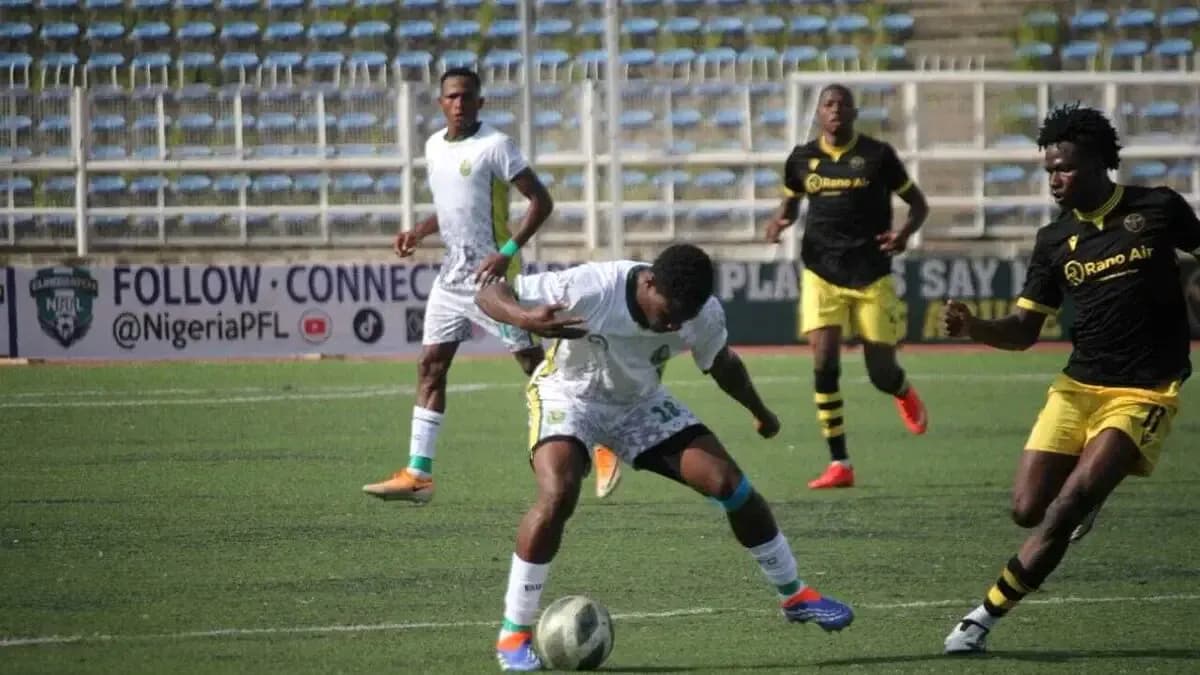
Kano Pillars Dominate Doma United 4-1 in NPFL Showdown
The late-afternoon heat at Sani Abacha Stadium framed a meeting between two sides carrying very different kinds of early-season momentum. Kano Pillars came into Round 4 of the NPFL season as an unbeaten, free-scoring side in front of their own crowd; Doma United arrived as league leaders, hardened by three wins from four and the aura that comes with sitting top of the table. Ninety minutes later, the scoreboard read 4-1 to Kano Pillars, and the story of both squads felt subtly rewritten.
Kano Pillars Overview
Heading into this game, Kano Pillars’ seasonal DNA was clear: attacking abundance, defensive vulnerability. Overall, they had scored 9 goals and conceded 5 in 3 matches, giving them a goal difference of +4 and 7 points, good enough for 3rd place. At home they were even more extreme: 7 goals scored and 3 conceded in just 2 matches, averaging 3.5 goals for and 1.5 against at Sani Abacha Stadium. They had not kept a single clean sheet in total, but they had also never failed to score.
Doma United Overview
Doma United, by contrast, were built on control and timing. Overall, they had 9 points from 4 matches, with 6 goals scored and 4 conceded (goal difference +2) and a spotless record in terms of clean sheets at home: 2 matches, 4 scored, 0 conceded. On their travels, though, the picture was more fragile. Away, they had played 2, winning 1 and losing 1, with 2 goals scored and 4 conceded, averaging 1.0 goal for and 2.0 against. The only heavy defeat in their early run had come away, a 4-1 loss that now has a twin in Kano.
Lineups and Tactics
The lineups underlined the contrast in squad profiles. Kano Pillars named an experienced and physically imposing core. At the back, the pairing of F. Maduabuchi and A. Musa (shirt number 5) was flanked by A. Abdullahi and F. Usman, a back four in which strength and aerial presence likely took precedence over finesse. In front of them, Z. Musa in the number 6 shirt looked the natural screen, a destroyer whose job was to break up transitions and feed the creative axis.
That axis revolved around the old heads and wide energy: R. Ali wearing 10, orchestrating between the lines; the wide threat of F. Ubong (14) and the direct running of A. Shola (26). Up front, the other A. Musa (shirt number 7) offered both mobility and experience, while O. Frank in goal provided the last line behind a unit that had not yet found a way to shut teams out but had been ruthless at the other end.
On the bench, Kano Pillars had depth to alter the game’s rhythm: S. Abdallah as an alternative in goal; defenders like S. Agu and N. Salihu; and attacking or midfield options in R. Ayemwenre, Y. Ibrahim, I. Sani, A. Samson and S. Ismaila. It is a bench built more for reinforcing intensity than for radical tactical reinvention, but it gives the coach the tools to keep the press and running power high into the final quarter.
Doma United’s starting XI carried a more balanced, perhaps more cautious, profile. In goal, I. Pius anchored a back line of A. Umar, S. Collins, B. Philimon and C. Uzoagara. Ahead of them, H. Abubakar and N. Agu suggested a double pivot capable of both screening and building, while the attacking line of M. Adegbite, S. Ulunwa and R. Sadiq supported from behind and around the lone forward. The presence of H. Abutu in the XI hinted at either an extra defensive layer or a flexible wide-midfield role, depending on the phase.
Their bench – including B. Melai, A. Abubakar, R. Usman, D. Simon, A. Edwin, J. Omah, J. Abah, A. Benedict and Y. Fantami – offered a mix of defensive cover and fresh legs in attack, but, as with Kano, the data does not suggest a dramatic change of shape was likely. Instead, Doma’s plan would have been about reinforcing their known strengths: disciplined structure and late-game impact.
Tactical Analysis
The tactical intersection between the two sides before kick-off was fascinating. Kano Pillars’ goals had come in distinct waves: 25.00% of their total goals between 16-30 minutes, another 25.00% between 31-45, and a pronounced late surge with 50.00% of their goals arriving between 76-90. Defensively, they were most vulnerable just after half-time, with 100.00% of their conceded goals in the 46-60 window.
Doma United’s scoring pattern was more evenly spread but with its own late-game twist: 16.67% of their goals between 0-15, 31-45 and 46-60, then a strong 33.33% between 61-75 and 16.67% again in the 76-90 period. Crucially, their away defensive weakness was back-loaded: 25.00% of their conceded goals between 16-30, 25.00% between 31-45, and a punishing 50.00% between 76-90. That late collapse zone overlapped exactly with Kano’s most lethal attacking phase.
This is where the “Hunter vs Shield” narrative emerged. Kano Pillars as hunters: a side that kept coming, with over 2.5 total goals in 2 of their 3 matches and over 1.5 in all of them. Doma United as a shield that had been impeccable at home but porous on their travels, conceding heavily in the very minutes when Kano typically turned the screw.
Key Matchup: Engine Room
In the “Engine Room”, the battle between Z. Musa and the Doma double pivot of H. Abubakar and N. Agu was always going to dictate territory. If Z. Musa could disrupt Doma’s attempts to play through the middle, it would force them wide and into the teeth of Kano’s physical back line. Conversely, if Abubakar and Agu found time to turn and pick passes, they could target the vulnerable 46-60 window where Kano had conceded all their goals.
Discipline and Penalties
Discipline added another layer. Kano Pillars’ yellow cards had been concentrated late, with 50.00% shown between 61-75 and 50.00% between 76-90, a sign of a team that defends on the edge as legs tire. Doma United, meanwhile, spread their cautions more widely but still peaked late, with 42.86% of their yellows between 76-90. This mirrored the game’s likely emotional arc: a tight contest opening up into a stretched, card-heavy final quarter.
One more detail tilted the psychological balance: penalties. Kano Pillars had been awarded 1 penalty in total and missed it, scoring none and missing 100.00% of their attempts. It is a small sample but a mental note for both sides in high-pressure moments. Doma United, by contrast, had not yet been involved in a penalty situation at either end.
Conclusion
Following this 4-1 result, the numbers will swell in Kano’s favour, but the underlying story remains similar: a side that overwhelms opponents at home, particularly in the final 15 minutes, and a league leader in Doma United whose only real cracks appear on their travels and under sustained late pressure. At Sani Abacha Stadium, the squad profiles and statistical patterns did not just predict the contest; they shaped it.