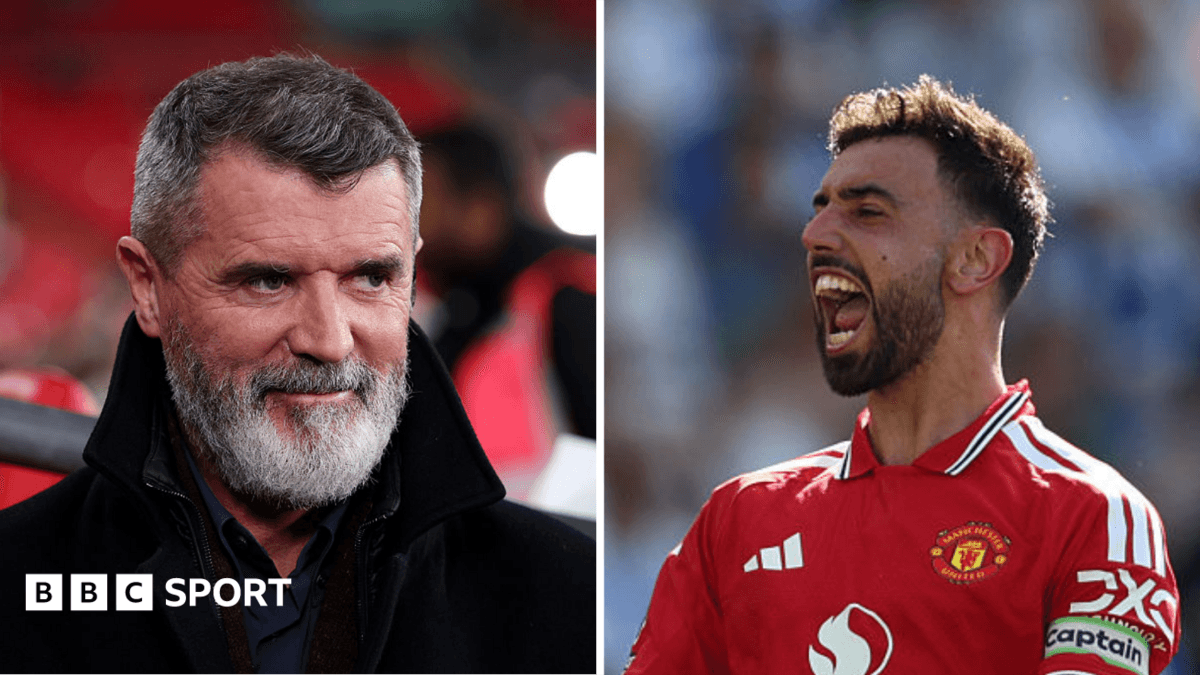
Roy Keane and Bruno Fernandes Resolve Misquote Dispute
Roy Keane and Bruno Fernandes have quietly drawn a line under one of the more curious spats of Manchester United’s recent past – with a phone call rather than a public showdown.
The former United captain revealed on the Stick to Football podcast that he and Fernandes have spoken at length after Keane misquoted the midfielder on air, prompting Fernandes to accuse him of telling “a lie”.
What began as a typical Keane broadside had threatened to turn into something more serious. Speaking on The Overlap after the penultimate round of last season’s fixtures, Keane questioned Fernandes’ mentality and even painted him as the ringmaster in a “circus act”, hinting that the Portuguese playmaker was leaning towards personal glory rather than team success.
The flashpoint came from Keane’s version of Fernandes’ post-match interview following United’s chaotic 3-2 win over Nottingham Forest. Keane told viewers that Fernandes had effectively said: “I probably should have shot but I made them passes” – a line that, in Keane’s world, sounded like a player obsessed with numbers.
Fernandes’ actual words were the opposite.
“There were probably moments today when I should have passed instead of shot,” he said at the time. “I’m very happy for the assist, but more than that, I’m happy for the win and to finish the season on a high.”
The misquote stung. Publicly, Fernandes pushed back, labelling Keane’s version a “lie” and making it clear he wanted to speak to the Irishman directly. This was not a player ducking criticism; it was a captain defending his professionalism and priorities.
All of this played out as Fernandes was rewriting the record books. On the final day of the 2025-26 Premier League season, he delivered his 21st assist in the win over Brighton, setting a new single-season benchmark. The numbers fed the narrative: was he chasing stats, or driving United forward? Keane’s comments poured fuel on that debate.
Instead of letting the row fester through headlines and social media clips, Fernandes reached for the phone.
“There was a reaction after what we said on the podcast a few weeks ago and he reached out to me and wanted a chat – I called him and we had a lovely chat,” Keane said. “We had a nice, mature conversation.”
That line matters. Keane has long kept his distance from active players, wary of blurring lines between pundit and insider.
“I like having boundaries with players,” he explained. “I don’t want to be speaking to players every few weeks or their agents, I don’t want to go down that road, but every now and then a player might reach out, so I think it was important I spoke to him.”
The call covered more than one misheard sentence.
“There has been lots going on and lots reported,” Keane added. “He’s obviously a big player for United, I’m an ex-United player and I think the idea of this communicating and having a proper conversation, I really enjoyed it. Hopefully I think he did as well. Nice chat about a bit of everything and I felt better afterwards.”
For Fernandes, the episode underlines the scrutiny that comes with wearing the armband at Old Trafford. Every word dissected. Every gesture replayed. Every statistic – even a record-breaking assist tally – turned into an argument about character.
For Keane, a man whose standards defined a generation at United, it is a rare glimpse of softening edges. The criticism remains, the bluntness is intact, but when a current captain asks for clarity, he picks up the phone.
The noise will move on. The next performance, the next result, the next controversy will roll in. But the most demanding voice from United’s past and the most scrutinised figure in its present now understand each other a little better – and that, in a club still searching for a stable identity, is no small thing.