Kevin Lamour Leaves FIFA Amid Controversy
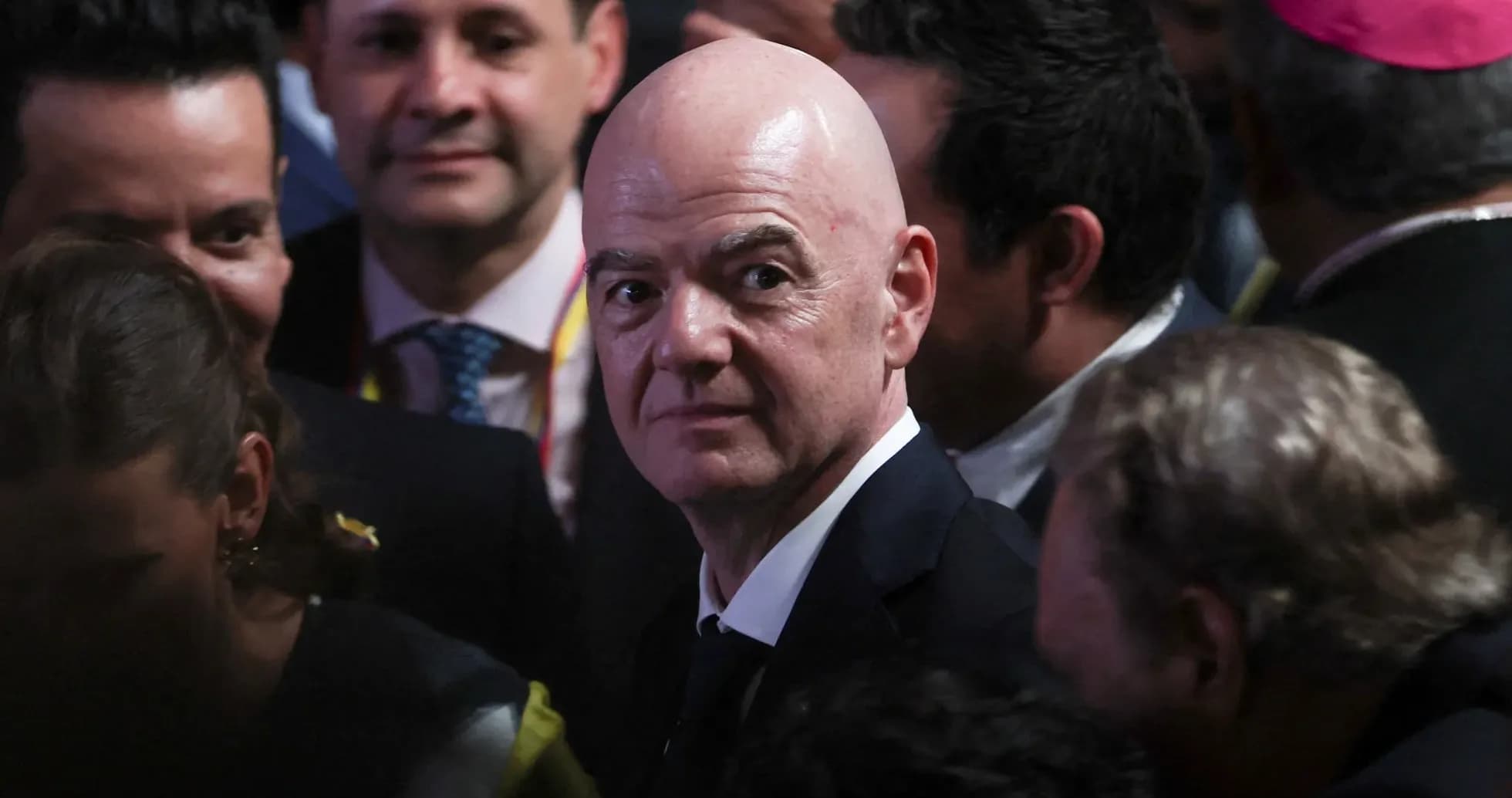
Kevin Lamour has left FIFA. The departure of the chief operating officer was confirmed on Monday night, just weeks after he publicly attacked president Gianni Infantino’s controversial plan to sell a stake in the organisation’s commercial rights.
“FIFA can confirm that the working relationship between FIFA and Kevin Lamour as FIFA’s Chief Operating Officer has ended on 17 August 2026,” a spokesperson said. “FIFA thanks Kevin for his two years of service and wishes him the best of luck for the future. No further comment will be made on the matter.”
No explanation. No detail. Just a clean break at a time of rare open revolt inside football’s most powerful institution.
A close ally turns critic
Lamour joined FIFA’s senior leadership in November 2024. The French executive was no outsider parachuted in from nowhere; he had been part of the tight-knit group that helped engineer Infantino’s rise to the presidency in 2016 after the collapse of the Sepp Blatter era.
That history made his recent intervention all the more explosive.
Last month, Lamour went public with his opposition to Infantino’s proposal to create a $20bn subsidiary and sell up to a 20 percent stake in FIFA’s commercial rights to private equity investors, a deal designed to raise about $4.2bn.
He accused the leadership of having “deceived” FIFA staff over the project and branded it “the project of one person”.
“Our mission … is to serve football, not to serve the personal interests of a person who, unfortunately, believes he embodies FIFA when he is supposed to be at its service,” Lamour said.
Those remarks landed just after Carlos Cordeiro, a senior adviser to Infantino and former U.S. Soccer president, resigned in protest, calling the plan “a bad deal for football”. Under mounting pressure, Infantino withdrew the proposal later the same day.
The U-turn did not cool the anger. It simply exposed how deep it ran.
Infantino’s fourth-term bid under siege
What once looked inevitable now looks fragile. Infantino’s attempt to stand for a fourth term as FIFA president at next March’s election is under intense scrutiny.
On paper, the rules are clear: FIFA presidents are limited to three terms. Infantino, however, successfully argued in 2022 that his first spell in charge from 2016 to 2019 should not count because he was completing an interrupted mandate after Blatter’s resignation and the corruption scandal that ripped through the organisation.
He was elected at an Extraordinary Congress in 2016, then re-elected unopposed in 2019 and again in 2023.
Human rights in sport group FairSquare now says that interpretation cannot stand. The organisation confirmed on Monday that it has written to FIFA’s Governance, Audit and Compliance Committee (GACC), urging it to rule Infantino ineligible for another term.
“The complaint we have filed provides clear evidence that this is a clear breach of the rules and one that sets a very dangerous precedent,” FairSquare director Nicholas McGeehan told Reuters. “The rules state clearly that three presidential terms is the maximum allowed. FIFA can’t simply circumvent this rule – which serves as a check on presidential power – by saying that his first term doesn’t count.”
FIFA did not immediately respond to a request for comment on Tuesday.
Power blocs harden their lines
The political map around Infantino has shifted sharply.
UEFA, the Asian Football Confederation (AFC) and CONCACAF, which oversees football in North and Central America and the Caribbean, are now openly lined up against the 56-year-old Swiss official. These are not marginal actors; they represent some of the sport’s most commercially powerful and politically influential regions.
Sources familiar with the internal discussions say the three confederations see their joint move as a way to give Infantino a path out – an opportunity to step aside with his dignity intact rather than be forced into a bitter fight over eligibility.
He is not isolated everywhere. Infantino still enjoys strong backing from the African and South American confederations, blocs that have been central to his dominance of FIFA politics since 2016. That support ensures any challenge will be complex and bruising.
But the calm, orderly coronations of 2019 and 2023 are gone.
Rules, reform and a battle over power
FairSquare’s letter to the GACC was drafted with the help of Miguel Maduro, the former head of FIFA’s independent Governance and Review Committee and one of the architects of the post-Blatter reforms.
He argues that the organisation cannot simply bend its own statutes to suit the incumbent.
“The principle of term limits was a fundamental aspect of the 2016 reform aimed at limiting power and the rule introduced is clear: no FIFA President can serve more than three terms of office,” Maduro said in a statement. “Trying to carve out an exception to such a rule for Mr Infantino reveals both a resistance to the principle of term limits and how some at FIFA conceive of rules not as rules but as obstacles to be circumvented.”
The language is stark. It goes to the heart of what FIFA claimed it had become after 2016: a body governed by clear checks and balances, no longer dominated by a single figure.
FairSquare has already tested Infantino’s standing in another arena. Its complaint to the International Olympic Committee over an alleged breach of the IOC’s political neutrality rules – linked to his support for United States President Donald Trump – was rejected last month. Infantino has been an IOC member since 2020.
This time, the fight is on home soil, inside FIFA’s own legal framework.
Lamour’s exit removes a prominent internal critic from Zurich’s corridors of power. It does not remove the questions he raised, nor the challenge now facing a president who once looked untouchable.