Liverpool's Bleak Season Ends with Uncertainty Ahead
The song drifted out from The Kop long before the final whistle.
“Every little thing is gonna be alright…”
It sounded less like belief and more like a plea. Liverpool’s bleak 2025/26 campaign ended with a flat 1-1 draw against Brentford, a result that secured Champions League football but underlined a season that has been, by any serious measure, a failure.
This wasn’t a lap of honour. It felt like a wake.
End of an Era, and the Fear of What Comes Next
Two more pillars of the modern Liverpool era walked away, players who helped drag the club back to the summit of European and domestic football over the last nine years. They joined a growing exodus: half the squad Arne Slot inherited just two summers ago has now gone. More are expected to follow Mo Salah and Andy Robertson out of the door.
For supporters who remember the 1990s, the parallels are uncomfortable. Graeme Souness once dismantled Kenny Dalglish’s ageing but title-winning squad in a hurry. He didn’t last. What followed was a decade of drift. That spectre hangs over Anfield again.
Salah, never one to play politics in public, has made his concerns clear as his extraordinary nine-year stay came to a close. He leaves a club that has slipped badly from its own standards.
The numbers are brutal. Liverpool finished fifth with 60 points. No trophy. No title challenge. No cup run to cling to. Just four wins in their last 14 games in all competitions and no victories in the final four league matches.
Sixty points would have left them ninth last season. The year before, seventh and out of Europe. Three seasons ago, ninth again. This time, it’s somehow enough for the Champions League – the lowest total to secure qualification since 2003/04, the season Gerard Houllier departed in that famously polite, staged farewell on the Anfield turf.
This was not progress. It was a regression dressed up by a quirk of the league table.
A Coach Apart on the Final Day
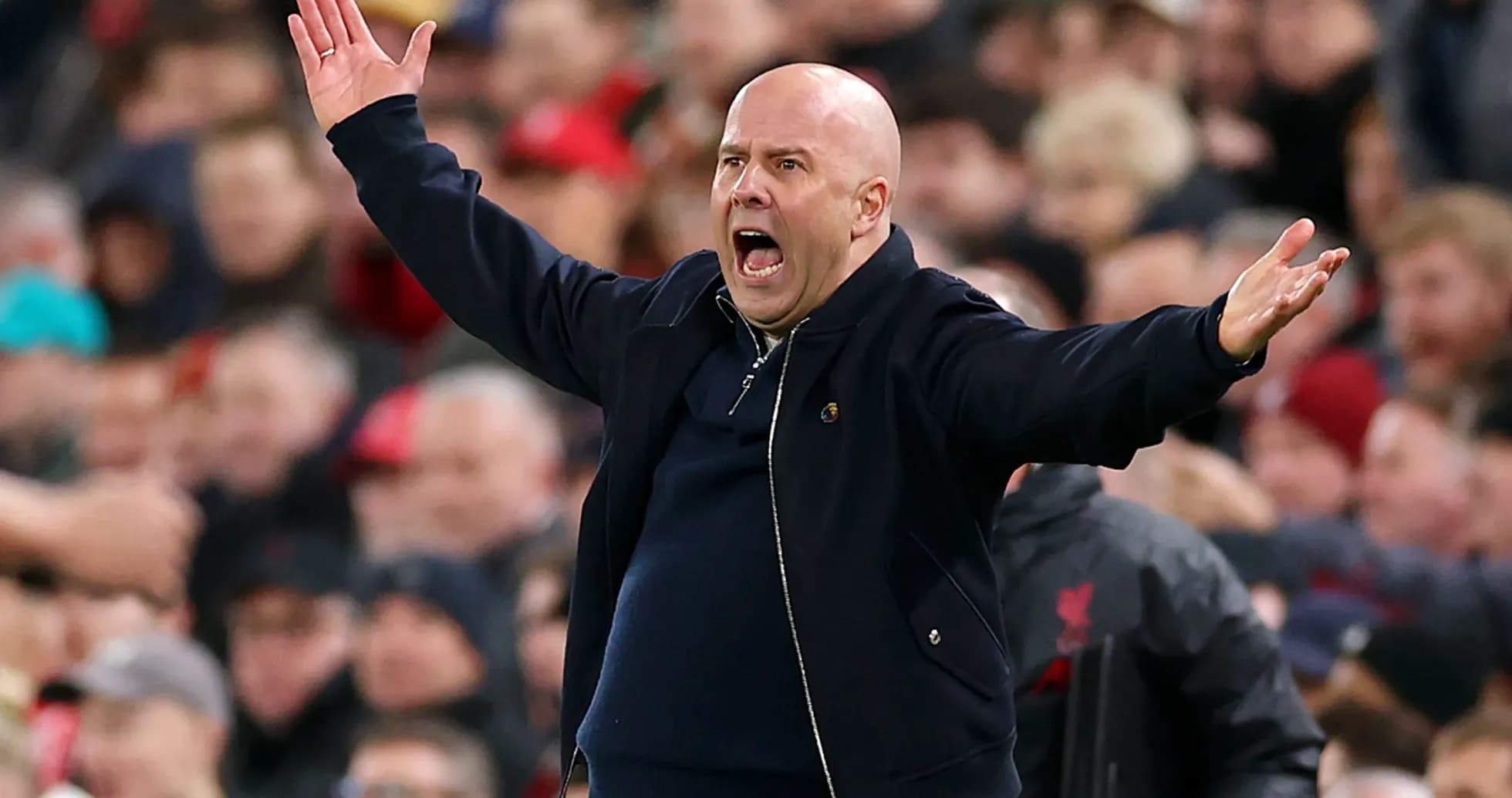
Slot insists he can win the fans back next season. On this evidence, he has work to do.
As the players and staff took part in the post-match lap of appreciation, the Dutchman remained on the bench, expression fixed, apart from the group. Perhaps he was simply deep in thought. Perhaps he wanted the spotlight to fall on the departing figures rather than himself. Either way, the optics were awful.
The walk around Anfield at the end of a season is about shared gratitude. Players and fans, together, acknowledging what they’ve been through – good or bad. It was a perfect moment for Slot to show he understands the club, that he feels the connection. Instead, he sat alone.
The contrast with Salah could not have been sharper. Speaking to Sky Sports, the forward captured the essence of the place in a single line: “They [the fans] don’t care that much about the result as long as you sweat and give your blood here, they’ll love you forever.”
That is the unwritten contract at Liverpool. Show up. Work. Suffer together. Walk through the storm, as they have had to after the shock and emotion around Diogo Jota’s death in pre-season. The season demanded unity. Too often, it looked fractured.
Injuries, a Small Squad, and a Manager Who Can’t Have It Both Ways
In his final press conference of the campaign, Slot was asked to sum up the season in one word. He chose “injury.”
On the surface, it’s understandable. Liverpool did suffer. But this is the same manager who, back in October, publicly backed the decision to go with a smaller squad. “This is a decision we have made together,” he said then. “I completely believe in this, because if you have 25 [players] it’s very hard to manage your squad.”
You cannot champion a lean group in autumn and then spend winter and spring lamenting a lack of options, fatigue, and late goals conceded because legs and minds are gone.
The landscape has changed. The expanded Champions League and the relentless pace of the Premier League demand depth, especially if you know new signings are not yet ready to play 90 minutes twice a week. Liverpool chose to go light. They paid for it.
Slot even spelled out the risk in October: if they lost “two, three or four” players, they’d be down to 15 or 16, with youngsters like Rio and Trey Nyoni having to play almost every minute. Yet when the crunch came, those youngsters barely featured.
Nyoni, handed his debut by Jurgen Klopp at 16 and widely hailed as a major talent, ended the season with just 21 league minutes. Federico Chiesa, marginalised yet again, played 318 league minutes. Wataru Endo managed 170. Kieran Morrison, captain and standout for the Under-21s, was named on the bench 13 times and used once – five minutes in an FA Cup tie at Wolves.
The squad wasn’t just small. It was underused. Some of that lies squarely with Slot’s trust levels.
Then there was the Harvey Elliott saga, a situation that veered into the absurd. With Liverpool crying out for quality from the bench in the second half of the season, there was no agreement in place to bring him back to Anfield in January. A self-inflicted wound.
Heavy Defeats, Heavy Standards
Slot has been quick to stress that Liverpool’s heaviest blows came against elite opposition: 4-0 to Manchester City in the FA Cup, 4-0 to PSG in Europe. City went on to lift the FA Cup. PSG haven’t lost a two-legged European tie in two seasons.
That context might soothe some managers. It doesn’t wash at Liverpool.
The standards here were set by nights when City were hunted down, not admired from afar. Van Dijk, Robertson, Salah, Curtis Jones – senior figures across the dressing room – have all said, in their own ways, that this season has fallen well short of what the club demands.
Salah’s parting words to his team-mates at the AXA Training Centre were blunt: “Being in Liverpool, winning something for Liverpool and winning games is the best thing that could happen to you all.” No caveats. No soft landings.
Slot tried to frame Champions League qualification as “our lowest base,” pointing out that other big clubs such as Chelsea and Tottenham failed to reach Europe at all. For some supporters, that sounded less like perspective and more like lowering the bar.
Liverpool should not be measuring themselves against who missed out. They measure themselves by what they win. Going out of competitions 4-0, even to eventual winners, in the middle of a run of four defeats in five, is not acceptable here.
Even the season’s longest unbeaten stretch – 13 games after the 4-1 humiliation at home to PSV – carried a hollow ring. The run included draws with Leeds (twice), Burnley and Fulham, and seven wins that featured Barnsley in the FA Cup and a West Ham side that ended up relegated. The streak flattered. It did not convince.
Transition, Uncertainty, and a Thin Core
Anfield faces another summer of upheaval, with little clarity beyond the storm.
Slot has only a year left on his contract. So do the club’s key decision-makers, Richard Hughes and Michael Edwards. The men who shape the squad could themselves be gone in 12 months.
On the pitch, the churn could be even more dramatic. Up to nine first-team players may depart. Salah and Robertson are already heading for the exit. Ibrahima Konaté is out of contract. Chiesa and Endo are likely to move on. Curtis Jones, wanted by Inter Milan and with just a year remaining on his deal, is widely expected to leave. Alisson has attracted serious interest from Juventus. Joe Gomez, another approaching the final year of his contract, could be sold. Alexis Mac Allister might go if the price is right.
Strip all that away and look at what remains. As things stand, Liverpool will begin next season with Cody Gakpo as the club’s leading current goalscorer. Behind him? Virgil van Dijk, a centre-back, as the next most prolific.
Slot has spoken of “a little transition” this summer, nothing as “drastic” as last year. On paper, that sounds optimistic. In reality, it looks like major surgery.
The Kop tried to sing away the anxiety with Bob Marley. Don’t worry about a thing. Not many will take that advice. They will worry – about the squad, about the direction, about whether this is a blip or the start of another long, grey stretch in Liverpool’s history.
Next season won’t just be about points and places. It will answer a harsher question: is this club still building towards titles, or quietly slipping back into the pack it once left behind?