Liverpool vs PSG: Champions League Quarter-final Analysis
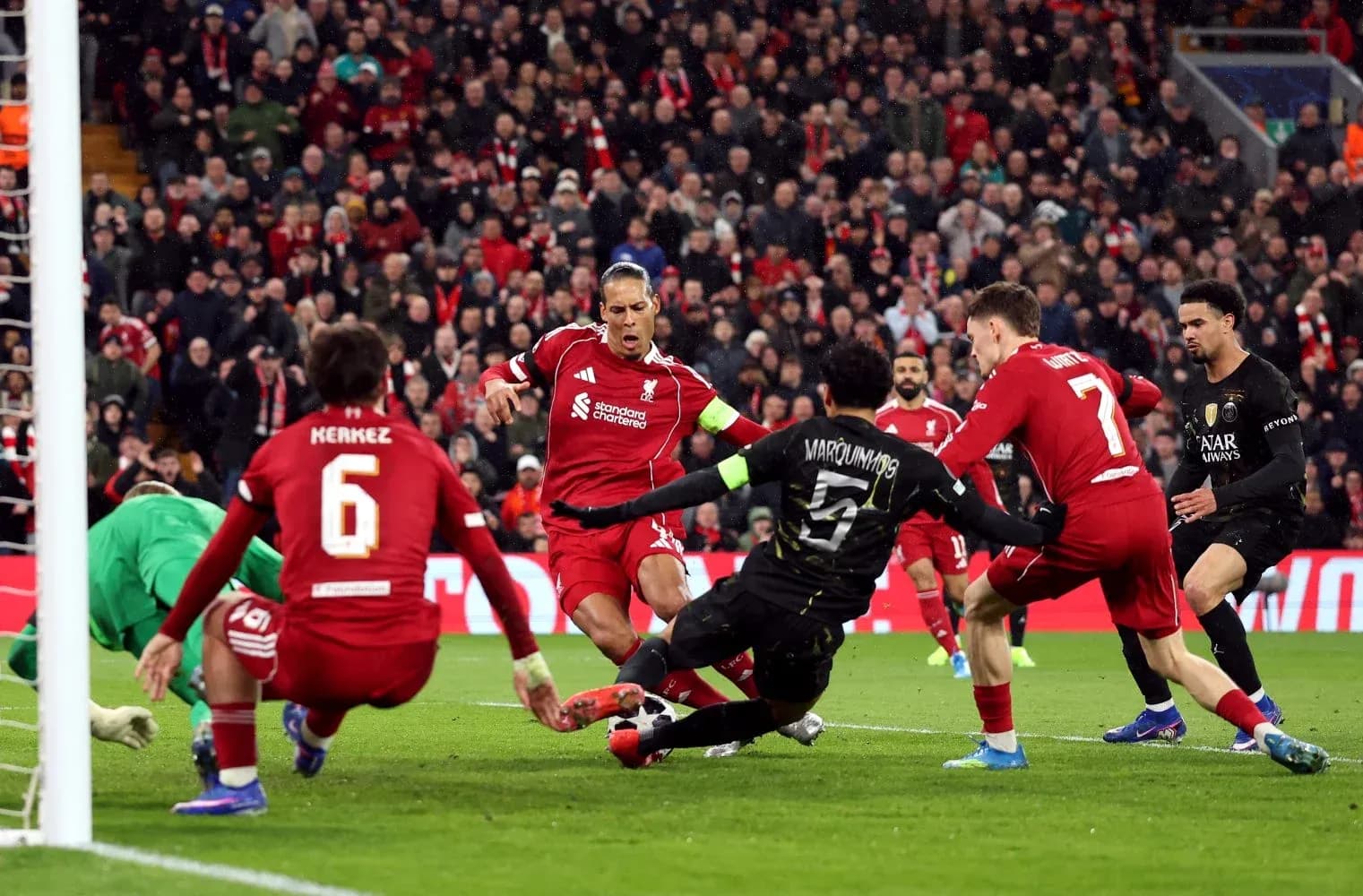
Anfield under the lights, a Champions League quarter-final, and a scoreline that cuts through the noise: Liverpool 0–2 Paris Saint Germain. Following this result, the evening becomes a story of contrasting European identities – Liverpool’s high-octane, sometimes chaotic power against a PSG side that arrived with one clear message: they belong among the continent’s most ruthless travellers.
I. The Big Picture – Styles Collide in a Quarter-final Cauldron
This was not a meeting of equals in terms of recent European rhythm. Heading into this game, Liverpool sat 3rd in the Champions League standings snapshot with 18 points, a goal difference of 12 built on 20 goals for and 8 against across 8 matches. At Anfield specifically, they had scored 11 and conceded 6 in 4 games – a home profile of 2.5 goals for and 1.3 against on average. Their season-long Champions League record reinforced that attacking DNA: overall, 24 goals from 12 fixtures at an average of 2.0 per match, offset by 13 conceded at 1.1.
PSG arrived as the tournament’s great away disruptor. Their standings snapshot showed them 11th with 14 points, a goal difference of 10 (21 for, 11 against) from 8 matches, and a balanced away record: 2 wins, 1 draw, 1 loss, 10 scored and 5 conceded on their travels. Across the full campaign, they had been even more explosive: 38 goals in total from 14 games, averaging 2.7 overall and 2.6 away, with only 17 conceded (1.2 overall, 1.0 away). If Liverpool’s identity was rooted in Anfield’s attacking roar, PSG’s was increasingly defined by their ability to punch hard and efficiently away from Paris.
The formations told their own tale. Arne Slot’s Liverpool set up in a 4-2-3-1, with G. Mamardashvili behind a back four of J. Frimpong, I. Konate, V. van Dijk and M. Kerkez. The double pivot of R. Gravenberch and D. Szoboszlai supported a creative trio of H. Ekitike, A. Mac Allister and F. Wirtz behind lone forward A. Isak. It was an XI built for aggressive occupation of the half-spaces and late arrivals from midfield.
Enrique Luis answered with a pure 4-3-3: M. Safonov in goal, a back line of A. Hakimi, Marquinhos, W. Pacho and N. Mendes, with J. Neves, Vitinha and W. Zaire-Emery forming a technically gifted midfield triangle. Up front, D. Doue, O. Dembele and K. Kvaratskhelia formed a fluid, dribble-heavy front three designed to stretch and isolate Liverpool’s defenders.
II. Tactical Voids – Injuries, Absences and the Card Landscape
Liverpool entered the tie with a conspicuous hole in their spine. Alisson’s muscle injury had already shifted responsibility onto Mamardashvili, altering the build-up and the psychological security of the back line. The absence of S. Bajcetic (hamstring), W. Endo (foot injury) and G. Leoni (knee) stripped Slot of natural defensive midfield profiles; instead, he leaned on the ball-playing qualities of Gravenberch and Szoboszlai as a double pivot rather than a true shield. C. Bradley’s knee injury and the inactive statuses of H. Davies and R. Williams further thinned the depth in defence.
PSG’s list was shorter but not insignificant. Q. Ndjantou (muscle injury) and F. Ruiz (knee) were missing, denying Enrique Luis an extra controller and a left-footed midfield balance option. Yet compared to Liverpool’s structural absences, PSG’s were tweaks rather than fractures.
Disciplinary trends also shaped the risk profiles. Across the campaign, Liverpool’s yellow cards clustered notably between 46-60 minutes, where 25.00% of their cautions arrived, and then 31-45 and 61-75 minutes at 18.75% each – a sign of a side that often ramps up aggression around the interval and into the early second half. PSG’s yellows, by contrast, spiked late: 37.50% of their cautions came between 76-90 minutes and 25.00% between 16-30, suggesting an early bite followed by end-game desperation. Red cards had largely haunted PSG’s depth options: I. Zabarnyi and L. Hernandez each carried a sending-off in this Champions League run, underlining how aggressive their defensive rotations can be when under stress.
III. Key Matchups – Hunter vs Shield, Engine Room vs Enforcer
The “Hunter vs Shield” narrative centred on PSG’s attacking spearhead and Liverpool’s defensive platform. K. Kvaratskhelia, one of the competition’s standout forwards, came into this stage with 8 goals and 5 assists in 13 appearances, from 26 shots (14 on target). His 38 dribble attempts with 19 successes, plus 26 fouls drawn, painted the picture of a winger who constantly drags defences into uncomfortable decisions. Up against him, V. van Dijk and M. Kerkez were tasked with both containing the one-on-one threat and preventing the Georgian from cutting inside to combine with Vitinha and O. Dembele.
Vitinha himself formed the brain of PSG’s midfield. With 6 goals and 1 assist, 1,463 passes at 93% accuracy and 16 key passes, he was not just a recycler but a penetrative passer. His penalty record carried its own narrative tension: 1 scored and 1 missed, meaning his conversion from the spot was not flawless and demanded psychological resilience in big moments.
On the other side, Liverpool’s “Engine Room” was defined by D. Szoboszlai. The Hungarian arrived with 5 goals and 4 assists in this Champions League campaign, 20 shots (14 on target), 30 key passes and 87% pass accuracy. He also contributed defensively with 23 tackles, 2 blocked shots and 6 interceptions. Against a PSG midfield that rarely relinquished control, Szoboszlai’s ability to break lines and press Vitinha was central to any Liverpool resurgence.
Out wide and in transition, A. Hakimi’s duel with Liverpool’s left flank was pivotal. The Moroccan full-back had 1 goal and 5 assists, 21 key passes and 15 dribble attempts, with 19 tackles and 1 blocked shot underpinning his two-way influence. His overlapping runs behind Wirtz or Ekitike threatened to pin back Kerkez and distort Liverpool’s 4-2-3-1 into a back five.
PSG’s secondary threats added layers. D. Doue, with 5 goals and 2 assists, 25 key passes and 40 dribble attempts (18 successes), offered a direct running threat between Konate and Frimpong. B. Barcola, from the bench, brought 2 goals, 4 assists and 25 key passes of his own, plus 42 dribble attempts, a late-game chaos agent perfectly suited to exploiting a stretched Liverpool chasing the tie.
IV. Statistical Prognosis – xG Shadows and Defensive Solidity
Even without explicit xG numbers, the statistical profiles sketch a clear pre- and post-match verdict. Heading into this game, Liverpool’s attacking averages at home (2.5 goals scored, 1.3 conceded) suggested they would create enough to trouble any opponent, but their 5 overall defeats in 12 fixtures hinted at volatility. Their 5 clean sheets overall – 3 at home – pointed to a defence that could be excellent in spells but was not impregnable.
PSG’s away metrics were more balanced and, crucially, more efficient. On their travels they averaged 2.6 goals scored and only 1.0 conceded, with 3 away clean sheets in the broader Champions League campaign. Their goal difference in the standings snapshot – 10 from 21 scored and 11 conceded – underlined an attack that consistently outpaced its own defensive leaks.
Overlaying those numbers onto the tactical picture, PSG’s 2-0 win at Anfield aligns with a probabilistic reading of the tie: a high-output, high-risk Liverpool side failing to convert pressure into goals against a PSG team whose away structure and front-line efficiency have been elite all season. The absence of a specialist defensive midfielder for Liverpool left Gravenberch and Szoboszlai with too much space to patrol against Kvaratskhelia, Dembele and Vitinha’s rotations.
Following this result, the narrative is clear. Liverpool remain a devastating force when the game bends to their tempo, but their European run has been shaped by fine margins and structural absences. PSG, by contrast, look like a fully formed away machine: a team that marries a 4-3-3 built on technical security with forwards who turn half-chances into full punishment. In the cold light of the quarter-final, the numbers and the night both point in the same direction – PSG’s defensive solidity and clinical edge have carried them a step closer to the summit of Europe.