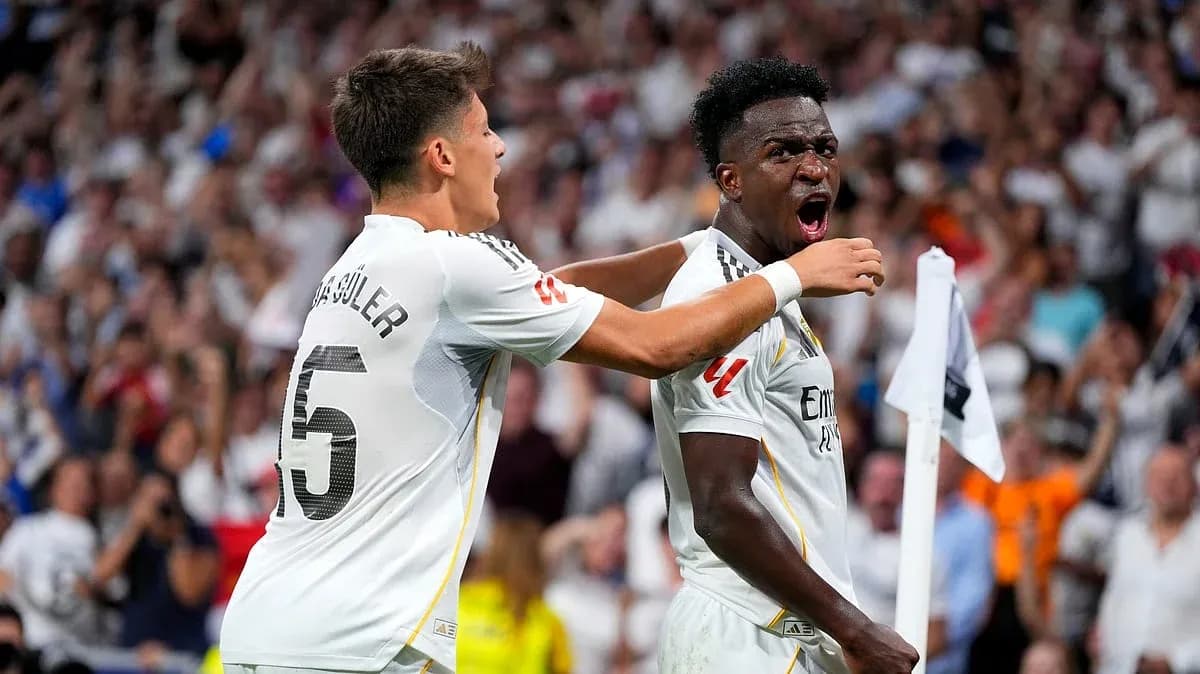
Mallorca Upsets Real Madrid 2–1 in La Liga Showdown
At Estadi Mallorca Son Moix, Mallorca edged Real Madrid 2–1 in a La Liga Regular Season - 30 fixture, delivering a classic low-block upset built on defensive discipline and ruthless efficiency. Despite conceding 64% possession and 15 shots, Mallorca converted two of their six attempts, while Real Madrid’s territorial dominance yielded only a single late goal. With xG virtually level (Mallorca 1.22, Real Madrid 1.27), the match turned on game-state management, compact spacing in Mallorca’s 4-3-1-2, and Real Madrid’s struggle to turn box occupation into clear, repeatable chances.
Scoring Sequence & Disciplinary Log
The opener arrived on 41'. Working from their 4-3-1-2 structure, Mallorca exploited one of their rare attacking phases: Manu Morlanes timed a forward run from midfield and finished a move created down the right by Pablo Maffeo. M. Morlanes’ goal, assisted by P. Maffeo, gave the hosts a 1–0 lead that they carried into half-time.
The second half began with a shift in tone. On 47', Real Madrid centre-back Dean Huijsen received a yellow card for a foul, reflecting Madrid’s need to counter Mallorca’s transitions more aggressively after the break.
Real Madrid’s response escalated on 59' with a triple substitution to tilt the game further in their favour:
- Éder Militão (IN) came on for Dean Huijsen (OUT).
- Vinicius Júnior (IN) came on for Manuel Ángel Morán (OUT).
- Jude Bellingham (IN) came on for Eduardo Camavinga (OUT).
Mallorca’s time-management strategy then began to show. On 66', goalkeeper Leo Román was booked for time wasting, the first of three such cautions for the hosts as they protected their narrow lead.
Martin Demichelis answered Madrid’s surge with his own triple change on 70':
- Mateo Joseph (IN) came on for M. Morlanes (OUT).
- David López (IN) came on for Samú Costa (OUT).
- Jan Virgili (IN) came on for Pablo Torre (OUT).
Real Madrid continued to chase the game, and on 72' they injected fresh creativity:
- Thiago Pitarch (IN) came on for Arda Güler (OUT).
Further attacking reinforcement followed on 76':
- Franco Mastantuono (IN) came on for Brahim Díaz (OUT).
Mallorca then refreshed their forward line on 81':
- Antonio Sánchez (IN) came on for Zito Luvumbo (OUT).
The defensive posture from Mallorca became increasingly explicit. On 84', centre-back Martin Valjent was booked for time wasting, underlining the tactical choice to slow the tempo and break Madrid’s rhythm.
Madrid finally broke through on 88'. From a right-sided situation, Trent Alexander-Arnold delivered and Éder Militão converted, with Eder Militao’s goal assisted by T. Alexander-Arnold to level at 1–1.
The closing minutes were chaotic. At 90', Vedat Muriqi restored Mallorca’s lead, finishing a decisive late action assisted by M. Joseph, making it 2–1. In parallel with this frantic phase, Franco Mastantuono received a yellow card for a foul on 90', while P. Maffeo was booked for time wasting at 90+5', capping Mallorca’s card total.
Discipline summary (all cards):
- Mallorca: Leo Román (66', time wasting), Martin Valjent (84', time wasting), Pablo Maffeo (90+5', time wasting).
- Real Madrid: Dean Huijsen (47', foul), Franco Mastantuono (90', foul).
Tactical Breakdown & Personnel
Mallorca set up in a 4-3-1-2 that was, in practice, a deep 4-3-3/4-5-1 without the ball. The back four of Johan Mojica, Omar Mascarell, Martin Valjent and Pablo Maffeo stayed narrow, conceding width but protecting the central lane. In front, Samú Costa, Sergi Darder and Manu Morlanes formed a compact trio, with Pablo Torre operating as a loose No. 10 who dropped into midfield to help against Real Madrid’s four-man line.
This structure was designed to absorb Real Madrid’s 4-4-2, where Kylian Mbappé and Brahim Díaz led the line, supported by a midfield of Arda Güler, Eduardo Camavinga, Aurélien Tchouaméni and Manuel Ángel Morán. Real Madrid’s numerical superiority in the middle (4v3) was mitigated by Torre’s defensive work and the narrowness of Mallorca’s forwards, Vedat Muriqi and Zito Luvumbo, who often dropped to form a five-man midfield line.
Real Madrid’s 64% possession and 568 total passes (88% accuracy) show they controlled territory. They produced 15 total shots, 13 from inside the box, but only six on target. The three blocked shots versus Mallorca’s single blocked effort underline how often Mallorca were able to get bodies in front of attempts.
Leo Román’s five saves were central to the result, especially given that Mallorca’s team-level goals_prevented is listed as 0; the data suggests Madrid’s chances were frequent but not of extreme quality, in line with xG (1.27). Conversely, Andriy Lunin recorded 0 saves, underlining Mallorca’s clinical edge: two shots on goal, two goals. Mallorca’s attacking plan was low-volume but high-impact, focused on exploiting rare transitions and set phases rather than sustained pressure.
Morlanes’ opener encapsulated this: a vertical surge from midfield, with Maffeo overlapping from right-back to provide the assist. After the break, Demichelis’ substitutions were clearly game-state driven. Mateo Joseph, Jan Virgili and David López all entered at 70' to refresh the press, add running power in transition and reinforce central protection. Joseph’s role became decisive when he assisted Muriqi’s 90' winner, attacking the space left as Madrid pushed numbers forward.
Alvaro Arbeloa’s in-game adjustments were aggressive and logical. The triple switch on 59' (Militão, Vinicius Júnior, Bellingham) turned the base 4-4-2 into a more fluid, high-risk attacking structure. Vinicius stretched the left side, Bellingham attacked half-spaces, and Militão added aerial threat and rest-defence stability. Later introductions of Thiago Pitarch and Franco Mastantuono further tilted the side towards creativity and directness.
Madrid’s late equaliser, scored by Militão from an Alexander-Arnold delivery, was the direct result of this shift: more crossing, more presence in the box. However, the same attacking commitment left them vulnerable to Mallorca’s last counter-punch, where Joseph and Muriqi combined clinically against a stretched back line.
The foul numbers (Mallorca 16, Real Madrid 13) and Mallorca’s three time-wasting yellows illustrate how the hosts leaned into game disruption as a deliberate tactic once ahead. Their six corners to Madrid’s four show they still found moments of territorial pressure, but the match was fundamentally about compact defending and exploiting key moments.
The Statistical Verdict
On expected goals, the match was essentially even: Mallorca 1.22 vs Real Madrid 1.27. Yet the conversion story was stark. Mallorca turned 6 total shots (5 inside the box) and just 2 shots on goal into 2 goals, a perfect on-target conversion rate. Real Madrid, by contrast, needed 15 shots and 6 on target to find the net once.
Possession (36% vs 64%) and passing volume (308 vs 568) underline Madrid’s control of the ball, but not of the scoreboard. Mallorca’s pass accuracy of 79% was lower than Madrid’s 88%, but appropriate for a side playing more direct, risk-accepting passes in transition.
Defensively, Mallorca’s 5 goalkeeper saves against Madrid’s 0 highlight the asymmetry in shot-stopping demands. The goals_prevented metric at 0 for both teams suggests that, while Román was busy, he was not required to make statistically “improbable” saves; instead, the defensive block in front of him limited shot quality.
Card totals were clear and asymmetrical in intent: Mallorca’s 3 yellows, all for time wasting, were tightly linked to game management, while Real Madrid’s 2 yellows (Huijsen and Mastantuono, both for fouls) reflected frustration and the need to halt counters.
In synthesis, Mallorca’s 2–1 win was a textbook example of underdog efficiency: structurally compact, opportunistic in attack, and uncompromising in managing tempo once ahead, against a Real Madrid side that dominated the ball but could not convert volume into victory.