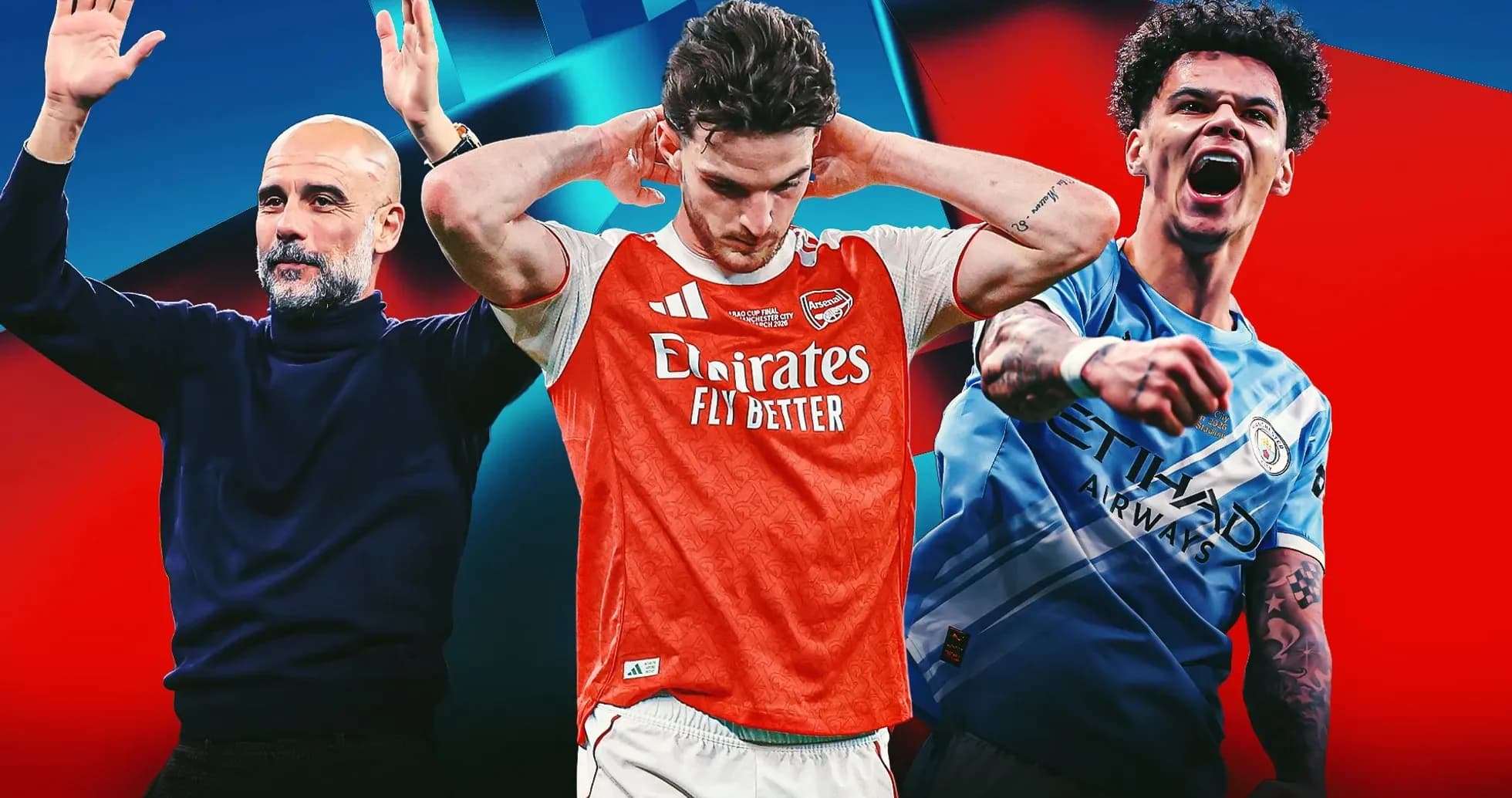
Manchester City Triumphs at Wembley: O'Reilly's Impact in Carabao Cup Final
At Wembley, Manchester City’s past and future shared the same strip of sky.
Before a ball was kicked, the blue end lifted a tifo to Dennis Tueart, the acrobat of 1976, the man whose bicycle kick against Newcastle became club folklore and, for 35 long years, their last domestic cup triumph. Back then, the hero was a Geordie tormentor. In 2026, the man who made City’s day was a kid from Collyhurst with “0161” inked into his skin.
Nico O’Reilly did not just play in this Carabao Cup final. He seized it and stamped his postcode across it.
Local boy, Wembley stage
O’Reilly grew up in north Manchester, a City fan in a City household, the kind of kid who turns down Manchester United and wears it as a badge of honour. His rise from the academy was one of the few unqualified positives in a turbulent City season. He arrived in the first team as a feelgood story. He is starting to look like something far more serious.
Restored to left-back at Wembley after his recent midfield stint, O’Reilly performed like a marauding Yaya Toure with a full view of the pitch. He defended, he drove, and when the moment came, he finished like the most ruthless No 9 on the grass.
The opener came from hunger. Kepa Arrizabalaga spilled a routine cross from Rayan Cherki, and O’Reilly reacted as if his career depended on it, darting in at the back post to force the loose ball home. Less than four minutes later, he drifted into the box unmarked and glanced in Matheus Nunes’ cross with the assurance of a seasoned forward.
On Friday, he was called into the England squad. On Saturday, he turned 21. On Sunday, he joined Tueart in City’s Wembley pantheon.
Some weekends change a career. This one might have changed a club’s future too.
Kepa’s cursed competition
For Kepa, the Carabao Cup has become a kind of private horror anthology. The 2019 refusal to be substituted against Chelsea, the 2022 shootout cameo against Liverpool that ended with his penalty soaring into the London night – both lived long in the memory.
So when word leaked on Saturday that he would start for Arsenal in this final, the narrative almost wrote itself. Either redemption at last, or another chapter in a book nobody at the Emirates wants on their shelf.
The answer came with brutal clarity.
He survived one scare early in the second half when he misjudged a long ball, clattered into Jeremy Doku outside the area and was fortunate the damage was only a free-kick. Arsenal fans might have hoped that would be his one wobble. It wasn’t.
Cherki floated in a cross that lacked pace and menace. Kepa came for it, got nowhere near it, and O’Reilly walked into the space he left behind. One flap, one finish, one final tilting decisively away from Arsenal. From that moment, they never looked remotely like recovering.
By the time City’s second goal went in, this felt like Kepa’s last act in a Carabao Cup final. A tournament that should have offered him redemption has instead become a catalogue of misadventure.
Guardiola’s response
Pep Guardiola arrived at Wembley bruised. March had cut into him: flat league draws with Nottingham Forest and West Ham that handed Arsenal the initiative, and two stinging defeats to Real Madrid in the Champions League. His season, and his authority, were being questioned.
He answered in the way he knows best – by dismantling his biggest domestic rival and outthinking his former assistant on the biggest domestic stage.
This victory gave Guardiola a fifth League Cup, a record for an English manager. In an era when top coaches routinely rotate heavily in this competition, he has treated it like a serious piece of silverware, and his team selections reflected that again.
Ruben Dias pulled out before kick-off, yet City barely missed him. Guardiola trusted James Trafford to continue as his cup goalkeeper despite the arrival of Gianluigi Donnarumma. He doubled down on Doku and Antoine Semenyo together after their misfire against Real Madrid. He parked sentiment, leaving Phil Foden on the bench until the 90th minute.
Every big call landed.
City dominated the early stages of the second half, suffocating Arsenal’s attempts to build any rhythm. When the chances came, they were sharper, more aggressive, more certain. The game was there for the taking. Guardiola’s side were the only ones willing to grab it.
Arteta’s missed moment
This was supposed to be Mikel Arteta’s night. A first trophy in almost six years. A chance to lift something tangible in front of his mentor and prove that Arsenal’s rise was not just a story of spreadsheets, xG charts and near-misses.
Instead, his team produced a performance that barely laid a glove on City.
Arsenal’s 2026 has been full of warnings. Too many laboured wins, too many games where a deep, expensively assembled squad crept over the line rather than sprinted. The results kept coming, so the questions were parked. Under the arch, they came roaring back.
Arsenal were blunt. Predictable. Passive. Arteta’s response from the touchline was oddly muted. He readied Noni Madueke and Riccardo Calafiori when the deficit was still one, but they did not get on until after O’Reilly’s second had effectively killed the contest. By then, City had total control.
This was the first League Cup final contested by the top two teams in the country. The league leaders looked like imposters.
The pattern is becoming uncomfortable. In 2021-22, Arsenal let Champions League qualification slip late. In 2022-23, they spent more days top of the Premier League than any side in history without winning it. In 2023-24, they put together 16 wins from 18 to finish the campaign, yet the result most remembered is the cautious 0-0 at the Etihad – the day Rodri openly questioned their mentality.
Here, with another trophy on the line, the doubts resurfaced. When the pressure peaks, this version of Arsenal still feels fragile.
Viana’s vindication and Cherki’s edge
This was also a landmark afternoon for City off the pitch. It was the first trophy of the Guardiola era lifted without sporting director Txiki Begiristain in attendance. His successor, Hugo Viana, watched on as his fingerprints were all over the final.
Semenyo and Cherki, two of his recent signings, tormented Arsenal. Trafford, re-signed from Burnley only to see Donnarumma arrive two months later, produced the kind of display that justifies investing heavily in two elite goalkeepers.
Viana has spent roughly £260 million across the last two windows. With the exception of Tijjani Reijnders, almost every move has paid off. Cherki, in particular, looks like a steal at £34m – the same fee Manchester United paid for Joshua Zirkzee a year earlier.
Cherki’s reputation is built on flair, the sort that makes highlight reels hum. Guardiola could be seen shaking his head when the Frenchman started juggling the ball mid-game, teasing Arsenal with kick-ups. Yet it was his work rate and intelligence that really hurt them. He pressed, he tracked, he picked his moments. His cross for the opener was simple, but he had earned the space to deliver it.
Semenyo, on the other flank, pounded away at Piero Hincapie. Pace, power, persistence. He forced Arsenal back, pinned their full-back, and helped City control the game’s wider channels.
For Viana, this was more than a medal. It was proof that the next iteration of City is already taking shape.
Trafford’s answer
James Trafford could easily have sulked. City brought him back from Burnley, then promptly signed Donnarumma, one of the biggest goalkeeping names in the game. Trafford admitted he had been “left in the dark” about that decision and did not rule out a summer move for more minutes. He promised only that he would keep working.
At Wembley, he was rewarded with the one thing every goalkeeper craves: a final, and a clean sheet that truly belonged to him.
His defining moment came early, a triple-save that set the tone and drew a sharp contrast with Kepa at the other end. In one frantic passage, he denied Kai Havertz and Bukayo Saka in quick succession, throwing himself around the six-yard box with conviction and authority.
He stayed switched on even as City took charge, and late on he added another smart stop from Calafiori to preserve his clean sheet. This was not just a quiet afternoon behind a dominant team. It was a performance that mattered.
“This moment means a lot to me,” he said afterwards. “Four or five years ago when they beat Spurs to win it, I think I was fourth or fifth choice, and I always imagined that I would win it one day.” That day arrived with him at the heart of it, not just along for the ride.
The quadruple question
Arsenal arrived at Wembley still alive in four competitions, the latest English club to stare down the mythical quadruple. None has ever completed it. None has come close without feeling the strain around this point of the season.
Arteta had already been asked about that mountain. His answer then was blunt: “Has it been done? That’s how difficult it is.” His plan was to go game by game, to “earn the right” to stay in the fight.
At Wembley, they fell short of that right. Not because of fatigue, not because of injuries, but because in a final against the one team they must dethrone, they shrank.
City, by contrast, looked like a side who know exactly what this stage demands. Even in a season that has wounded them, even with Madrid scars still fresh, they found another trophy, another hero, another reason to believe the cycle is far from over.
For Arsenal, the question lingers again, sharper than before: when the season narrows to moments like this, do they truly have the mentality to finish the job?