Manchester United's Carabao Cup Exit: A Case Against Club Management
The boos started before the final whistle and never really stopped. A few fans simply turned their backs and headed for the exits. Manchester United’s limp Carabao Cup exit on Wednesday was not just another bad night in a domestic competition; it felt like the latest exhibit in a long-running case against how this club is being run.
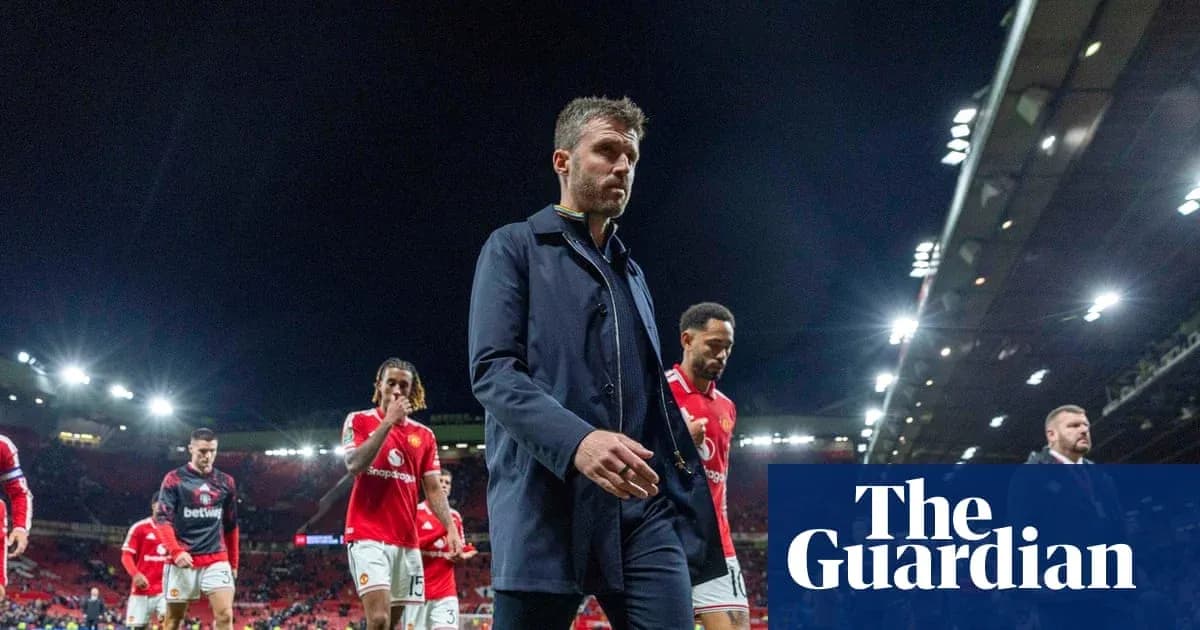
Michael Carrick, expression fixed and sombre, walked towards the tunnel as the jeers rained down. His players followed, heads low. Up in the directors’ box, Jason Wilcox cut a stony figure. The director of football did not look surprised, but he did look exposed. He should. So should those above him.
This is how football works. Supporters know what they are watching and they respond instantly. They see Carrick and his squad front and centre: doing media, selling sponsors, carrying the badge. They pay to be there and they let those in the firing line know exactly what they think.
The head coach always becomes the lightning rod. Tactics, substitutions, transfer strategy – it all gets pinned to him. Yet the reality at United is far more tangled.
Carrick only came back to the club in January. The overarching plan, such as it is, predates him. Others have been steering the long-term strategy into which he has had to fit. Still, the pressure is his to bear. Lose at Fulham on Sunday and it will intensify again, sharply.
United’s supporters are not naïve. Protests against the Glazer family and Sir Jim Ratcliffe have become a familiar backdrop. The fanbase understands that not every misplaced pass or flat 90 minutes can be laid solely at the head coach’s door. The boos are for the performance. The apathy is for the project.
And the wider picture is bleak. United are back in the Champions League but watched newly promoted sides outspend them in the summer. Years of financial mismanagement have left them squeezed. Every pound now has to work harder. It often hasn’t.
The 3-2 defeat by Brighton told its own story. Two goals up inside 10 minutes, United then all but vanished from the contest. For the remaining 80 minutes they were passengers, and they deserved to lose. Brighton rotated heavily, yet still looked fresher, smarter, more coherent.
That is not an accident. Brighton’s squad has been pieced together through sharp scouting and bold recruitment, pulling in players from seven different countries this summer alone. United, by contrast, shopped almost exclusively within the Premier League, adding four players from domestic rivals. Risk-taking and imagination are supposed to be part of elite recruitment. At Old Trafford, they are rare visitors.
The irony is that last summer’s most effective signing, judged on fee and reliability, was Senne Lammens from Royal Antwerp – a low-cost, low-profile deal that actually worked.
Carrick and Wilcox will argue they cannot be fully judged until Carlos Baleba, the most expensive of the three summer recruits, is fit and available. On paper, his athleticism should address the glaring lack of mobility in midfield. Targeting that area made sense after Casemiro’s departure and Manuel Ugarte’s struggles. But it was never the only weakness in a thin, unbalanced squad.
Internally, United accepted that the squad had multiple deficiencies. Yet they still committed heavily to one position. The lack of variety in their strengthening looked naïve at the time and is being exposed now.
Buying from other Premier League clubs is almost always expensive. The trade-off is supposed to be quicker adaptation. Even so, with a left-back shortage already looming and Joshua Zirkzee failing to convince, there was a strong argument to find a cheaper midfield solution than Andrey Santos at £50m and spread the resources. Instead, United spent £155m on three players in broadly the same area of the pitch.
Someone at the club should be explaining why that was deemed wise. No one is. So the outside world is left to guess, while Carrick scrambles for a plan B now that Luke Shaw, as many feared, is sidelined again.
Wilcox has not been entirely silent. On 30 October 2025, after three straight wins, he spoke at length to the club’s in-house media about the long-term vision. Within just over two months, that plan had already been ripped up with the sacking of Ruben Amorim. When results were good, Wilcox was happy to talk. During downturns, beyond the formal statements announcing dismissals, he has disappeared from view.
On the continent, sporting directors are expected to front up. They talk, explain, and absorb some of the heat. The Premier League has not embraced that culture, and at United the silence is deafening as the team sits 13th.
Wilcox arrived from Southampton in 2024, originally as technical director, and played a key role in the decision to keep Erik ten Hag after an eighth-placed finish. Ten Hag was then dismissed only after a poor start to the following campaign. Amorim came in from Sporting with a defined tactical approach that never aligned with the squad he inherited, and without the budget needed for a proper overhaul. The result: a 15th-place finish and a tame Europa League final defeat by Tottenham.
Amorim paid with his job after 14 months. Wilcox stayed, granted another chance to get it right.
Carrick does not escape scrutiny. This United side are underperforming, and thrashings of promoted Ipswich and Azerbaijan’s Sabah do not disguise the broader pattern. The defence has creaked, leaking seven goals in four Premier League matches. Against Brighton, the central pairing of Leny Yoro and Ayden Heaven looked alarmingly out of their depth. Up front, the attack has lacked cohesion and clarity.
Wilcox’s reputation from his Manchester City days, where he led the academy, remains strong. Those who worked with him speak highly of his eye for youth development and his fit for that environment. But this is a different job. At United, higher up the chain, his decisions are being dissected in real time.
The possible departure of JJ Gabriel is another flashpoint. Many outside the club will be furious if a talent of that calibre leaves. On this issue, at least, Wilcox has pushed hard to keep him, working through the teenager’s inner circle to sell the project. If Gabriel goes, the blame will not sit squarely at his door.
Still, the pattern is unmistakable. At United, power has concentrated around a small group, but only one figure consistently stands in the firing line. Ten Hag and Amorim have already paid for their failures. Others carry on, relatively untouched.
Carrick and Wilcox are both deeply invested in making this work. Yet as the pressure mounts and the table refuses to move, it feels inevitable that only one of them will truly live with the consequences if this slide continues.