Marcus Rashford's World Cup Challenge: Commitment Over Personal Gains
Marcus Rashford has spent the past year rebuilding his reputation under the Catalan sun. Now, as the World Cup crackles into life, the debate around him has nothing to do with transfer fees, loan clauses or shop windows.
It’s about whether he can help England finally end 60 years of hurt.
Barcelona revival, uncertain future
Rashford’s season-long loan at Barcelona in 2025-26 did exactly what both he and Manchester United needed it to do: it reminded everyone what his best football looks like. He left La Liga with a title medal, a Spanish Super Cup win and 14 goals alongside Lamine Yamal and Robert Lewandowski. The raw pace, the direct running, the clean strikes – all back on display at Camp Nou.
Barca had the chance to make it permanent. Just £26 million would have turned the loan into a long-term stay. They walked away. Their money has gone instead on Anthony Gordon, the former Everton and Newcastle winger, a different kind of wide threat for the Blaugrana.
So Rashford’s future drops back into the swirl. Manchester United, reshaped under Michael Carrick after his interim spell became a full-time appointment, are open to a reset. Carrick, by all accounts, is prepared to wipe the slate clean at Old Trafford. Rashford, though, looks ready for a clean break. Premier League options are being discussed. So are moves across Europe. Nothing is settled.
What is clear is that the World Cup arrives at a delicate moment in his career.
Barnes’ warning: this is not a shop window
The temptation is obvious. A player with an uncertain club future, coming off a strong year in Spain, stepping onto the biggest stage of all. Shine here, and the offers write themselves.
John Barnes wants no part of that narrative.
Speaking to GOAL in association with viagogo and their ‘World Cuts’ campaign, the former England playmaker cut straight through the noise. For him, any idea that Rashford should treat this tournament as a personal audition is a direct threat to England’s chances.
“England needs to do well as a team,” Barnes said. “If he feels he wants to do well by himself, that's not going to help England.”
He painted the picture of a forward trying to turn the World Cup into a personal highlight reel – demanding the ball, dribbling through traffic, chasing the spectacular rather than the sensible. That, Barnes insisted, is not what wins tournaments.
“So him needing to do well for himself is not important,” he continued. “He needs to do well for England.”
Barnes placed the responsibility squarely on the manager, Thomas Tuchel, rather than the player. If Tuchel sees Rashford as a bit-part figure, that is simply the reality of elite football.
“And if Thomas Tuchel feels that he's going to be a bit-part player in the squad, he can do nothing about that,” Barnes said. “It's not a question of individual players feeling I'm going to take this mantle upon myself to do things, to put myself in the shop window. That's not going to help England.”
In Barnes’ eyes, Tuchel will demand something very specific: discipline, simplicity, team-first decisions.
“Thomas Tuchel isn’t worried about Marcus Rashford putting himself in the shop window. He's worried about Marcus Rashford playing well for England, which means he just holds the position, passes it simple, plays a simple game, which maybe will help the team but not help him individually.”
For Barnes, the World Cup is not a marketplace. It is a test of collective purpose.
Attitude, not ability
Barnes doesn’t question Rashford’s talent. He questions what surrounds it.
“It depends on his attitude and his commitment. That has always been the issue with Marcus Rashford,” he said. “I know he's got the talent, but in terms of his attitude, his commitment is the most important thing.”
Those are pointed words. Not about work rate in a single game, but about the consistency and focus that define careers at the very top. Barnes is clear: this tournament is “nothing to do with Marcus Rashford trying to find himself a club. It's to do with England trying to win the World Cup.”
The subtext is hard to miss. If Rashford buys into that, he plays a role. If he doesn’t, England move on without him.
A flying start – but no rush to judgment
On the evidence of the opening game, Rashford has heard the message.
England’s 4-2 win over Croatia was exactly the kind of wild, attacking contest that can inflate expectations overnight. Harry Kane, the captain and record-breaker, scored twice to move to 81 international goals. Jude Bellingham, preferred in the No.10 role ahead of Morgan Rogers, struck early in the second half to underline his growing authority in this side.
Then came Rashford’s moment.
Bukayo Saka burst forward, the Croatian back line retreating in panic. The ball broke to Rashford on the edge of the box. One touch to shift it onto his right foot, one clean drive into the bottom corner. No fuss. No showboating. Just a decisive finish to cap an impressive second-half display.
It looked like the Rashford of old. Confident. Certain. Cruel in front of goal.
Barnes, though, refused to be swept away by 15 minutes of sharp football.
“Watching Marcus Rashford for 15 minutes isn't going to lead us to know whether he's back to his old self or not,” he said. “We can't get carried away because he came on and did what he did to say, ‘OK, he's back to his old self, let's play him’.”
The same goes for England’s performance as a whole.
“Very much like we can't get carried away that we've beaten Croatia 4-2 and thinking we're going to win the World Cup,” Barnes added. “I don't go from minute to minute or from game to game to make a decision as to who I think is going to do well, either individually or collectively.”
Barnes has long believed that international football suits Rashford. More space. More room to run. Defenders less drilled in week-to-week pressing systems.
“Marcus Rashford, I always felt that he'd do better for England than he does for his club,” he said. “I think international football, particularly from an attacking perspective, you get more room, you get more space. It's easier for him.”
He even reached back to Darius Vassell as a comparison – a player who often looked more dangerous in an England shirt than he did for Aston Villa. But Barnes stopped well short of suggesting this guarantees Rashford a starting spot when the stakes rise.
“I don't think that that's necessarily going to mean that Thomas Tuchel is going to put him in to start when the big games come along,” he said.
Beyond the braids: a different era
Off the pitch, this England squad lives under a different kind of microscope. In the 1990s and 2000s, World Cups and European Championships came with a parallel sideshow: haircuts, boots, fashion statements. David Beckham’s mohawk. Paul Gascoigne’s peroxide. Later, Phil Foden’s tribute to Gazza.
So will this generation spark a new wave of World Cup-inspired trips to the barbers?
Barnes doesn’t think so.
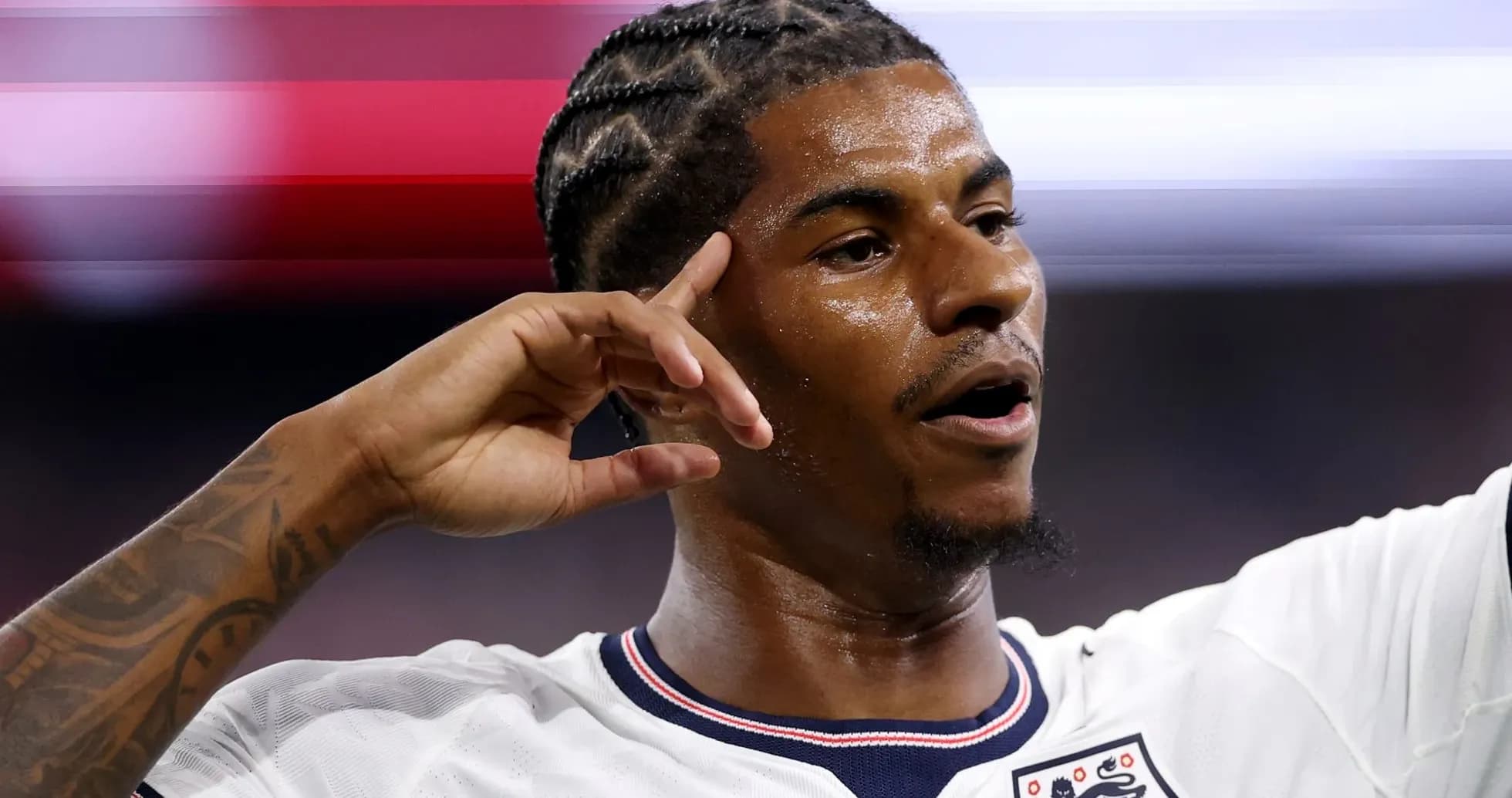
“No, those days are over,” he said. “Footballers are sensible now. You don't let anything get in the way of football. Marcus Rashford, he has some kind braids, but haircuts don't mean much anymore. So no, I think they'll be concentrating on the football this World Cup, not the hairstyles.”
The message is consistent. Strip away the noise. Forget the image. Focus on the football.
A nation watching
Back home, kids may not be queuing up for World Cup haircuts, but they are watching. They see Rashford, Saka, Bellingham, Kane and the rest of England’s class of 2026 as the ones who might finally deliver a first major international trophy since 1966.
Rashford, fresh from a revitalising year in Spain and a sharp cameo against Croatia, stands at a crossroads. One path leads back to Manchester and a possible rebirth under Carrick. Another points to a new club, a new league, a new challenge.
For now, none of that is supposed to matter.
For now, the only question that counts is the one Barnes keeps coming back to: will Marcus Rashford commit himself entirely to England’s cause when the real pressure hits?