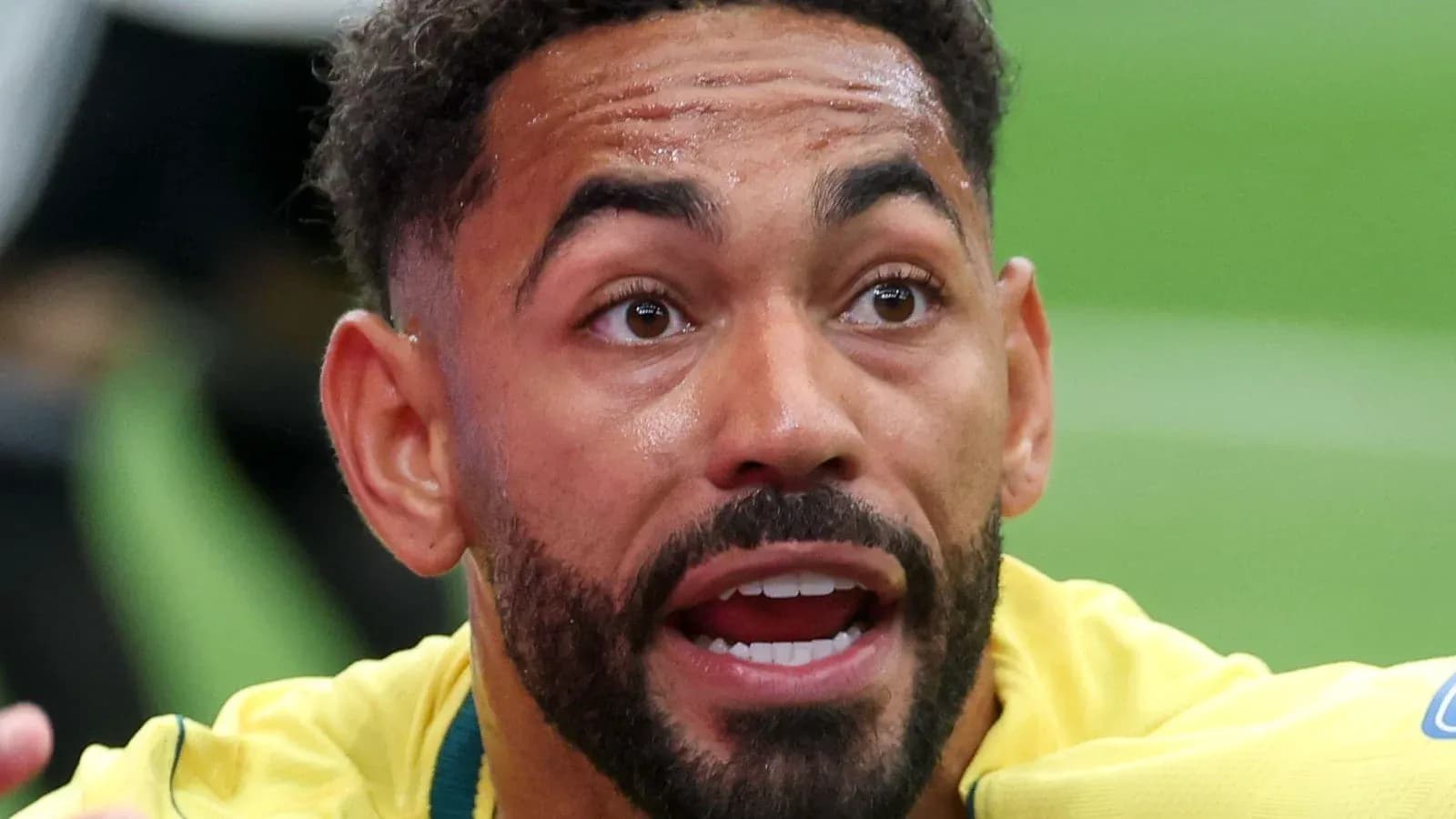
Matheus Cunha and the Media’s Morality Test in Football
Matheus Cunha is apparently too nice.
Too nice for Brazil.
Too nice, we’re told, for Manchester United as well.
That is the curious charge laid at his door after Brazil’s win over Japan, where the Manchester United forward paused amid the chaos of World Cup celebration to console a devastated Ao Tanaka. A small, human moment on a huge stage. For some, it became evidence of a fatal flaw.
According to Jeremy Cross, there is now a “general feeling” and an “awkward narrative” around Cunha: that he “lacks the grit to go with the guile needed to become a great footballer, instead of a good one.” The implication is clear. Comforting an opponent, showing empathy, is somehow a symptom of softness. The sort of softness that will stop him ever taking Neymar’s baton or leading Brazil’s next era.
It’s a big leap.
Especially for a player once banned for removing an Ipswich security guard’s glasses during a fracas. This is not a man unfamiliar with confrontation.
The conclusion is even stranger: when Neymar eventually walks away, the baton will go to Vinicius Junior, not Cunha. Of course it will. Vinicius is one of the best players in the world and the face of Real Madrid. That has nothing to do with Cunha’s character, or his decision to show a moment of decency to a distraught professional whose World Cup dream had just been shredded.
Yet this is where the conversation has drifted. Footballers are being judged not only on goals and assists, but on whether their personalities fit a pre-approved template of “edge” and “grit” – and that template seems to move depending on the name on the back of the shirt.
The Kane Exception
Nobody illustrates that better than Harry Kane.
Craig Hope of the Daily Mail describes the England captain like this: “Kane does not have an ego in a traditional sense – he is the humblest of superstars – but he does not score the goals he does without a stubborn streak of high self-regard.”
It’s a neat line, but it folds in on itself.
No ego “in a traditional sense,” yet a “stubborn streak of high self-regard.” The humblest of superstars, yet still driven by the same ruthless self-belief that powers every elite forward.
Strip away the phrasing and you’re left with a simple truth: Kane, like every great striker, believes in himself. Deeply. He has to. You don’t lead England, chase records across leagues and continents, and shoulder the responsibility he carries without that.
The interesting part isn’t the description itself. It’s the contrast.
When Kane shows steel, it’s framed as admirable self-belief. When Jude Bellingham shows fire, he has been branded a “divisive soloist,” a “poster boy for moodiness,” a “brand ambassador for petulance,” an “angry young man.” The language hardens. The tone shifts. The same traits – intensity, demand, self-assurance – are cast as virtues in one player and vices in another.
The question hangs in the air: why is one man’s edge romanticised while another’s is weaponised against him?
Bayern, Barca and a Geography Lesson
Hope’s assessment of Kane’s move from Bayern Munich to Barcelona follows a similar pattern. He explains the lure of Barcelona by contrasting it with the Bundesliga and Bayern:
“Bayern is not Barca and the Bundesliga is not LaLiga. Der Klassiker is not El Clasico. Der Klassiker is Bayern versus Dortmund, by the way.”
That last line lands like a teacher pausing to explain the obvious to a slow class. Bayern, in this version, become the sensible, “stable,” “logical” option. Barcelona are the “irresistible” romantic choice, the club whose crest still glows brighter in the imagination.
Barcelona probably do carry the grander global mythology. But painting Bayern as the dull, dependable alternative feels detached from reality when the German champions went further in last season’s Champions League and won more trophies. The Nou Camp – or what used to be the Nou Camp – still sells dreams. Bayern have spent the last decade cashing cheques.
Kane didn’t leave a backwater. He left a giant for another giant. You don’t need to belittle one to explain the pull of the other.
England’s “Boost” and Brazil’s Reality
Back to Brazil’s clash with Japan. The Daily Mirror’s Matty Hewitt framed Japan’s early lead as something that “looked as though the Three Lions were going to be given a major boost,” with the Canarinho at risk of going out.
That logic ignores the recent past. England lost to Japan three months ago. Japan are organised, fearless and increasingly seasoned on the biggest stage. Calling them a “major boost” for anyone feels lazy, especially when England have beaten Brazil more recently than they have Japan.
The real story from that match was Brazil’s resilience under pressure and Cunha’s small act of sportsmanship. But that moment of class, for some, became a stick to beat him with. Too nice. Not ruthless enough. Lacking “grit.”
As though the only acceptable reaction to victory is total, unblinking celebration. As though empathy somehow cancels out ambition.
Nagelsmann and the Manufactured Snap
If Cunha is too gentle, Julian Nagelsmann is, apparently, too sharp.
After Germany’s penalty shootout exit to Paraguay, MailOnline led with: “Germany manager Julian Nagelsmann snaps at female reporter’s questioning after being knocked out of the World Cup by Paraguay – as Jurgen Klopp eyes up his job.”
Two things jump out immediately. First, the insistence on “female reporter” in the headline, despite Lili Engels being called simply a “reporter” in the body of the piece. The word does a lot of work. It primes the reader to see a power imbalance, to frame Nagelsmann’s response as something more sinister, more loaded.
Second, the word “snaps.” Watch the clip and you see a tense exchange between a coach under enormous pressure and a journalist doing her job. It’s prickly, sure. But it is hardly a meltdown. This is a manager whose team has just been dumped out of a World Cup. Of course the tone is sharp. Of course the answers are clipped.
Label it a “snap,” and you turn a normal post-match flashpoint into a morality play. Put “female” in the headline, and you change the implication again. The football almost becomes a backdrop to a drama that never really happened.
The Fixation on Character
All of this circles back to one thing: the way football discourse has drifted away from the pitch and into a strange obsession with character archetypes.
Cunha consoles an opponent? He’s too soft.
Bellingham demands more? He’s moody, petulant, angry.
Kane shows the same internal fire? He’s the humblest of superstars with a charming streak of self-regard.
Nagelsmann pushes back in a difficult interview? He “snaps” at a female reporter.
At the same time, real issues hover in the background. The Daily Mirror notes that FIFA has “taken a decision” over investigating Algeria vs Austria after match-fixing claims. That’s the sort of story that genuinely shapes trust in the game. It barely gets a fraction of the emotional energy expended on whether a forward smiled too much, sulked too little, or comforted the wrong opponent.
Football will always be about more than goals and tactics. Personality matters. So does body language. So do the things players and managers say under the floodlights. But when kindness becomes a flaw, when intensity becomes a problem for some and a virtue for others, you have to ask: who is setting the standard?
Matheus Cunha may or may not become a great for Brazil or Manchester United. That will be decided by his feet, his fitness, his form, the managers who trust him and the teams built around him.
It won’t be decided by whether he took ten seconds at a World Cup to put an arm around a broken opponent.