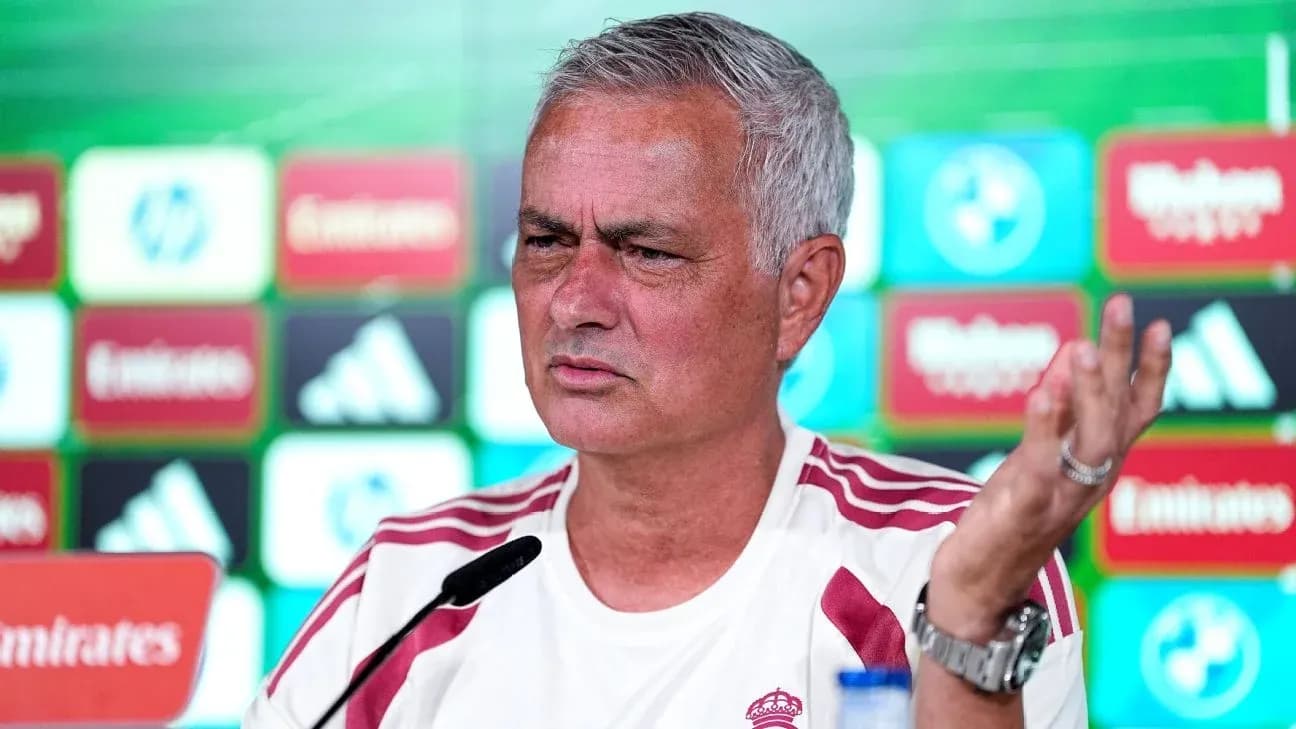
Mourinho's Challenge: Fitting Mbappé, Vinícius, and Bellingham Together
José Mourinho knows exactly where the problem lies. It’s not the names. It’s the puzzle.
Kylian Mbappé, Vinícius Júnior, Jude Bellingham. Three of the game’s most explosive talents, one starting XI. On the eve of his first competitive match back in charge of Real Madrid, away to Espanyol on Saturday, Mourinho didn’t try to pretend it will be simple.
“It’s difficult,” he admitted. But incompatible? He shut that idea down.
“They're incredible players,” he said in his first news conference since returning to the Bernabéu this summer. “But the tactical structure could be more difficult. [Carlo] Ancelotti found the perfect role for Vini with Brazil, [Didier] Deschamps found the perfect role for Kylian, and [Thomas] Tuchel found the perfect role for Jude [at the World Cup]. But it's harder to find the perfect role for all three. I have a lot of confidence that we'll do well when all three play together. I don't think they're incompatible at all.”
Real Madrid arrive at this new era with an old problem: Barcelona have won back-to-back LaLiga titles, and Madrid have gone two seasons without a major trophy. That is the backdrop to Mourinho’s return and to Mbappé’s arrival, Vinícius Jr.’s contract renewal and the club-record signing of Yan Diomande. The attack is loaded. The expectations are heavier still.
The question now is not whether Madrid have enough firepower. It’s whether that firepower will work without the ball.
Mourinho’s forwards have been accused before – at previous clubs, in previous cycles – of not doing the dirty work. At Madrid, the criticism has lingered around the front line’s reluctance to track back and press with conviction.
“We need to be a team, work hard, and not negotiate things that are non-negotiable,” Mourinho said. “Commitment has to be present in every minute of every game.”
That word – commitment – hangs over more than just the forwards. Mourinho walked back into a dressing room that had already been through its own storm. Last season, a clash between Aurélien Tchouaméni and Federico Valverde escalated into a dressing-room row so serious that Valverde ended up in hospital. It was one of the first issues waiting for him.
“I arrived with a lot of information,” Mourinho said when asked about the pair. “But I decided to start from zero. From the day Tchouaméni arrived, I've been keeping an eye on it, and I've felt no need to talk about it. I've seen that everything is normal. Seeing how they've interacted, you couldn't imagine what happened.”
If the front three dominate the headlines, the midfield has shaped much of the summer’s intrigue. Madrid chased Rodri, only to watch the Spain captain choose Barcelona instead. Mourinho has already admitted he spoke to the midfielder about a possible move. Losing that battle to their great rivals could have left a mark.
He insisted it hasn’t.
“I don't think we have a deficit [in midfield],” he said. “[Rodri] would have been the icing on the cake... But when you have Tchouaméni, [Eduardo] Camavinga, Valverde, Bernardo [Silva], Arda [Güler] -- because with time he can play there -- we won't have problems.”
The names roll off the tongue, but the margin for error is thin. Mourinho returns to a club where second place, or a season of “almosts,” is not tolerated. He knows that better than most. His first spell from 2010 to 2013 brought trophies, conflict and a lasting imprint on the club’s identity. This time, the stakes are different but the demand is the same.
Does he feel pressure? He chose another word.
“I wouldn't say pressure. I'd say adrenaline,” he said. “It's positive... In the end, it's about results. Ending the season without trophies at Real Madrid isn't a successful season.”
The stage is set: Mbappé, Vinícius, Bellingham, Diomande, a stacked midfield, and a coach who thrives on that “adrenaline.” Now comes the only part that counts at this club – turning all that talent, and all that tension, into silverware.