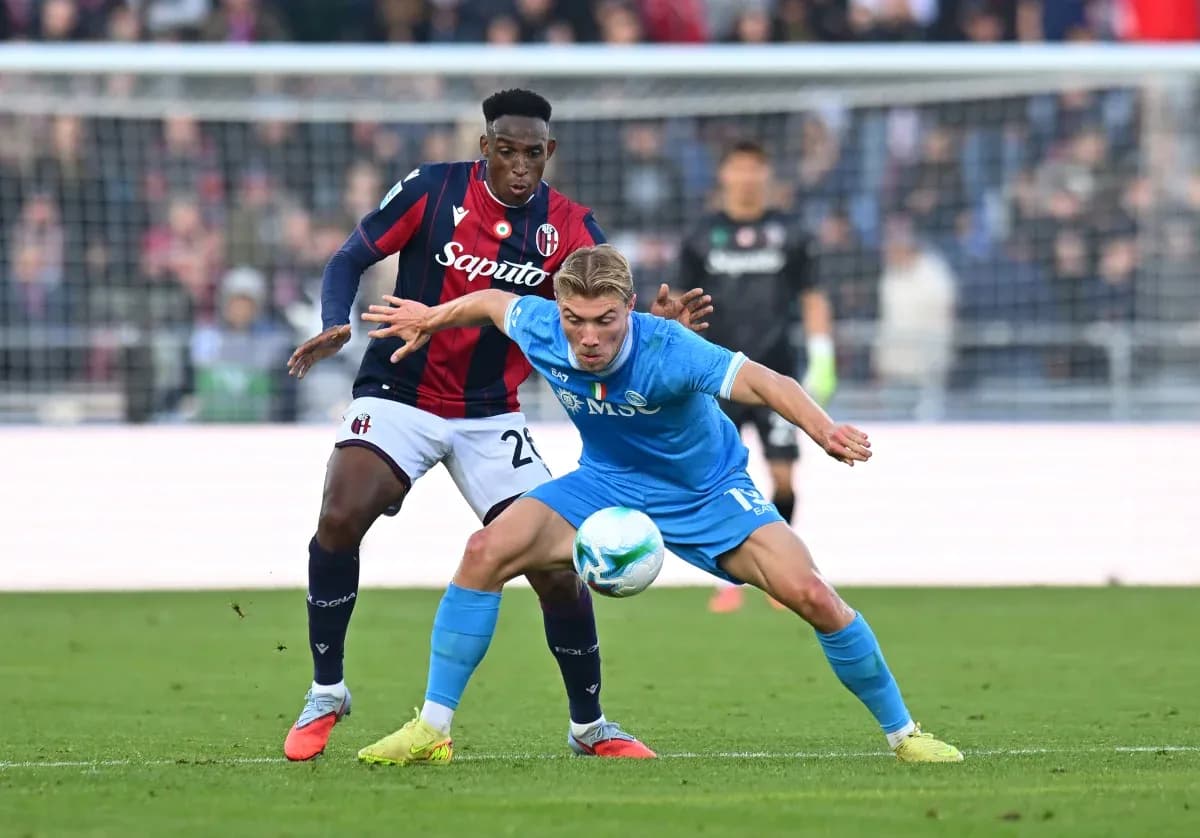
Napoli vs Bologna: Tactical Analysis of a Complex Defeat
Napoli’s 2-3 defeat to Bologna at Stadio Diego Armando Maradona unfolded as a structurally complex contest where shape, pressing height and wing dynamics mattered more than raw shot volume. Antonio Conte’s 3-4-2-1 produced territorial control and a slight possession edge (52%) but was repeatedly punished in the wide channels and in transition by Vincenzo Italiano’s 4-3-3, which converted 3 of just 4 shots on target and leveraged penalty-area clarity over volume.
Executive Summary
Across 90 minutes, Napoli generated 14 total shots (5 on goal) and 0.75 xG, against Bologna’s 10 shots (4 on goal) and 1.32 xG. The hosts completed 484 passes, 425 accurate (88%), compared to Bologna’s 458 passes, 386 accurate (84%), but the visitors’ more direct, vertical use of possession and superior penalty-box efficiency tilted the match. Defensively, both goalkeepers posted negative goals prevented values (each at -0.82), underlining that finishing quality and defensive spacing, rather than shot-stopping heroics, determined the scoreline.
Scoring Sequence & Disciplinary Log
Goals (chronological, all minutes in regular time):
- 10' Federico Bernardeschi (Bologna) — assisted by Juan Miranda
- 33' VAR — Penalty confirmed for Bologna (Juan Miranda)
- 34' Riccardo Orsolini (Bologna) — Penalty (no assist)
- 45' Giovanni Di Lorenzo (Napoli) — (no assist)
- 48' Alisson Santos (Napoli) — assisted by Rasmus Hojlund
- 90' J. Rowe (Bologna) — (no assist)
Disciplinary log (all cards, in exact chronological order):
- 38' João Mário (Bologna) — Foul
- 47' Federico Bernardeschi (Bologna) — Foul
- 58' Eivind Helland (Bologna) — Foul
- 69' Jhon Lucumí (Bologna) — Foul
- 84' Matteo Politano (Napoli) — Foul
Totals: Napoli: 1 yellow card, Bologna: 4 yellow cards, Total: 5 cards.
Tactical Breakdown & Personnel
Conte’s 3-4-2-1 for Napoli had Vanja Milinkovic-Savic behind a back three of Giovanni Di Lorenzo, Amir Rrahmani and Alessandro Buongiorno. The wing-backs, Matteo Politano on the right and M. Gutierrez on the left, pushed high to pin Bologna’s full-backs, while S. Lobotka and Scott McTominay formed the central double pivot. Giovane and Alisson Santos operated as narrow attacking midfielders behind Rasmus Hojlund.
This structure gave Napoli numerical superiority in central build-up and produced sustained phases of possession (52%) and territory. The 11 shots inside the box show that the positional play did reach dangerous zones. However, the back three plus double pivot were repeatedly stretched horizontally by Bologna’s 4-3-3, particularly when both wing-backs advanced simultaneously. Bologna targeted the spaces outside Di Lorenzo and Buongiorno, using Miranda and João Mário to progress, then allowing Bernardeschi and Orsolini to cut into the half-spaces.
Bologna’s 4-3-3, with M. Pessina in goal, a back four of João Mário, E. Fauske Helland, Jhon Lucumí and Juan Miranda, and a midfield trio of T. Pobega, Remo Freuler and Lewis Ferguson, was built for quick vertical surges. Orsolini and Bernardeschi held wide starting positions but constantly drove inside once full-backs overlapped. The first goal encapsulated this: Miranda advanced aggressively, drawing Politano deep and creating a channel for Bernardeschi to exploit. Napoli’s three centre-backs were too narrow to track the wide-to-inside run in time.
Out of possession, Napoli’s pressing was mid-to-high but not fully synchronized. Lobotka stepped onto Freuler while McTominay tracked Pobega, yet the distances between the lines sometimes left the half-spaces open for Bologna’s forwards to receive on the half-turn. The penalty episode, confirmed by VAR at 33', stemmed from Bologna again isolating the left side, forcing Napoli’s defenders into reactive, last-ditch challenges inside the area.
After the break, Napoli’s structural aggression finally converted into goals. Di Lorenzo’s proactive stepping into midfield and Hojlund’s ability to pin and link gave the hosts central superiority. The 48' equalizer highlighted a rare moment where Bologna’s midfield screen was bypassed cleanly, with Hojlund between the lines and Alisson Santos attacking the gap between full-back and centre-back.
Substitutions then reshaped the battle. For Bologna, N. Zortea (IN) came on for João Mário (OUT) at 64', reinforcing the right flank defensively. Later, N. Moro (IN) for T. Pobega (OUT) and S. Sohm (IN) for Lewis Ferguson (OUT) at 81' plus T. Heggem (IN) for E. Fauske Helland (OUT) at 82' added fresh legs and physicality, effectively turning Bologna into a more conservative, transition-oriented 4-3-3/4-5-1 hybrid.
Napoli’s response was more attacking: E. Elmas (IN) came on for Giovane (OUT) and B. Gilmour (IN) for S. Lobotka (OUT) at 76', injecting creativity and vertical passing, while L. Spinazzola (IN) for M. Politano (OUT) at 85' and P. Mazzocchi (IN) for M. Gutierrez (OUT) at 87' pushed both flanks aggressively. This tilted the pitch but also thinned Napoli’s rest defense. The late winner from J. Rowe, who had earlier replaced Federico Bernardeschi (OUT) at 73', was the direct consequence: Bologna broke into the vast space behind the advanced wing-backs and wide centre-backs, with Rowe exploiting a one-vs-one situation in transition.
Goalkeeper reality was telling. Milinkovic-Savic faced 4 shots on target and made 1 save; with Bologna at 1.32 xG and 3 goals scored, his goals prevented figure of -0.82 reflects underperformance versus shot quality. At the other end, M. Pessina produced 3 saves from 5 shots on target, but Napoli’s relatively low xG of 0.75 combined with 2 goals conceded gives him the same negative goals prevented value (-0.82). In essence, both keepers were slightly below average on the day, and the match outcome was driven more by defensive spacing and transition management than by exceptional or disastrous goalkeeping.
The Statistical Verdict
The raw metrics underline Bologna’s tactical efficiency. With just 10 total shots to Napoli’s 14, and a marginal possession deficit (48% vs 52%), they nevertheless generated the higher xG (1.32 to 0.75) and converted at a ruthless rate: 3 goals from 4 shots on target. Their shot profile — 5 efforts from outside the box and 5 inside — contrasted with Napoli’s 11 attempts in the area but of generally lower-quality situations, often from crowded central zones rather than clear, cut-back chances.
Napoli’s 484 passes, 425 accurate (88%), signal controlled circulation but not enough vertical incision. Bologna’s 458 passes, 386 accurate (84%), were used more purposefully, with quicker progression once the first line was broken. Set-piece and restart impact was minimal beyond the penalty, but discipline played a subtle role: Bologna’s 12 Fouls and 4 yellow cards, all for Foul, reflected an intentional readiness to break rhythm and halt transitions. Napoli’s single yellow for Matteo Politano (Foul) hints at a less cynical approach, which, combined with their expansive structure, left them vulnerable to the decisive late transition that J. Rowe converted for 2-3.