Nice's Turmoil: From Champions League Dreams to Relegation Playoff
The final whistle had barely died when the anger finally snapped.
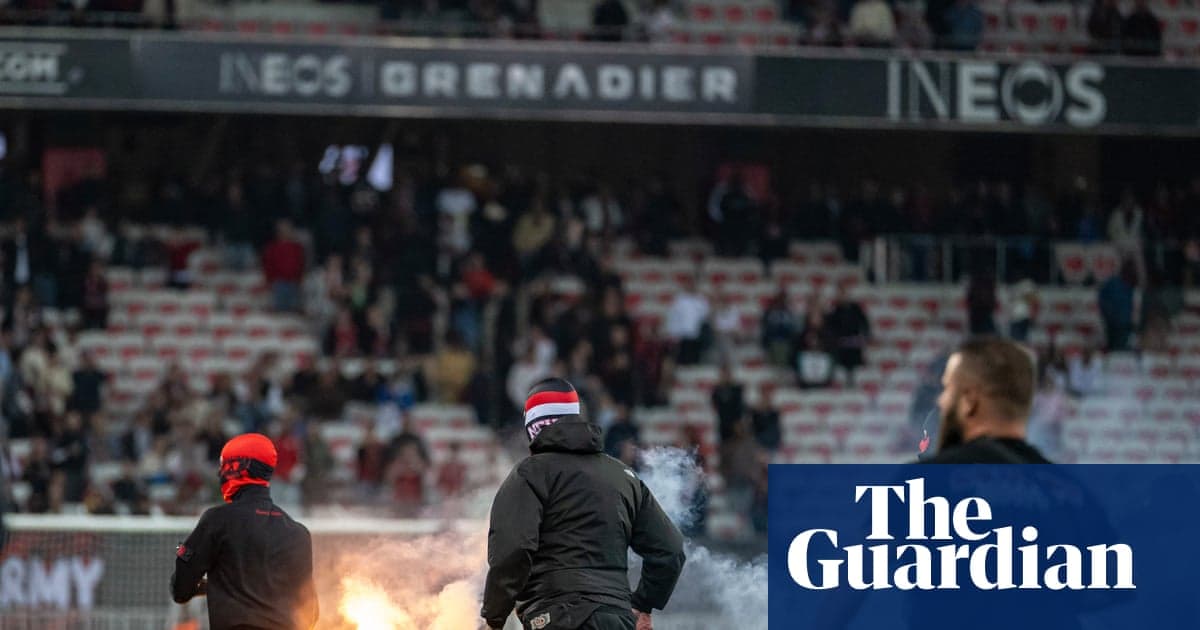
From the second tier of the Allianz Riviera, Nice’s ultras poured down towards the pitch, a furious tide in red and black. Players sprinted for the tunnel. Staff and guests were locked inside the stadium until after midnight as trouble flared around the ground. A goalless draw with already-relegated Metz had just condemned Nice to a relegation playoff. The scenes that followed told the rest of the story: this is a club broken.
Only a few months earlier, Nice’s own players and staff had been attacked by their fans. On Sunday night, the fracture widened into open revolt. For Ineos, who arrived in 2019 trumpeting the ambition of challenging PSG’s dominance, this was the full, damning portrait of failure.
From Champions League dreams to the brink
Nice’s season started with Champions League qualifiers. It will now be decided in a two-legged relegation playoff against Saint-Étienne. The drop to Ligue 2 is no longer a distant fear but a very real possibility.
The timing could hardly be worse for Ineos. The ownership group is already looking for an exit, ready to cut their losses on a €100m project that never came close to matching its rhetoric. What was supposed to be a sleek, data-driven rise into the European elite has curdled into a desperate scramble to stay in the division.
All they had to do on the final day was beat Metz at home. A Metz side already down, with only three league wins all season. A Metz side that had not won a single game under Benoît Tavenot since his January appointment. Tavenot arrived in Nice still chasing his first victory of the season with any club, having gone winless in 11 with Bastia before leaving in October. He leaves this campaign with a staggering record: no wins, nine draws, 18 defeats, two relegations.
And still Nice could not beat him.
What should have been a formality became an ordeal. The home crowd knew it. “Get your arses into gear,” came the chant before kick-off. The mood was strange even then – a volatile mix of anger, nostalgia and grim anticipation.
One banner read “Everyone to Paris”, pointing to Friday’s Coupe de France final against Lens at the Stade de France. A huge tifo honoured club captain Dante, who had hoped this would be his farewell at the Allianz Riviera before retiring at 42. It should have been a celebration of a modern club icon.
Instead, the rage swallowed everything.
A club with its head elsewhere
By full-time, the cup final felt like a sideshow. The two legs against Saint-Étienne will define the season, and Nice co-president Jean-Pierre Rivère did not pretend otherwise. “It is no longer a priority at all,” he said of the Coupe de France.
Nice will go to Paris the way Reims did last year: distracted, anxious, mentally already in the playoff. Reims lost the cup final to PSG and then went down to Metz in the playoff. Yehvann Diouf, who played in all three of those games for Reims before moving to Nice in the summer, knows exactly how that script reads. He will be desperate not to relive it.
The warning signs have been flashing for months. Targets were vague from the start: a return to Europe, but no clear standard, no firm line in the sand. With Ineos focusing their energy and resources on Manchester United, the tap at Nice has run dry.
Key players left. Evann Guessand and Marcin Bulka were sold. Their replacements did not measure up. Kevin Carlos, brought in to fill Guessand’s boots, has not scored a league goal. Others simply turned their backs. Mahdi Camara chose Rennes over Nice.
Franck Haise, in charge in the autumn, made little effort to disguise his frustration. He said he did not have the squad to challenge for Europe. Then he went further: he could not even “create a group” from what he had. The message landed with the fans, who turned their fury primarily on the players, but also on sporting director Florian Maurice and Fabrice Bocquet, the short-lived president who briefly replaced Rivère.
Violence, exits and a disastrous return
In November, the tension spilled into violence. Terem Moffi and Jérémie Boga were attacked as they stepped off the team bus at the training ground after a defeat at Lorient. Both players later left the club. Bocquet followed them out the door. Haise was gone by the end of the year.
The solution? Claude Puel.
Rivère felt Haise had lost his fight, so the club turned back to a familiar face. The decision has been catastrophic. Puel has managed just two league wins in 18 games. His tactics, his selections, his entire approach have drawn fierce criticism from all sides.
On Sunday, as the boos rolled around the Allianz Riviera almost non-stop during a drab, lifeless draw, it was impossible to know exactly who they were aimed at. The players? The coach? The board? Ineos? It felt like everyone was in the crosshairs.
At half-time, the ultras moved from the second tier down to the first. Nobody thought they were looking for a better view. By the final whistle, the inevitable happened. They surged on to the pitch. The anger that had simmered for months finally boiled over.
Puel tried to show understanding. Their “disappointment is legitimate,” he said. Rivère appealed for “unity”. Those words sounded thin against the images of chaos and the reality of a club tearing itself apart.
Nice are now a fractured institution with no obvious figure capable of stitching it back together. Talks with prospective buyers are ongoing, and that may soon make the whole mess someone else’s problem. If Ineos walk away this summer, they will not be leaving behind a project in transition. They will be leaving wreckage.
Nantes implode, Vahid bows out
Nice were not alone in their turmoil on the final day.
In Nantes, the situation exploded even faster. Already relegated, the club hosted Toulouse in a match that lasted only 22 minutes. The owners did not attend, citing safety concerns. They were right to be afraid.
Ultras hurled black flares and then stormed the pitch in huge numbers. Players, officials and staff sprinted for the tunnel. One man stayed: Vahid Halilhodžić.
The Nantes manager stood his ground, facing down fans in balaclavas, arms out, pleading. Eventually he turned and walked off, anguish and sadness etched across his face. Later he admitted that, in 40 years as a player and coach, he had never experienced anything like it. He also confirmed it would be his last memory in football.
That is how “Coach Vahid” leaves the game: alone on a pitch, trying to talk sense into a mob.
A strange title party in Paris
On a night dominated by violence and fury, Paris offered a different, almost absurd image.
PSG had already wrapped up the Ligue 1 title in midweek by beating Lens. There was no trophy presentation that night. The plan was to celebrate after Sunday’s derby against Paris FC.
Paris FC had other ideas. They had just secured their own safety and wanted to stage their own post-match ceremony. They were not interested in turning their home into a stage for PSG’s coronation.
So PSG improvised. Before kick-off, they erected a small stand in front of their away fans. No grand podium, no sweeping ceremony. Just a makeshift platform and a subdued celebration that somehow suited a club whose domestic dominance is now treated as routine, almost background noise.
Luis Enrique has already said his eyes are fixed on the Champions League final against Arsenal. His team played like it. PSG slipped to a 2-1 defeat to Paris FC that meant nothing in the table and even less in the minds of players already thinking about Wembley.
Across France, the images could hardly have been more different: ultras charging pitches in Nice and Nantes, a patched-together title party in Paris, a giant of the touchline walking away for good. As the season tilts into its decisive weeks, one question hangs over the Riviera in particular.
Will Nice still be a Ligue 1 club by the time the dust settles on this chaotic, bitter year?