Norway’s Tactical Evolution: A World Cup Team Beyond Haaland
Erling Haaland will dominate the billboards and the broadcast trailers, but Norway are not turning up to this World Cup as a one-man show. Stale Solbakken has built something more layered, more awkward to pin down – a team that attacks from unusual angles, leans on its full-back for chaos and uses a 6'5" centre-forward as a “winger” to make it all work.
This is not the Norway of old. And it is not a side anyone in the so‑called Group of Death – France, Senegal and Iraq – will enjoy facing.
Wing talent built to feed a monster
The brief is simple: find Haaland. The cast around him is anything but.
On the left, Antonio Nusa looks set to carry the load. The RB Leipzig winger is only 21, but he glides past defenders like a player who’s been doing this on the big stage for years. Six goal contributions in six qualifying games tell their own story, yet even those numbers barely capture his influence.
He shredded Italy home and away in qualifying. A goal and an assist in a 3-0 win, then another decisive contribution in a 4-1 demolition in the return fixture. When he isolates a full-back, Norway’s entire bench leans forward. They know what’s coming.
Behind him waits Andreas Schjelderup, another left-sided livewire and another who arrives in North America on an upward curve. The 22-year-old’s second half of the season under Jose Mourinho at Benfica was a statement: 10 combined goals and assists in just 14 league games, plus a brace against Real Madrid in the Champions League in January. He isn’t yet a locked-in starter for Norway, but he is treated inside the camp – and across Europe – as a future headliner.
On the right, the picture is far less conventional. Alexander Sorloth, Atletico Madrid’s 6'5" centre-forward, often starts wide. On paper, it looks odd. On the pitch, it makes sense. When Norway have the ball, he tucks in alongside Haaland, turning the penalty area into a forest of limbs and aerial threats.
Sorloth matched the shape with substance in qualifying: eight goal contributions in eight games. He arrives at the World Cup off a 20-goal season with Atletico, achieved without being a guaranteed starter. He is not a decoy; he is a second striker hiding in plain sight.
If Solbakken needs a different profile, Fulham’s Oscar Bobb can work that flank with more traditional winger instincts, even if his start at Craven Cottage has been slow. Jens Petter Hauge, revitalised at Bodo/Glimt after his AC Milan spell, has forced his way into the squad despite not featuring in qualifying, powered there by eye-catching performances in the Champions League – including in famous wins over Man City and Inter.
Norway’s width, then, is a puzzle: youthful trickery on one side, a towering forward masquerading as a winger on the other, and a bench full of players who can change the rhythm of a game.
Odegaard’s orchestra
If Haaland is the finisher and the wingers the mess-makers, Martin Odegaard is the conductor.
Norway’s midfield is stacked with experience from the Premier League and Champions League, but everything runs through the Arsenal captain. He is flanked by Sander Berge, Fulham’s imposing defensive midfielder, and Benfica’s Fredrik Aursnes, a tireless No.8 with the engine and intelligence to glue everything together.
Aursnes is a story on his own. Two years ago, he walked away from international football, saying he wanted “more time and freedom to prioritise other things in my life besides football”. In February, he changed his mind. Now, without playing a single minute in qualifying, he is on track to start at the World Cup. At 30, he returns as a mature, Champions League-tested presence in the heart of a side that badly needed his balance.
Behind that first-choice trio, Solbakken can still call on Bodo/Glimt captain Patrick Berg, as well as Serie A pair Kristian Thorstvedt and Morten Thorsby. There is depth, and it is reliable.
But Odegaard is the difference-maker.
He divided opinion at Arsenal this past season, his form fluctuating and his influence sometimes drifting in and out of games. With Norway, the equation changes. He is the undisputed hub. Even in an injury-hit qualifying campaign that saw him miss three of eight matches, the 27-year-old delivered seven assists – including a hat-trick of them in one game against Israel. No player in Europe provided more during qualifying.
His job in North America is clear. Link with Nusa, Schjelderup, Sorloth and the rest. Thread passes through lines into Haaland’s stride. Control the tempo when Norway need calm, and flip it when they sense blood. If Haaland is the headline act, Odegaard is the scriptwriter.
Life after Haaland? Norway have a plan
Solbakken will not want to imagine a World Cup where Haaland doesn’t start every game and play every minute. But if the unthinkable happens, Norway are not empty-handed.
Sorloth would step in as the main striker, a role he knows well and one he has filled with a solid scoring record for his country. His 20-goal season in Madrid underlines his readiness to carry that responsibility.
Solbakken summed up his value in an interview with FIFA: Sorloth, he said, brings “a lot of physicality” and is “a loyal player that can play in different positions up front. Sometimes he plays together with Erling, sometimes he plays a little to the right. He's a goal threat, but he's also an assist threat. But the best thing is that he works so hard for the team, sometimes in a position that he maybe doesn't prefer."
Behind him, Crystal Palace’s Jorgen Strand Larsen offers another robust option and is unlikely to be just an emergency plan. With Sorloth expected to spend plenty of time starting from the right, the 26-year-old could see serious minutes even with Haaland fit.
He has earned admirers quickly since arriving in the Premier League in 2024, then sharpened his edge with a brace in a warm-up friendly against Sweden. He also scored against Italy in qualifying. If called upon, he is not a downgrade in attitude or aggression – only in name recognition.
The right-back who turns everything upside down
Norway’s most intriguing attacking weapon doesn’t wear No.9, doesn’t start on the wing and doesn’t even play in midfield.
He’s the right-back.
Julian Ryerson is the reason Sorloth starts wide. When Norway have the ball, Sorloth drifts into the middle to partner Haaland, and the Borussia Dortmund defender explodes into the space he leaves on the flank. The pattern is simple, but the execution has become one of Europe’s most productive attacking outlets from full-back.
Ryerson finished the 2025-26 Bundesliga season with 18 assists. Eighteen. His delivery from wide areas is lethal, his timing on overlaps relentless. With Haaland and an inverted Sorloth occupying centre-backs, Ryerson often arrives untracked, whipping balls into a penalty area loaded with targets.
He is just as dangerous from dead balls. Corners, free-kicks, rehearsed routines – many of those 18 assists came from set plays, where his technique and composure punish any lapse in concentration. For opponents in North America, he will be the detail that cannot be ignored in video sessions, even if all the outside noise revolves around Haaland.
Call him Norway’s secret weapon if you like. Inside the camp, he is anything but a secret.
A nation finally returns – and knows its place
For all the tactical quirks and individual brilliance, this World Cup means something more basic to Norway: they are back.
Solbakken has lived both sides of that story. He played at the 1998 World Cup. He has since watched his country sit out every edition that followed. He knows what this return means.
"I think it means a lot for the whole nation, especially the common supporter," he told FIFA. "I think it's been hard for everyone to sit home at every World Cup back to when I played in 1998. Fifty-thousand fans came to meet us [after qualification was confirmed] on a Monday in minus four [degrees], so that says it all. They have waited for this moment for so long, and now it's finally here."
He is not selling a fantasy, though. Norway are not arriving under any illusion that they are contenders to lift the trophy.
"I don't think we are dark horses to get all the way," Solbakken said. "I think we are dark horses in terms of, on our day, we can maybe beat a stronger opponent. But to say that we are dark horses for the whole tournament is too far. We are in a very hard group. I think it will be very tight and hopefully we have the organisation and the match-winners to get through."
The ambition is clear: be bold, be different, and trust that the collective can amplify the stars.
"For Norway, this is the World Cup to express themselves – to show the world that we play, maybe, a different kind of football than what we have done before, and that we are an offensive team with good individuals that work hard for each other," Solbakken added. "My dream scenario? I won't talk about it, because my dreams are for myself. But hopefully we can get the best out of the team and on our day, then we can beat anyone."
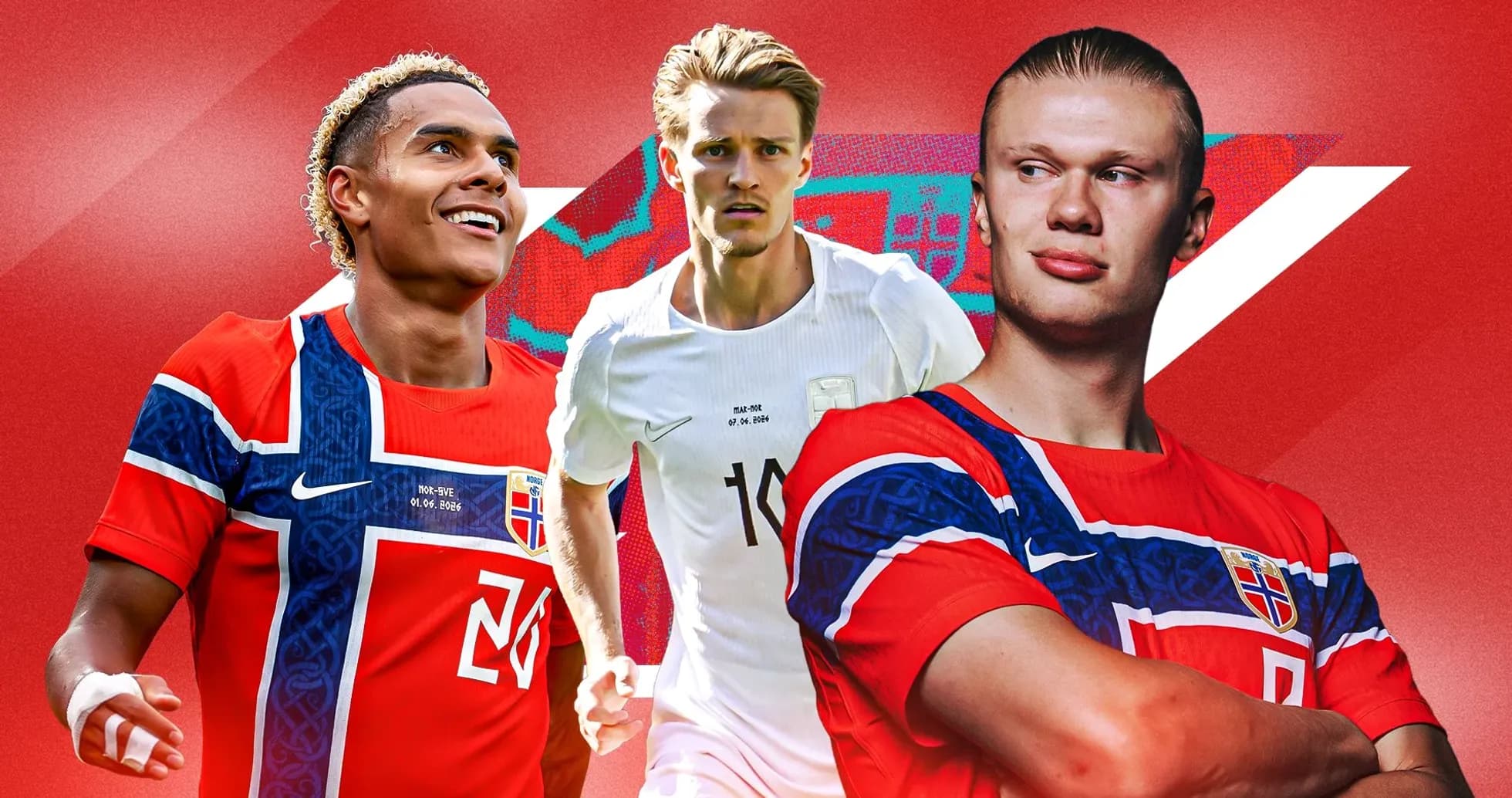
So the picture comes into focus. Haaland at the tip. Odegaard pulling strings. Nusa and Schjelderup slicing in from the left, Sorloth blurring the line between winger and striker, Ryerson roaring past them all to sling crosses into a crowded box.
Norway have waited 28 years to step back onto this stage. They are not here just to make up the numbers.