Portugal and Ronaldo: The Inevitable Conversation
At some point, every great career reaches the moment nobody wants to name. For Portugal and Cristiano Ronaldo, that moment is no longer creeping into view. It is here, in full glare, under the lights of a World Cup he once bent to his will.
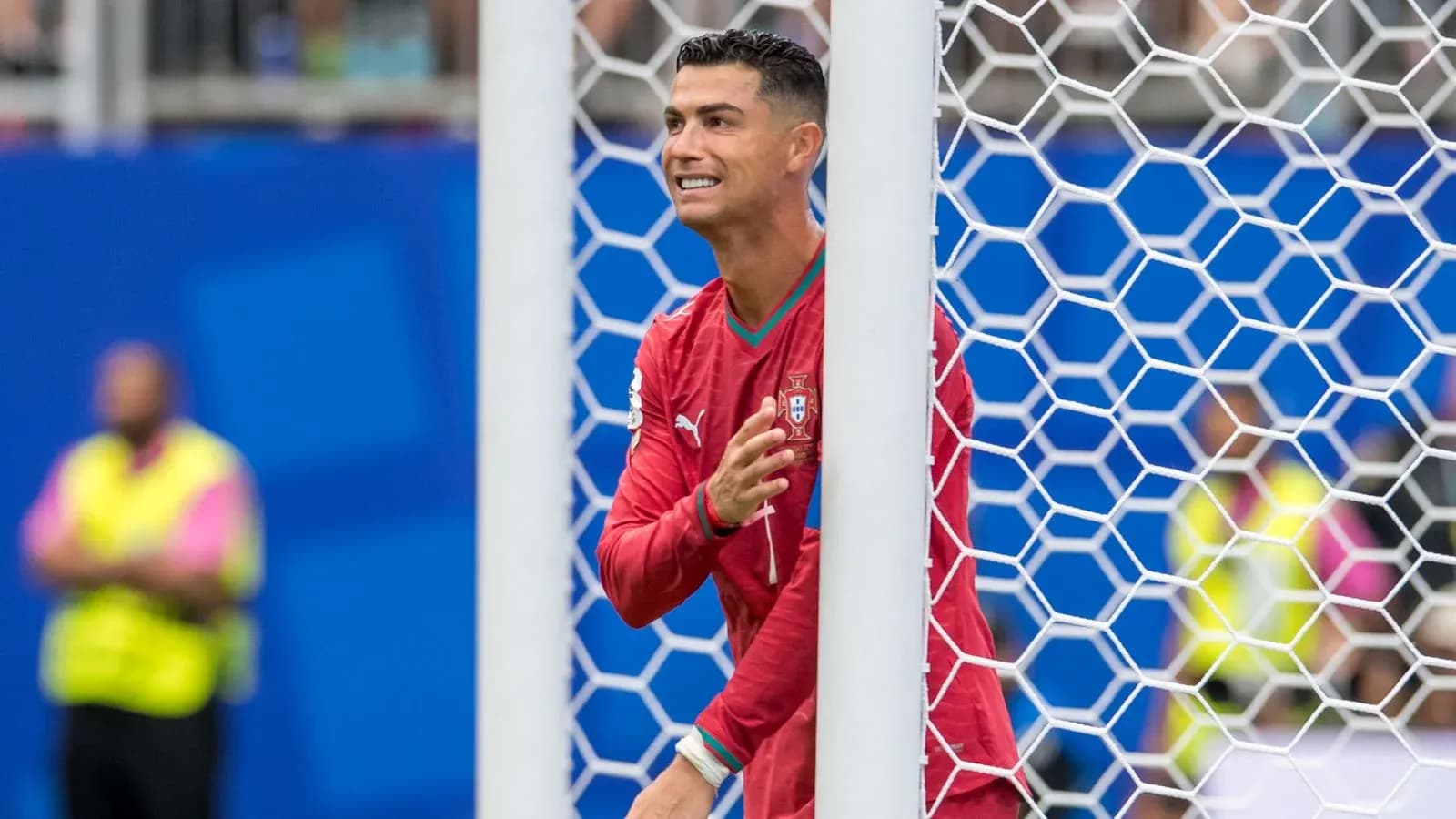
Ronaldo, 41 years old and playing in a record-extending sixth World Cup, walked out in Houston as captain against DR Congo with the usual noise swirling around him. Kylian Mbappe had scored twice the night before. Erling Haaland had scored twice. Lionel Messi, the eternal measuring stick, had gone one better with a hat-trick.
Ronaldo’s answer? Twenty-nine touches, as many shots as Messi had goals, and a goalless, scowling drift through a game that ended in a flat, disappointing draw.
Again, he was the story. Not because he decided it, but because he couldn’t.
His drought in major international tournaments now stands at 10 games without a goal. Messi, over his last 10 on the same stage, has nine. That contrast is brutal in its simplicity. One is still bending big nights to his rhythm. The other is trying to live off echoes.
Ronaldo’s involvement against DR Congo was minimal. Of Portugal’s starting XI, only Bernardo Silva — withdrawn at half-time — had fewer touches. For a man once defined by his gravitational pull on a match, it was a stark image: the captain marooned, the game happening around him rather than through him.
Martinez Stands by His Man
Roberto Martinez, though, isn’t ready to turn the page.
"It makes no sense to get the best goalscorer in world football out in a game that you need goals," he insisted afterwards. For the Portugal coach, Ronaldo’s value still lies in the chaos he creates in the box, the way he drags defenders with him and opens up channels for others. "When you look for goals, you need to have Cristiano."
It’s a clear stance. But it also throws a harsh spotlight onto everyone around him.
Martinez has an embarrassment of creative talent: Bernardo Silva, Bruno Fernandes, Pedro Neto, Vitinha, Joao Neves, Joao Cancelo, Nuno Mendes. Players who, at club level, slice teams apart, thread passes through the tightest gaps, and live in the final third.
To suggest they are all failing him is a bold charge. The numbers offer a more nuanced picture.
Are Portugal Letting Ronaldo Down?
Stack Ronaldo’s recent international output against the other elite forwards and the narrative twists.
Across each player’s last 10 competitive internationals, only Harry Kane has taken fewer shots than Ronaldo. The Portuguese forward has 30 efforts in that span, one more than the England captain, but the underlying numbers are less kind.
Ronaldo’s expected goals (xG) over those 10 games sits at 5.36. Kane’s is 7.15. Mbappe’s is 8.76. Messi’s detailed xG isn’t available in the same way, but the comparison with his peers is already damning. They are getting into better positions, more often, and turning those positions into higher-quality chances.
Team context matters. While Ronaldo has been on the pitch, Portugal have generated a combined xG of 12.76 in those 10 games. England, with Kane, built 16.39. France, with Mbappe, a hefty 21.99. On a per-90 basis, Portugal sit at 1.32, England at 1.34, France at 1.72.
The gap is clear. France, especially, are creating far more danger.
Look closer at where Ronaldo’s chances come from and the story sharpens. His xG from team-assisted shots over this barren run is just 2.55. Kane’s equivalent is 3.2. Mbappe’s explodes to 5.78.
For all the artistry in Portugal’s midfield and wide areas, their star striker is often surviving on scraps compared with his rivals. That supports Martinez’s argument to a point: the machine behind Ronaldo is not feeding him at the same rate as other nations feed their stars.
But that is only half of the equation.
When the Finisher Stops Finishing
Because even within those reduced opportunities, Ronaldo is not doing what he used to do better than anyone: finish.
Fernandes, Silva, Neves and the rest can legitimately argue that while they may not be producing at France’s or England’s volume, they have still created enough for their No 7 to make a dent. A couple of those chances taken, and the debate around his place would be far quieter.
Instead, the numbers scream decline.
‘Post-shot’ xG — which measures the quality of the attempt after the player has struck the ball — underlines how clinical a finisher really is. Kane and Mbappe both overperform. Kane sits at +2.05. Mbappe at +2.25. They are scoring more than the underlying chances suggest they should.
Ronaldo is on the other side of the line, and not by a fraction. His post-shot xG stands at -2.8. Across those 10 games, he has scored nearly three goals fewer than expected once he has actually pulled the trigger.
For a forward whose reputation was built on punishing the slightest lapse, that is not a blip. It is a warning siren.
A Fixed Point in a Moving Game
There is another problem, and it is not in the numbers but on the pitch map.
Ronaldo’s touch map and heatmap against DR Congo show how narrow his influence has become. Limited touches, clustered in small pockets, often on the left side where Neto and Mendes should have been stretching and tearing at the opposition. Instead of a fluid front line, Portugal had a traffic jam.
Unlike Messi or Kane, Ronaldo does not drop deep to knit play together. He never really has. That was fine when his movement in the box was razor sharp and his finishing ruthless. You built the team around that penalty-area gravity.
Now, his lack of positional versatility is starting to choke the system. He doesn’t link play like Kane. He doesn’t roam and create like Messi. He occupies zones that overlap with his own wide players and doesn’t compensate with the same end product.
Martinez cannot realistically rip up his entire creative structure to accommodate one man, no matter how storied. Yet he also refuses to remove that man from the equation because of what he believes Ronaldo still represents in big moments.
And so Portugal sit in limbo.
A golden generation — Fernandes in his prime, Bernardo at full craft, a conveyor belt of young talent in Neves, Vitinha and others — risks being remembered less for what it achieved and more for what it never quite became.
The numbers say the team aren’t giving Ronaldo enough. The numbers also say Ronaldo is no longer doing enough with what he gets.
At some stage, the conversation Portugal have been dodging for years must happen: is this still Cristiano Ronaldo’s team, or is his shadow now the biggest opponent they face?